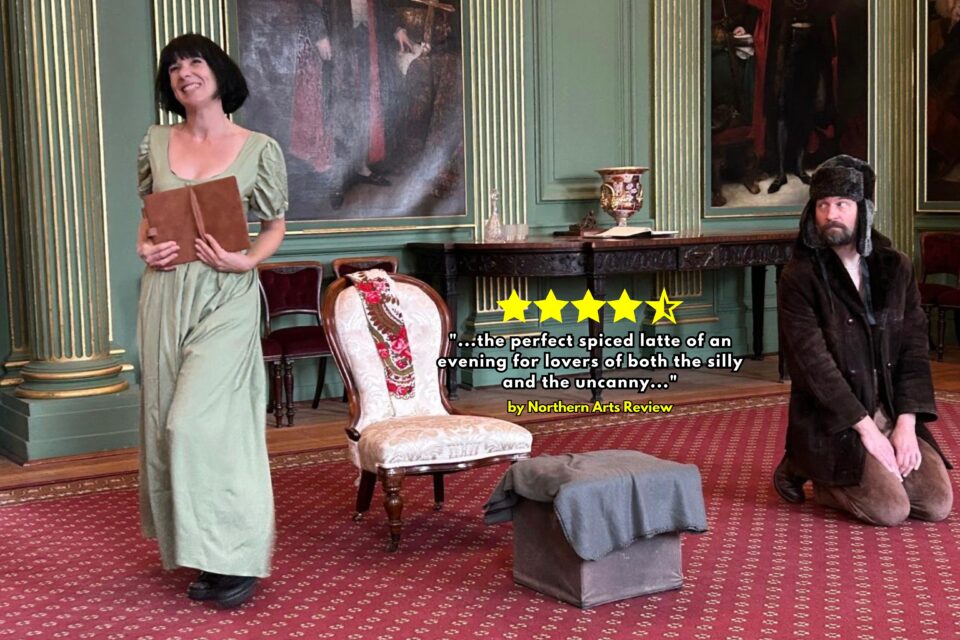
“…the perfect spiced latte of an evening for lovers of both the silly and the uncanny…”

The Moors by Jen Silverman, York Theatre Royal
By Sean Sable
I’ve always had a soft spot for the Brontës. Maybe it’s a Yorkshire thing, but there is just something about the way they capture the windswept vastness of the landscape that has always made me feel that the moors are as much a feeling as a place. So when a play like The Moors pops up, promising gothic absurdity and a touch of Brontë-esque madness, I was already halfway in love. Then, when I heard it was set in the Georgian ballroom of the York Mansion House—yes, please.
Written by American playwright Jen Silverman, The Moors is a black comedy that takes all my favourite gothic tropes (think lonely governesses, reclusive sisters and windswept estates) and twists them into something dark and playful. Emilie, a young governess and our audience insert, is lured to the moors by the elusive Branwell to take up a mysterious post. But when she arrives, she is greeted by the austere Agatha and her flighty sister Huldey. The two women are less genteel spinsters than eccentric power brokers in a crumbling household that’s equal parts Jane Eyre and The Addams Family.
Downstairs, the maid (whose name hilariously changes depending on the floor she’s on) manages domestic chaos with an amusingly poker-faced disapproval, whilst a philosophical Mastiff waxes poetic, wooing a timid Moorhen into an unlikely courtship. Soon, what begins as a loving pastiche of Brontë tropes gradually morphs into something more reflective. In a tangle of love, loneliness and the strange, the play examines the way in which women attempt to assert control in an uncontrollable world.
Fully committing to the peculiar rhythm of Silverman’s script, the performances were uniformly strong and far surpassed what one might expect from a small-scale regional staging. The Moorhen, played by Sonia Di Lorenzo, was an irresistible bundle of bright-eyed energy who gradually dimmed into quiet mistrust as the story turned darker. The maid, played by Joy Warner, was a delight: dry, detached, and entirely convinced by her own revolving cast of identities. Her deadpan delivery, announcing that on one floor she’s pregnant and on another dying of typhus, landed every time.

Hannah Thornton’s Agatha had the command of a true Yorkshirewoman: broad accent, steely eyes and the disposition of a woman who will be obeyed. Beneath the black fabric and severity, she possessed the stern ruthlessness of a gender-bent Mr Rochester. By contrast, Helen Lewis’s Huldey drifted through the story with a near-maniacal desperation to be seen. Forever clutching her “exceedingly personal and private” diary (which she insists on reading aloud at every opportunity), her musical number was a gloriously unhinged moment of theatrical excess. It was exactly the right kind of wrong and I loved the way she absolutely threw herself into the bit.
Director-performer Alexander King played the lonely mastiff whose alienation from the family begins as a bittersweet bid for companionship and morphs into an examination of the brutal reality of the natural world. His scenes opposite the Moorhen provided the production’s most tender and grounded moments. It’s a truly meta-move to make the romance between a mastiff and a moorhen the respite from the surrounding absurdity.
Visually, the production leaned into its location in the Georgian ballroom of the York Mansion House. High ceilings, oil paintings and ornate plasterwork did the heavy lifting—a clever and budget-friendly way to offer grandeur to a smaller production. Set design embraced simplicity, offering only a few period-appropriate chairs and a table. Costumes were modest but effective, nodding towards the era without over-insisting on period accuracy.
I wanted to say the staging was faultless because all the right ingredients were there: a charismatic cast, a clever use of space and a room with bags of built-in atmosphere. But the lack of a considered lighting design occasionally stymied its potential. There was a clear intention to evoke gothic gloom by leaning into dim lighting, even providing candles on the tables next to the audience. But the performance area was almost entirely unlit, offering only a dusky, low-contrast environment. A few practical lighting choices could have transformed everything: a table lamp here, a candelabra there—even an electric candle carried from room to room—would have added the chiaroscuro depth I longed for.
I left the York Mansion House smiling, filled with the kind of fun kookiness I love in these all-heart productions. The Moors may mock the gothic, yet it also understands it: the ache of isolation, the allure of power, the strange beauty of being just a little lost. For those of us who are in love with the untamed Yorkshire wilderness, it’s impossible not to recognise the truth of that. Halloween may be over, but autumn still has us in its red and gold grip and The Moors is the perfect spiced latte of an evening for lovers of both the silly and the uncanny.

The Moors plays at York Theatre Royal until Saturday 08 November. Tickets are available here.
Trending Now
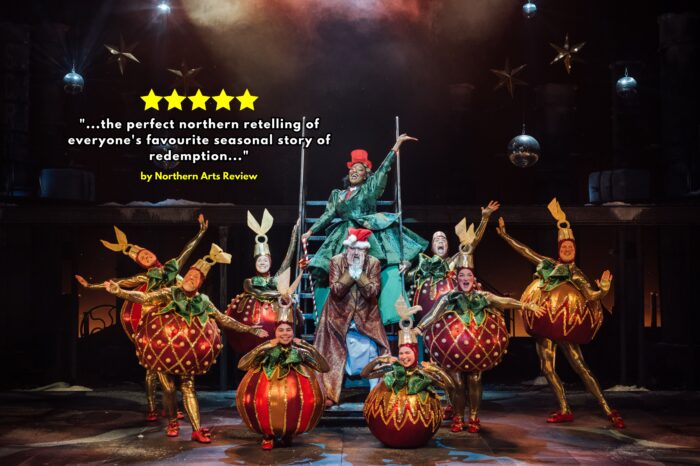
Review: A Christmas Carol at Leeds Playhouse

Review: Miss Saigon at Leeds Grand Theatre
You may also like