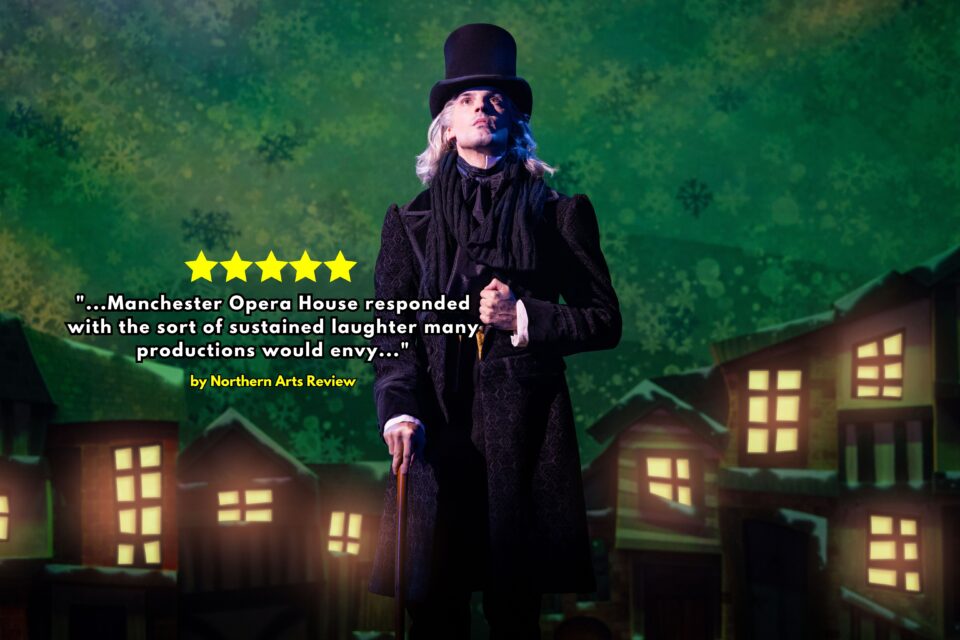
“…Manchester Opera House responded with the sort of sustained laughter many productions would envy…”
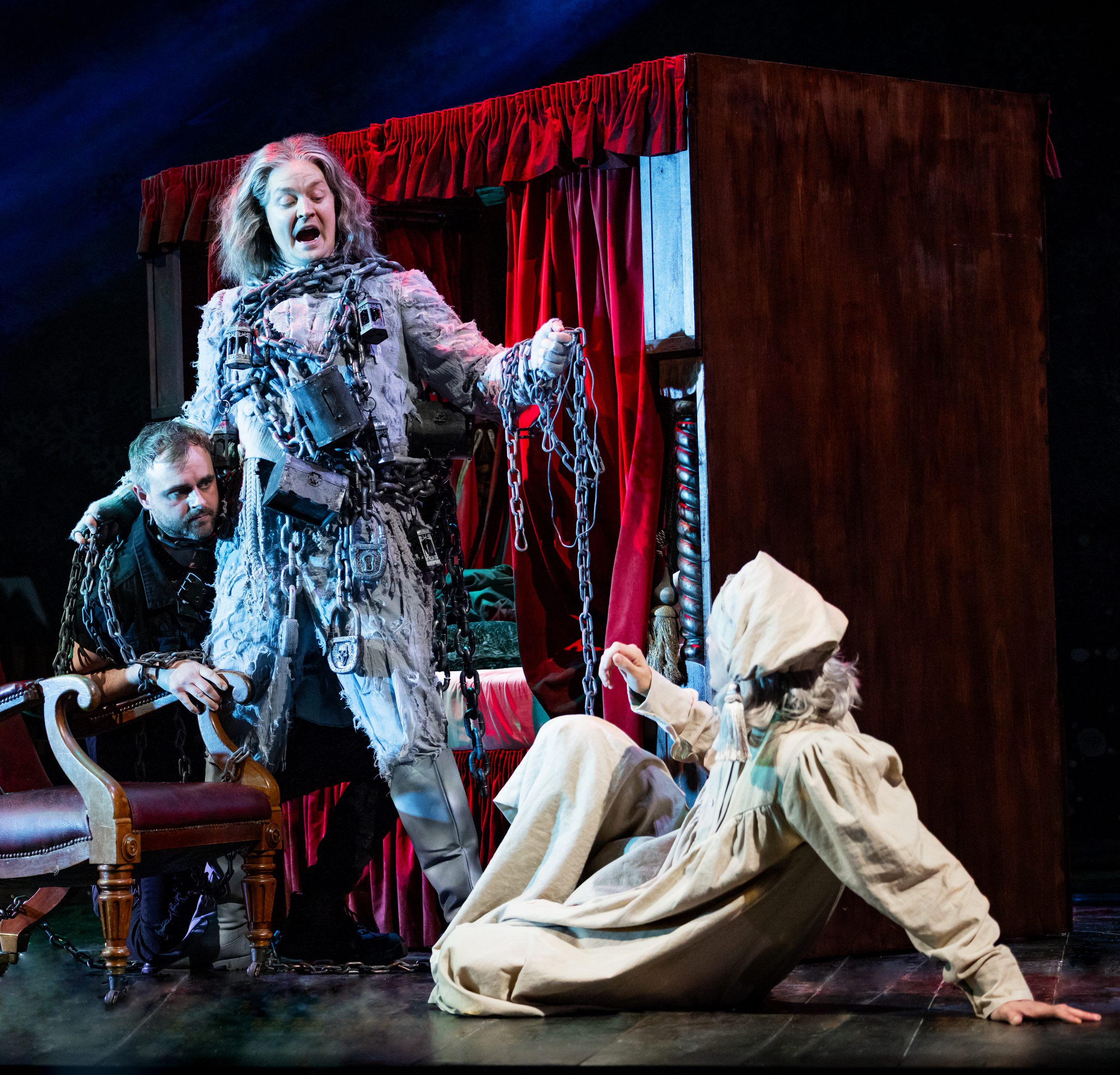
Christmas Carol Goes Wrong by Henry Lewis, Jonathan Sayer and Henry Shields, Opera House, Manchester
By Christopher Balmer
The first time I saw The Play That Goes Wrong, with much of the original company still attached, it carried a sense of discovery that is difficult to recreate. The apparent chaos was so meticulously choreographed, the disasters so perfectly timed, that audiences found themselves laughing not merely at what was going wrong but at the astonishing skill required to make it look that way. Here was a company that had taken the theatrical disaster comedy of Michael Frayn’s Noises Off and introduced it to a modern audience with remarkable confidence.
Much has happened since. Mischief has grown from an inventive theatre company into one of British theatre’s most recognisable brands. Tours, television series, international productions and an ever-expanding “Goes Wrong” universe have transformed the company into a commercial success story few could have predicted when the original production first appeared.
Which poses an interesting question as Christmas Carol Goes Wrong arrives at Manchester Opera House. When audiences already know the formula, when the disasters are expected and the chaos is literally advertised on the poster, can a comedy built upon things going wrong still surprise us? Or perhaps more importantly, does it need to?
After a long working week, I arrived less interested in witnessing theatrical innovation and more interested in having a good laugh. Judging by the reaction around me, I was not alone.
Presented by the ever-ambitious Cornley Drama Society, the evening opens onto the exposed rear of the Cornley Playhouse, where a festive turkey sits centre stage beside Tiny Tim’s crutch. Anybody expecting the evening to remain quite that simple is sorely mistaken. Following an early mishap with the staging within the play—a structural blunder that serves as the spine for most of the set disasters to follow—Dickens’ festive classic is dismantled from the inside out. Without giving the game away, a popular brand of spherical confectionery provides repeated comic mileage, while a graveyard sequence with missing letters rearranges a solemn epitaph into something altogether more suggestive—and let us just say you have never experienced Tiny Tim quite like this before.
For all the apparent anarchy, the whole thing is a triumph of functional design, movement and split-second precision. It is a minor miracle nobody sustains a serious injury. While the audience is invited to believe everything is disintegrating before their eyes, props fail exactly when they should, entrances occur at precisely the wrong moment, and dialogue veers off course in ways that feel spontaneous while revealing extraordinary attention to detail. Like the finest farce—and, at times, classic British music hall playing directly out to the stalls—the comedy depends upon complete control.
The cast execute that controlled car crash with relish. Henry Shields anchors the madness as the increasingly unravelling director Chris Bean, holding Scrooge and the production together until a denouement of colossal madness sees him finally snap. Alongside him, Henry Lewis brings a standout vocal range that carries an Orson Welles scale of captivation paired with the look of a jovial Henry VIII—minus the tyranny. Jonathan Sayer once again proves a master of the company’s signature physical grammar, turning inanimate objects and missed cues into effortless comic currency, while Matt Cavendish grows steadily into the evening. Sasha Frost’s vocal delivery remains crisp and articulate throughout, grounding the mayhem around her. Allie Dart’s gyrating Ghost of Christmas Past delivers a glorious comic highlight—channeling an unhinged energy somewhere between festive spirit and the “I am a shape” song from CBeebies’ Mister Maker—and Chris Leask achieves a moment of pure physical perfection as the Ghost of Christmas Yet to Come, literally falling to pieces.

Perhaps the show’s cleverest achievement is its relationship with Dickens. Lesser productions might simply have used A Christmas Carol as a convenient backdrop for slapstick. Instead, there is a genuine affection for the source material. The company are unafraid to embrace both warm nostalgia and the odd flash of seaside smut, and the balance works remarkably well. Even when a false ending tricks the room into thinking the chaos has peaked, an epilogue of sorts brings genuine reconciliation, something genuinely dangerous, and a cheerful retreat for cake at the back of the pub.
What struck me most, however, was the audience response. Before attending, I found myself wondering whether familiarity might have diminished the impact of the Mischief formula. Yet Manchester Opera House responded with the sort of sustained laughter many productions would envy. Entire sequences disappeared beneath waves of audience reaction, with the anticipation of impending disaster often proving almost as funny as the disaster itself.
We naturally celebrate innovation in theatre, and rightly so, yet there is also value in reliability. Not every production needs to reinvent the art form. Sometimes audiences simply want the reassurance of knowing they will enjoy themselves, especially as winter begins to settle in and another working week draws to a close. Those seeking a radical reinvention of the Mischief template may leave wishing the company had taken greater risks, but nobody criticises a Christmas pantomime for understanding exactly what its audience wants. Likewise, Mischief understands its audience remarkably well.
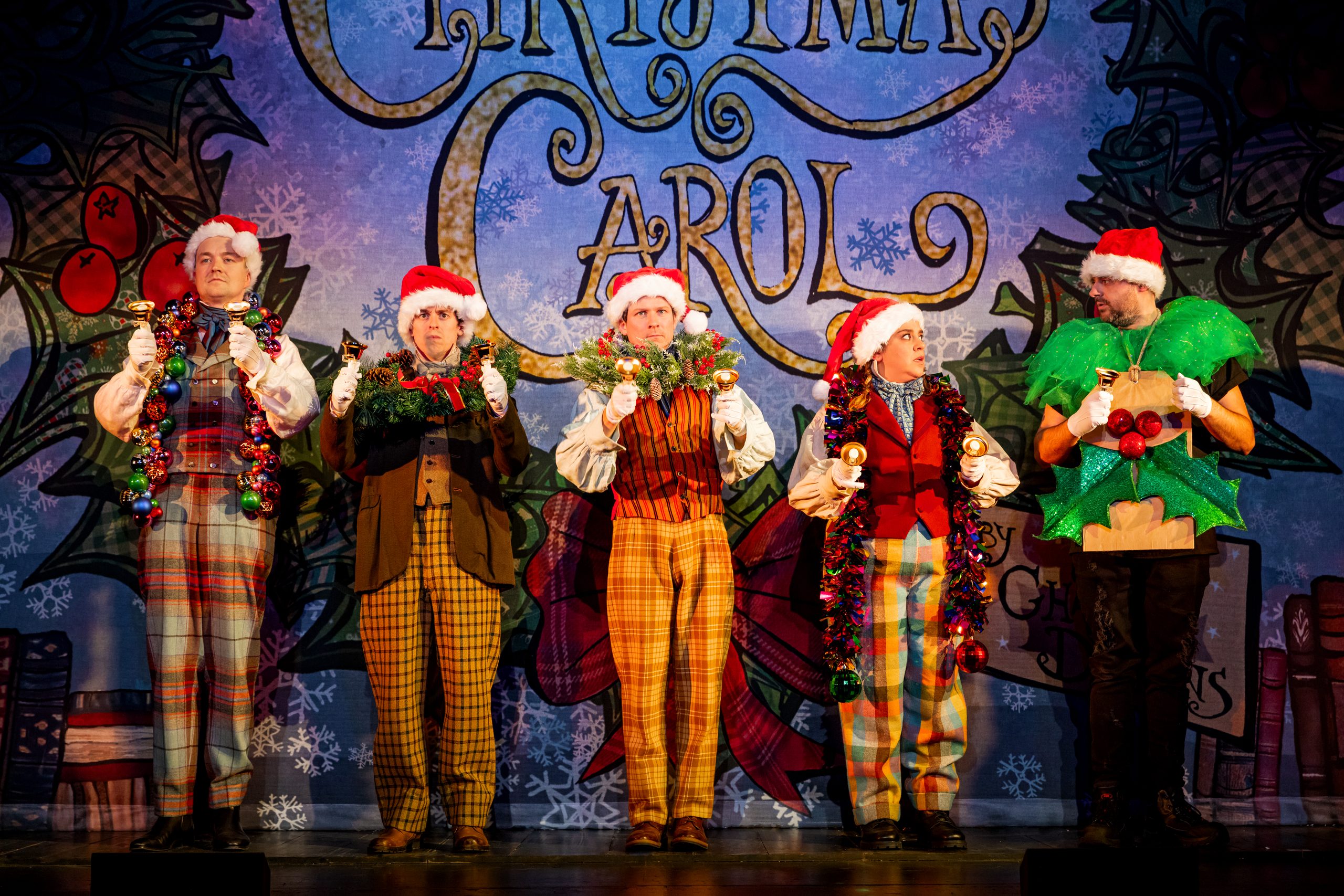
Visually, the production embraces the atmosphere of a traditional Victorian Christmas while continually finding inventive ways to undermine it. Snow, seasonal imagery and Dickensian nostalgia collide with collapsing theatrical illusion, creating a festive environment that remains engaging even as everything falls spectacularly apart.
By the curtain call, it is clear that Christmas Carol Goes Wrong no longer possesses the element of surprise that once astonished audiences in The Play That Goes Wrong. How could it? Yet perhaps surprise was never the point. Mischief’s formula has matured into a recognisable theatrical brand—and to their immense credit, it works a treat. The magic trick may no longer be new, yet the magicians remain infuriatingly good at pulling it off. After a cold November evening, a long week at work and two hours spent watching scenery misbehave, cues collapse and Dickens endure one theatrical indignity after another, I found myself laughing just as hard as everyone else around me.
There are worse Christmas gifts than that.
Christmas Carol Goes Wrong plays at Opera House Manchester until Saturday, 21 November 2026. Tickets are available here.
Christopher Balmer is a Lancashire writer and lifelong theatre‑goer whose work blends northern humour, folklore‑tinged insight, and a deep love of live performance. He’s spent years telling stories in classrooms and on the page, bringing a sharp eye, a warm voice, and a distinctly northern sensibility to everything he writes. Christopher works across genres — from psychological folklore to contemporary northern‑gothic — with several pieces published across the UK. When he’s not at the theatre, he’s usually reading, teaching, or shaping his next story. You can find Christopher on Facebook and Instagram. You can peruse his books here.
Trending Now
Review: A Christmas Carol at Leeds Playhouse
You may also like