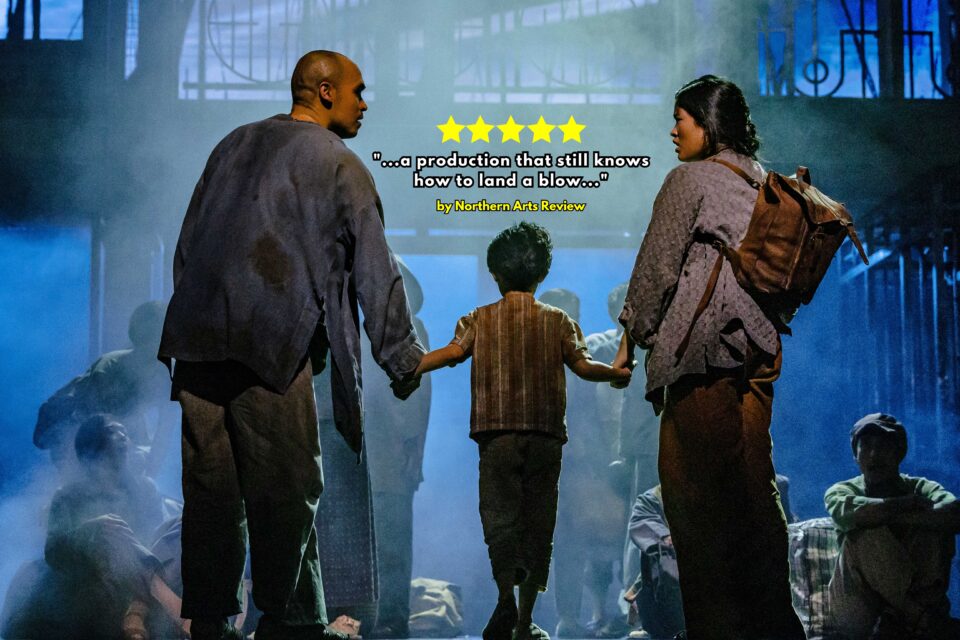
“…a production that still knows how to land a blow…”
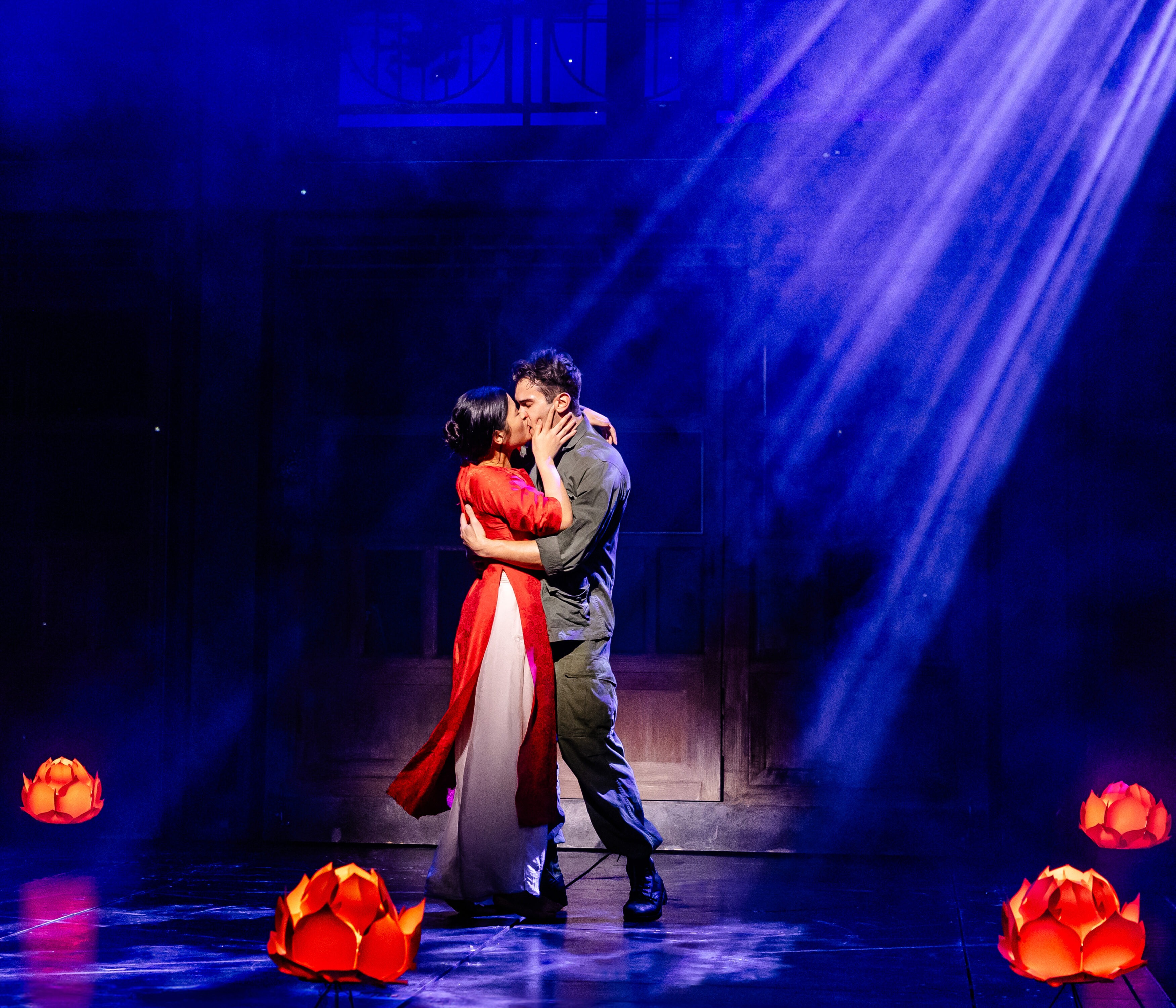
Miss Saigon by Claude-Michel Schönberg, Leeds Grand Theatre
By Sean Sable
Walking into the Leeds Grand Theatre, I had the odd feeling of greeting a younger version of myself. The last time I saw Miss Saigon was in the 90s, in a much larger venue, armed with a cast album I’d played so obsessively that I swear if it were possible to wear a groove in a CD, I’d have done it. Coming back to it thirty years later felt a bit like meeting up with an old friend after a long absence. I knew it would be good, but would it still feel as enormous as I remembered? Or had my memory turned it into a “level 11” production that never really existed outside teenage hyperbole?
Based loosely on Puccini’s Madama Butterfly, Miss Saigon tells the story of Kim, a 17-year-old who flees her village for Saigon in the last days of the Vietnam War. She meets Chris, an American GI, in the Dreamland bar (a brothel run by a smarmy man known as the Engineer). They take brief but beautiful refuge in one another’s arms, only to lose everything they built together when Saigon falls. The years that follow revolve around survival, hope, and a family divided by trauma as much as geography. The 2025 revival, directed by Jean-Pierre van der Spuy and touring under Michael Harrison and Cameron Mackintosh, reshapes the show for theatres like the Grand—houses that could never have staged the mammoth 1989 original.
I must admit I was leery. Part of what worked so well about the original production was the sheer scale. But I was pleasantly surprised by how well the new design fits its smaller footprint. Andrew D Edwards’ set uses rotating walls, a two-level gantry, and clever flips between Dreamland’s chaos and the cramped rooms behind it. This is the sort of staging innovation that tickles my little theatre brain. It is the joy of watching live theatre invent solutions in real time, rather than simply throwing CGI at the problem.
Lighting designer Bruno Poet pushes the neon-soaked palette far further than I remember from the original production: vibrant blues, electric pinks and even spectral greys. Even the signage becomes part of the emotional weather, offering a kind of pathetic fallacy of light. I also appreciated the incorporation of handheld practical lighting when the women of Dreamland carried glowing lotus lights onto the stage, setting the mood and their well-wishes for Kim and Chris’s love story.
The infamous evacuation sequence has, inevitably, changed. The original incarnation looms so large in musical theatre folklore that it is practically a spoiler in itself. But now the moment is scaled to the space, a decision made for wider venue accessibility—a principle I can get behind. The team cleverly pushes the emphasis towards lights, sound and psychological impact rather than sheer mechanical bravado. Despite the smaller scale, the panic and claustrophobia in that embassy courtyard still feel achingly immediate.
The score has held up astonishingly well and admit that I know far too many lyrics for my own good, to the point where I could feel my mouth wanting to sing along. Okay, that’s a lie. I sang along. I can only offer my condolences to the theatregoers sitting near me. My familiarity did mean that I noticed very slight changes, though. Some songs seemed slightly leaner, as if they had been trimmed and tightened. In “The Movie in My Mind” I was waiting for a particular line that never arrived, which briefly jolted me out of the moment (probably to the relief of many nearby). Whether those cuts are new to this tour or crept in earlier, I couldn’t say, but the overall effect is a little pacier, which is often appreciated by modern audiences.
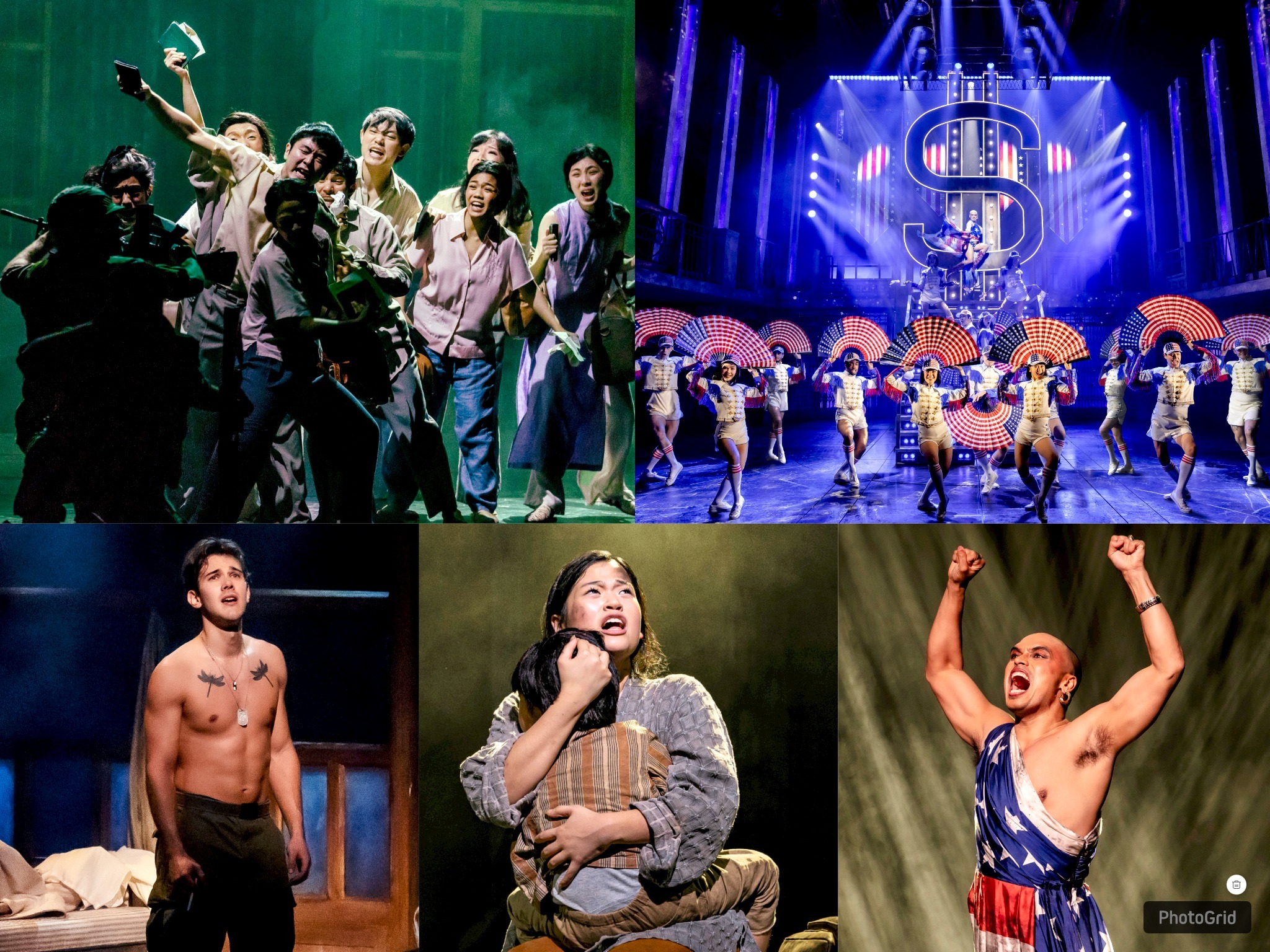
There is no chance I am going to forget to mention “Bui Doi”. It has always been one of my favourites, and this production did not disappoint. Dom Hartley-Harris as John steps into the spotlight in Act Two with the kind of rich notes that just make your heart break. The song’s recognition that these are “souls in need” feels necessary in a world where the language we use about refugees and mixed-heritage children has shifted, but the underlying issues have not.
At the centre of everything is Julianne Pundan’s Kim, making her professional debut in a role that asks for almost impossible stamina. There is something about the way she has been cast and costumed that brings Kim’s age front and centre. In contrast to the original production (or perhaps due to my advancing age), she genuinely felt like a girl who has stumbled in from the countryside to a world she cannot comprehend. Her voice is haunting and clear, and at the close of Act One, when she sings “I’d Give My Life For You,” it has the sense of a young woman who has already decided exactly how far she will go for the people she loves.
Jack Kane’s Chris took me a moment to adjust to. Years of listening to the original cast album had etched a particular sound into my brain, and his voice sits higher and brighter than that old recording. At first I found myself thinking, “This feels too young.” Then I realised this is precisely what the role demands. This Chris feels like a man who has not yet grown into the full weight of the choices he is making and whose idealism and impulsiveness sit right on the surface.
The Engineer, though, is the gravitational pull in every scene he sashays into. Seann Miley Moore leans into the character’s sleaze but layers it with a kind of cabaret flamboyance that the original production gets close to but never quite sticks the landing on. In my notebook I scribbled that he felt like a cross between Gary Glitter and Cruella de Vil—not a sentence I expected to write this year, yet here we are. Is there really another way to describe a man draped in an American flag ballgown being hoisted by a neon dollar sign?
At the end of the evening, I found myself reflecting on how much about theatre has changed since I was a teenager. Maybe what I was nostalgic for was not just this show, but a whole era of theatre. There was a time when these big, theatre-pummelling productions told stories that were written for the stage first. They had original scores and messy, untested narratives. These days, so many large-scale musicals feel as if they have already been obliterated by the Hollywood meat grinder. By the time a title has gone from film to musical, and occasionally back again, the story can arrive onstage already pre-chewed. In all fairness, I still enjoy plenty of those “jukebox” musicals and medium effort film adaptations. I am not immune to a Disney ballad (or seven). But Miss Saigon reminded me what it feels like to experience a story whose source material was never a glossy studio product in the first place.
I left the theatre feeling hollowed out in the best possible way. Thirty years later, Miss Saigon is a production that still knows how to land a blow and how to give repeat viewers a small ache of nostalgia we didn’t see coming.
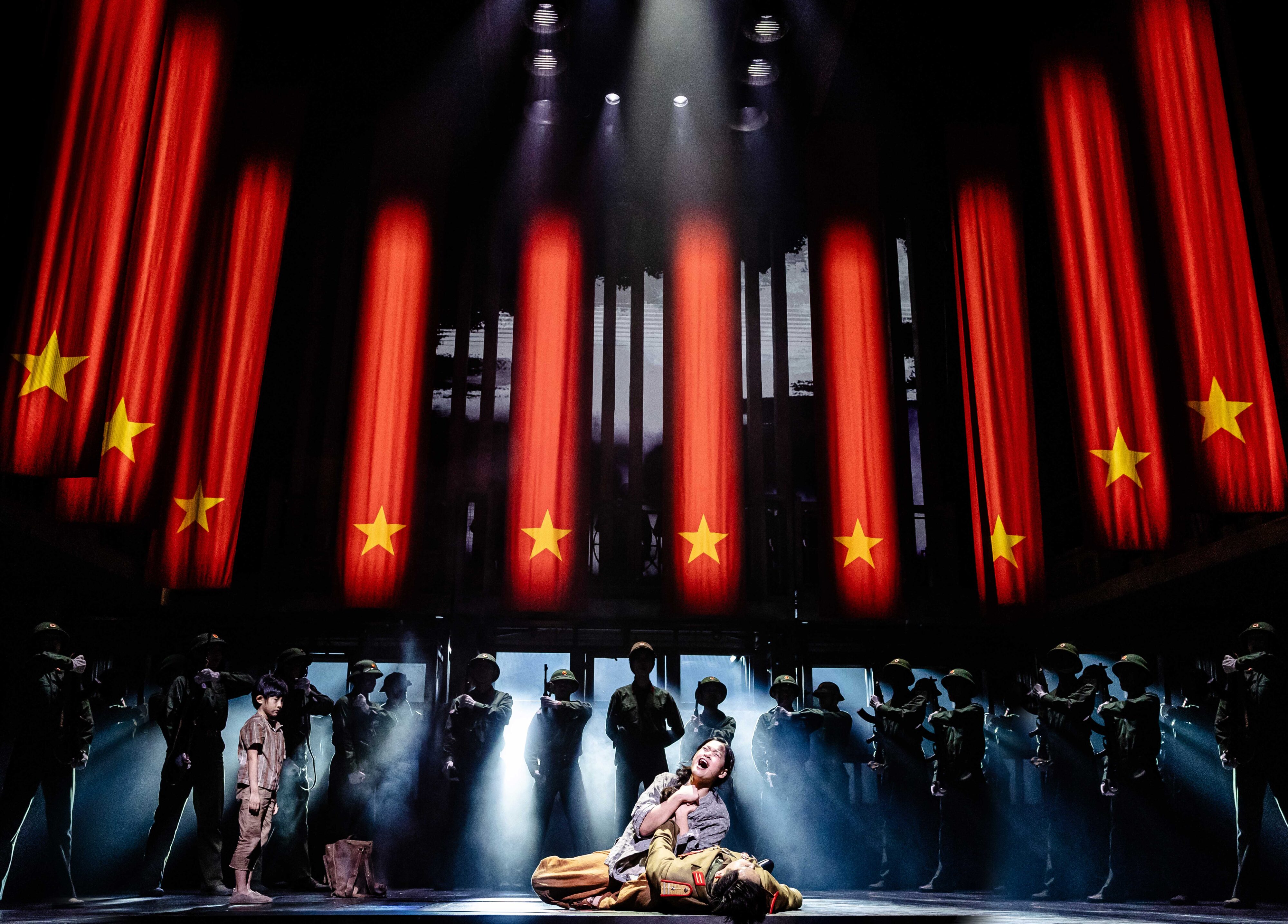
Miss Saigon plays at Leeds Grand Theatre until Saturday 13 December. Tickets are available here.
Sean Sable is a Yorkshire-based freelance writer and editor specialising in Young Adult and Horror fiction, frequently at the same time. When she isn’t buried under a pile of books and manuscripts, she is looking for her keys and having extensive one-sided conversations, in Swedish, with her deaf cat. You can find her online at: www.seansable.co.uk
Trending Now
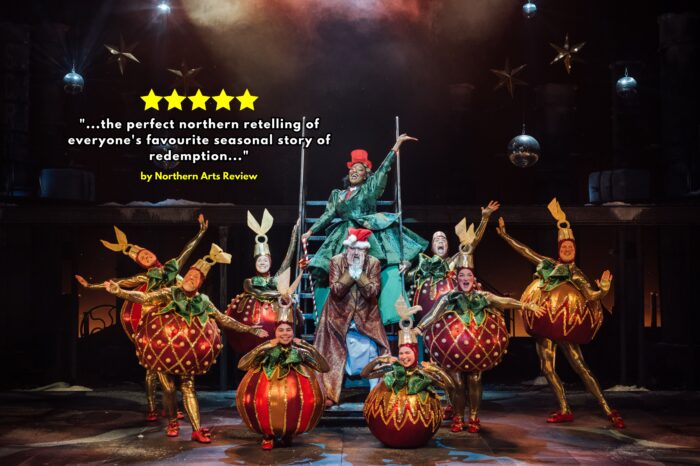
Review: A Christmas Carol at Leeds Playhouse

Review: Miss Saigon at Leeds Grand Theatre
You may also like