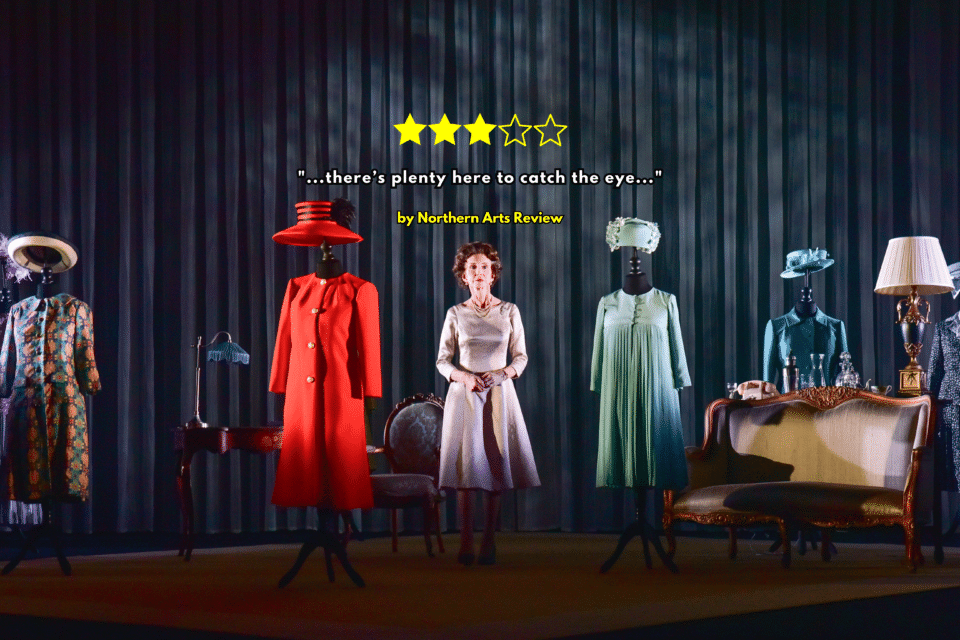
“…there’s plenty here to catch the eye…”

By Royal Appointment by Daisy Goodwin, York Theatre Royal
By Sean Sable
Every year on my birthday, my mother would trot out a twee little “memory” book, its cover decorated with sentimental illustrations of doe-eyed children in that distinctively 70s flavour. Marker-pen in hand, I was directed to complete a yearly survey about my life. Height, weight, favourite colour, favourite toy, favourite book. Officious in my attention to detail, I would fill in each line as though completing a job application or a tax form. And it was with great solemnity and earnestness that, from seven to eleven, I declared my intention to be Queen when I grew up. Not the band Queen. The waving-like-you’re-unscrewing-a-lightbulb Queen. Not princess. Queen.
Lack of royal lineage notwithstanding, I think I gave up on this ambition when I was twelve because I realised that being Queen required one trait I would never possess: subtlety. I’m not the kind of woman who commands attention by withholding, meting out my approval or disapproval with a simple nod. Sophisticated and mysterious are not words fated to appear on my tombstone. Thus, my career as monarch ended before it began. Yet our mutual ambition to be Queen has always given me a sense of kinship with Elizabeth II – and an even greater admiration for her ability to wield power like a swan: grace above, powerhouse of machinery below. So, when I heard By Royal Appointment was coming to York Theatre Royal, I was excited by the opportunity to examine how fashion and soft power intersected in the life and reign of our most subtle of monarchs.
Written by Daisy Goodwin, By Royal Appointment is her debut stage play, which premiered at Theatre Royal Bath in June 2025. Directed this time by Anthony Banks, the production returns for a second UK tour in 2026, coinciding with the centenary of Queen Elizabeth II’s birth. The play explores the Queen’s relationship with fashion and its role in shaping her public image. The story examines several decades of her reign, highlighting important historical events and the outfits that came to define them. Behind the palace doors, her Designer, Milliner and Dresser were responsible for crafting her image, ensuring that each choice was a carefully considered opportunity to communicate with the public. At the centre of the story is the Queen’s relationship with her working-class Dresser, whose growing influence within the royal household creates tensions with her colleagues and, eventually, the monarch herself.
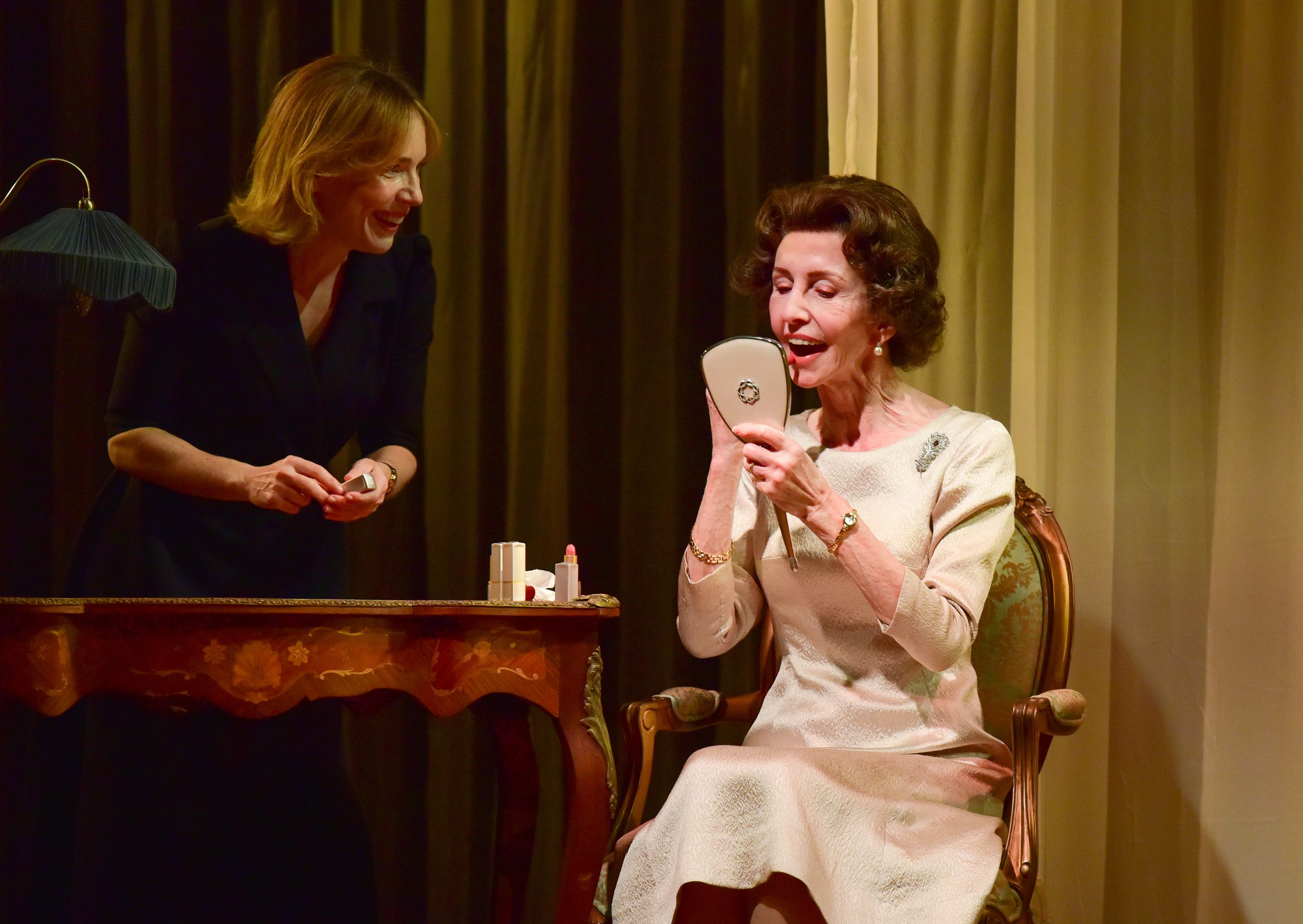
With fashion front and centre, it’s only fitting that we talk costumes first. Jonathan Fensom’s replicas of some of the Queen’s most iconic outfits were impressively painstaking in their detail, as was his attention to the Queen’s “standard” dress. A champagne garment (almost nude in colour) with simple lines, it provides a neutral canvas for the more elaborate outfits, creating a paper-doll effect that allows the Queen to play dolly without the indignity of being seen to dress and undress. It’s a clever piece of engineering that demonstrates the show’s commitment to design as expression.
In a play that celebrates restraint, Fensom’s set design reflects the same principle. It’s economical, but well judged: a series of sheer curtains creating layers reminiscent of chiffon skirts. Peeled back one at a time, they reveal a series of tidy tableaux: a sofa and a console table, or a writing desk with a chair. Each piece of furniture nods at that French Rococo style we have come to associate with the monarchy and gives us just enough sense of place to feel situated without competing with the garments for visual attention.
Richard Howell’s lighting design beautifully supported the evening’s themes. As each new outfit is introduced, a wash of matching colour lights up the sheer curtains like a herald, announcing the mood we are about to encounter. Emerald green for a visit to Ireland. Cerise for the Queen’s Silver Jubilee. Yellow for a visit to the deserts of Mexico.
Sarah Weltman’s sound design had a “barely there” quality that suited the story. With tiny nods to time and place, including audio recordings of the Queen’s favourite television programme – the races – and murmurs of radio hits like (Hit Me) Baby One More Time, we always had just enough sound to retain depth.

Jane Asher’s Queen Elizabeth was played with characteristic quiet grace, becoming softer and slightly warmer as her age progressed. But the relationship between David Robb’s Designer and Matthew Cottle’s Milliner felt like much of the beating heart of the show. The warmth and chemistry between the two co-workers-cum-reluctant-friends had an undeniable authenticity that made me look forward to how each scene change would bring a new twist to their dynamic. Cottle’s breakdown as he struggled to cope with the loss of his long-time partner to AIDS brought a surprising earnestness to a largely comedic character mostly known for being chronically late to every appointment (girl, same).
There was a lovely gentle quality to the pacing with only a hint of drama coming from the interplay between the staff members as well as between Laura Main’s Dresser and the Queen. These small relationships acted like a series of dials, and you never knew quite which one was going to turn with each of the frequent scene changes. This created just enough tension to give the story forward momentum.
Yet at times I struggled with a sense of being teased with the promise of being on the “inside”, only to find a Queen who remained aloof and unknowable, largely appearing to suffer the presence of the Designer and Milliner rather than create the cosy, if somewhat austere, bond I’d hoped to see. In my pre-show reading, much was made of the relationship between the Queen and her Dresser, and I am afraid some narrative choices left me feeling a bit uncomfortable with the implied message. A staff member who chooses to lose her marriage to remain loyal to the Queen and has wild rants at co-workers for not appreciating the difficulty of her work (whilst never appearing to appreciate theirs) kept me from fully investing in her character. With a nearly seven-minute monologue at the end that swung between gender essentialism and schmaltz, I found myself pulled away from the story’s central themes into questions far less interesting.
Still, the warmth and humour of the Designer and Milliner’s friendship provided some moments that really sang and when I left, I felt reminded that behind even the most carefully cultivated public image, there are ordinary people simply making their way through extraordinary lives, one hat and skirt at a time.
By Royal Appointment reminds us that a dress can be more than just a dress, particularly when the woman wearing it is ‘Queen of England’. For those fascinated by the subtle language of royal fashion, there’s plenty here to catch the eye.
By Royal Appointment plays at York Theatre Royal until Saturday, 14 November. Tickets are available here.
Sean Sable is a Yorkshire-based freelance writer and editor specialising in Young Adult and Horror fiction, frequently at the same time. When she isn’t buried under a pile of books and manuscripts, she is looking for her keys and having extensive one-sided conversations, in Swedish, with her deaf cat. You can find her online at: www.seansable.co.uk
Trending Now
Review: A Christmas Carol at Leeds Playhouse
You may also like