“…Kara Tointon was excellent…”
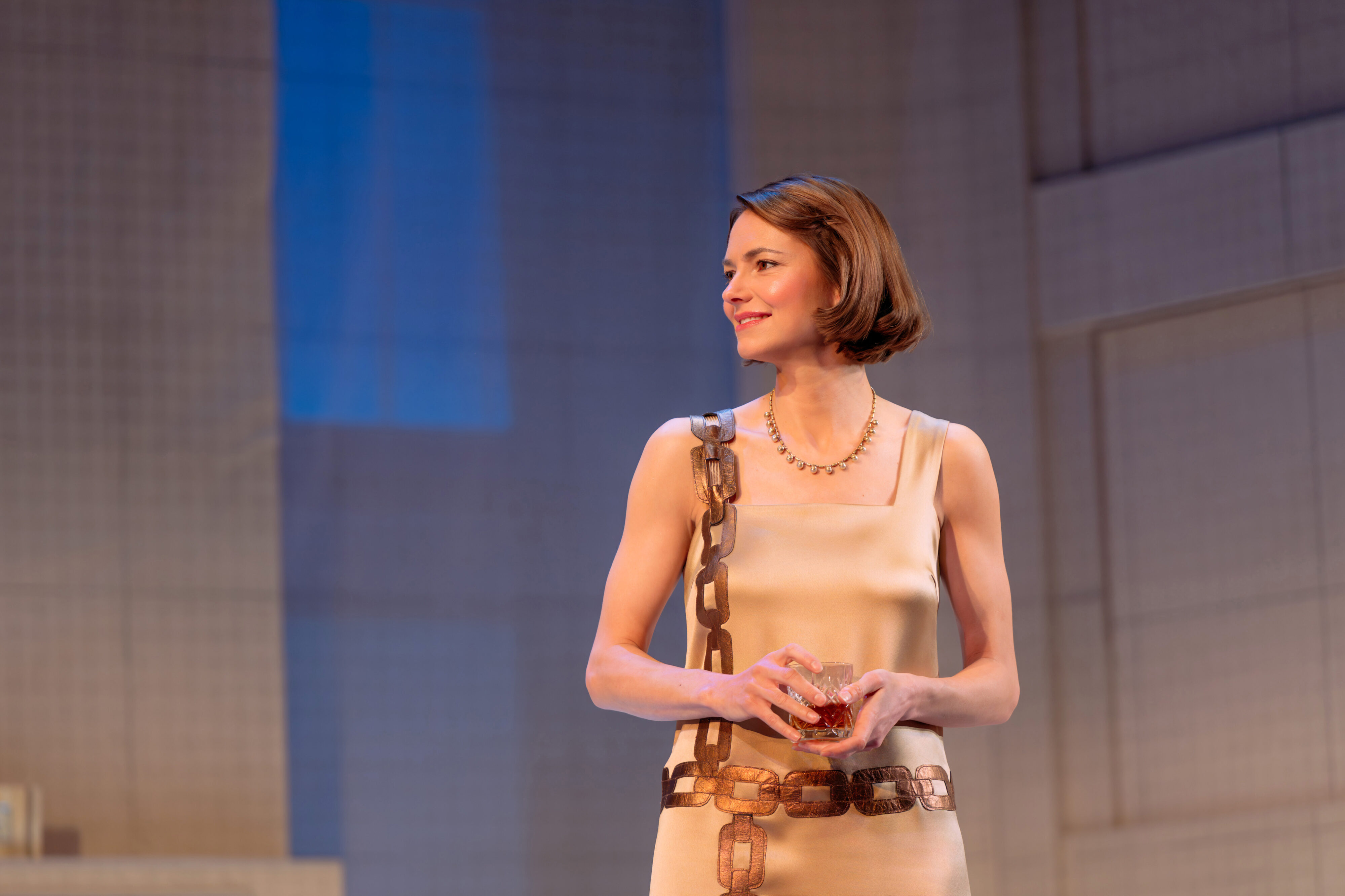
The Constant Wife by W. Somerset Maugham adapted by Laura Wade, York Theatre Royal
By Sean Sable
“She eats well, sleeps well, dresses well and she’s losing weight. No woman can be unhappy in those circumstances.” Mrs Culver’s assessment of her daughter opens The Constant Wife, and it’s the kind of logic that makes perfect sense until you think about it for even a second. The entire play operates on this same principle: everyone is confidently wrong about Constance Middleton and watching her let them be wrong while she calmly secures her own power is both very funny and surprisingly layered.
Laura Wade’s adaptation of Maugham’s 1926 drawing-room comedy was a sell-out hit at the RSC’s Swan Theatre and has recently begun a six-month national tour, arriving this week at York Theatre Royal. The premise is simple: Constance discovers her husband John is having an affair with her best friend, Marie-Louise. But that’s where the simplicity ends. Rather than leaving John, Constance stays, realising that not only does she still care about John, but divorce would result in losing everything about her life that she truly loves: her home, her position, and even her closest true confidant—her butler. The play quickly moves past the tired tropes of infidelity and becomes more interested in how Constance uses patience and cunning to rebalance an unequal marriage on her own terms.
As a comedy of manners, a great deal of the fun comes from how information is revealed. In true farce fashion, everyone makes it about themselves. Watching this absurd pile-up is both funny and poignant as it becomes clear that the only person whose feelings don’t seem to matter is Constance.
Kara Tointon was excellent as Constance and felt incredibly well suited to the role, playing the part with a kind of amused clarity that sits just on the right side of smugness. Jane Lambert, performing as Mrs Culver this evening as an alternate, gave genuinely hilarious monologues on the “naturally polygamous” nature of men. But it was Gloria Onitiri’s Marie-Louise who stole every scene she dramatically floated into. There’s a moment where she throws herself on the floor in despair, crying about being put in a terrible position that had me in stitches. You can’t help but root a little bit for a character that flings herself down onto the piano keys in abject—and hilarious—despair. Philip Rham’s Bentley was a warm, softly funny presence, and his relationship with Constance allowed us to examine her emotional landscape without becoming sentimental.

Anna Fleischle’s set design was impressive: a large, stylish Art Deco interior with tall ceilings and a strong sense of space. The upstage wall included two vertical strips of wallpaper that became sheer when backlit, revealing a staircase and landing behind them. This added depth to the single room set and allowed us to see characters arriving or moving in the background, which was particularly effective in a play about secret dalliances. During the flashback sequences, parts of the set flip to reveal an older, more Victorian style of décor in the process of modern redecoration. The changes were small but efficient, saying as much about the passage of time as it did about the freedom Constance gains through her work as an interior decorator.
Sally Ferguson’s lighting was mostly functional, but during time shifts we were treated to bolder washes of blues and purples, accompanied by short musical interludes with characters dancing or Bentley at the piano. Sound design by Claire Windsor was minimal, mostly limited to practical effects. It worked well enough, though (as usual) I found myself longing for a little more sound to help flesh out the space.
Though all aspects of the production were well considered, the technical element of the programme that truly shone was the costume design. So often 1920s costumes slide straight into fancy dress territory. Rarely have I seen productions of this era that aren’t layered in flapper dresses and feathered headbands. But Cat Fuller and Anna Fleischle’s eye for authenticity cannot be denied. There was not a single beaded layer to be found. Instead, we were treated to clothing that looked ripped straight from the fashion plates of the day. Bold geometric designs, handkerchief hems and silhouettes with swing as well as line, demonstrated a deep understanding of the space where Art Nouveau ends and Art Deco begins. Constance’s final outfit, a lovely two-piece with fall-front palazzo trousers and a bell-shaped top, communicated the effortless confidence and independence of a woman who has earned her place.
The Constant Wife is a witty and thoughtful production that reminded me a little of Oscar Wilde or George Bernard Shaw around the edges. It’s the perfect night out for those looking for social commentary with a side of twittering laughs.

The Constant Wife plays at York Theatre Royal until Saturday 31 January. Tickets are available here.
Sean Sable is a Yorkshire-based freelance writer and editor specialising in Young Adult and Horror fiction, frequently at the same time. When she isn’t buried under a pile of books and manuscripts, she is looking for her keys and having extensive one-sided conversations, in Swedish, with her deaf cat. You can find her online at: www.seansable.co.uk
Trending Now

Review: Enlightenment at People's Theatre
Review: A Christmas Carol at Leeds Playhouse
You may also like