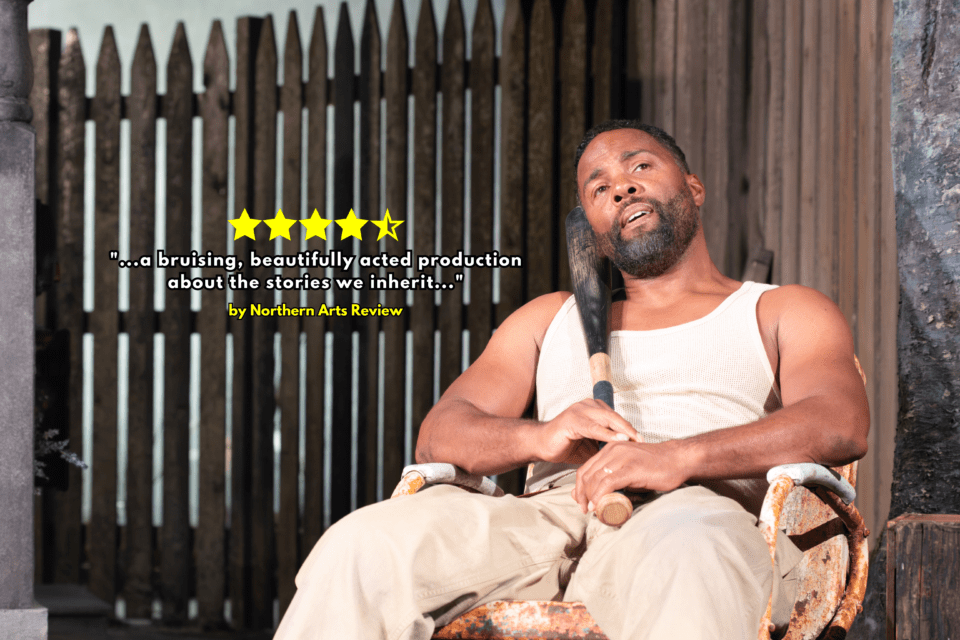
“…a bruising, beautifully acted production about the stories we inherit…”
Fences by August Wilson, Leeds Playhouse
By Sean Sable
As a young child, I had a very sloppy grip on the truth. I often think this is true for a lot of writers. While at five or six, many children begin to get a firm grip on the concrete details of life: there is no Father Christmas, there is no monster lurking under our beds, there are no dragons waiting to be slain—writers aren’t quite so ready to give up the story. After all, that’s where the marrow of life is juiciest. And as any writer can tell you, a good story doesn’t need a whole lot of truth. If you choose the right beginning, leave out the awkward middle, add a few exciting twists and turns (and stop just before any pesky consequences arrive), you can spin a yarn that will keep everyone on the edge of their seats.
But learning to find the fuzzy edge between narrating yourself into a good story and telling a lie comes with an even more important lesson: if we aren’t careful, we’ll confuse our stories for the truth. If we are busy telling the tale of The Put-Upon Mother, we might never see the village around us ready to offer a helping hand. If we are committed to the romance of The Damsel in Distress, we might never notice the way our white knight waves a red flag.
In August Wilson’s drama Fences, Troy, the patriarch of the Maxson family, may not be a writer, but he is a natural-born bard who spends much of his life weaving grand autobiographical tales. And his big-fish stories aren’t entirely untrue. He really did survive a difficult childhood. He really did go to prison. He really did play Negro League baseball. He really did provide financially for his family. But truth, like any good story, depends on where you choose to put the emphasis. Troy has spent so long casting himself as the hero, the victim, the provider and the survivor that he can no longer see the real life unfolding beyond the edges of his own mythology. Whilst he’s busy becoming an archetype, his wife and sons are becoming people in their own right, with dreams and disappointments that do not fit into the story he has written for them.
Fences is one of ten plays in August Wilson’s American Century Cycle, an ambitious body of work chronicling Black American life across each decade of the twentieth century. Set between 1957 and 1965, it won Wilson the Pulitzer Prize for Drama in 1987 and has become one of his best-known works. This new production, directed by Daniel Bailey, is a co-production between Leeds Playhouse, Headlong, Lyric Hammersmith Theatre and HOME Manchester, and marks the first major UK revival of the play in more than a decade before touring nationally. At its centre is Troy Maxson, a former Negro League baseball player now working as a binman in Pittsburgh, where he lives with his wife Rose and teenage son Cory. When Cory is recruited to play football, father and son lock horns over what opportunity looks like for a young Black man in a changing America. As the tales of old disappointments begin pressing against the reality of new ambitions, the Maxson family is forced to reckon with the collateral damage of living inside a myth that has begun to overshadow the truth.
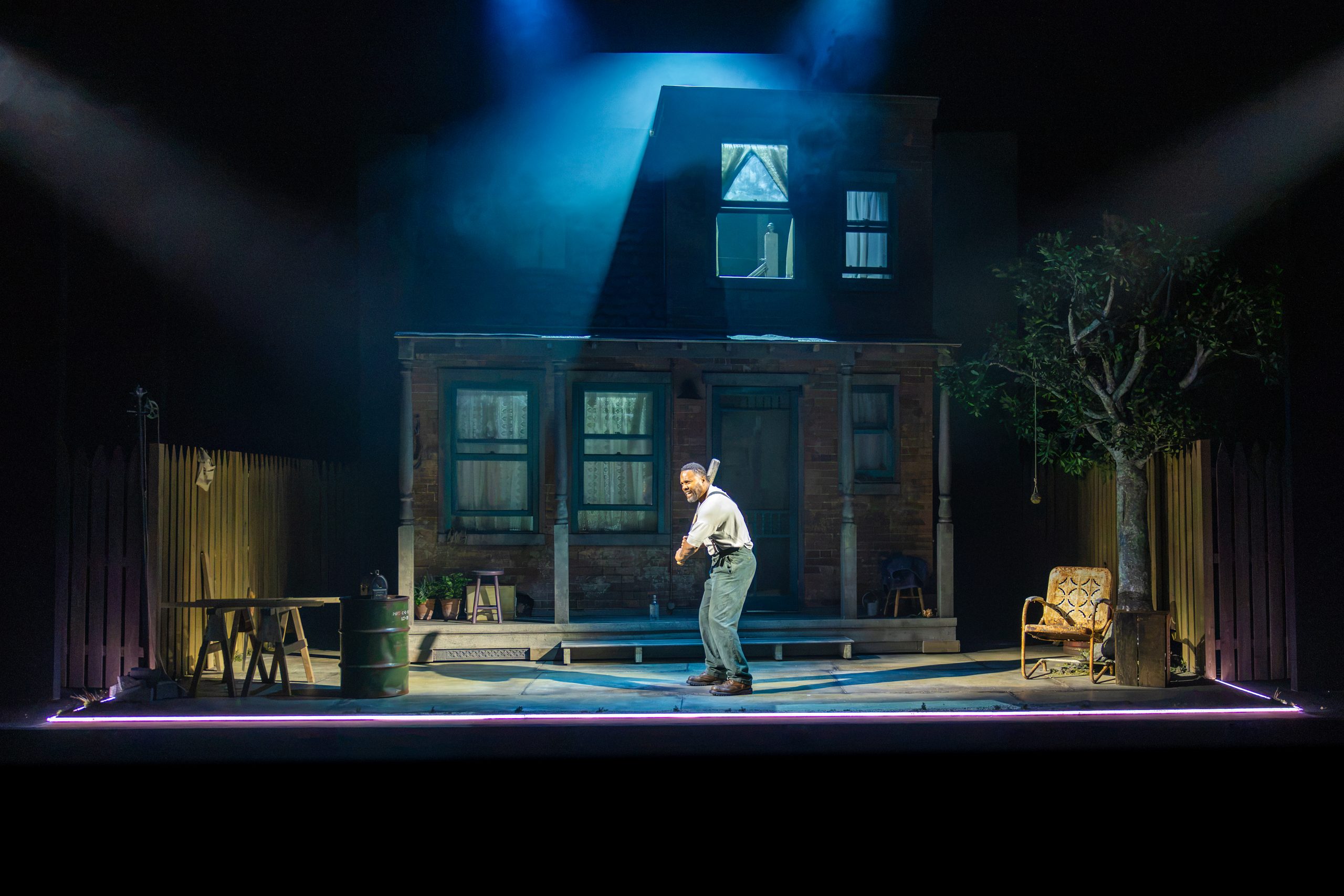
Lily Arnold’s set design is ambitious. In the centre of the stage sits a ramshackle, wood-clad, two-storey house surrounded by all the detritus of life: a broken-down fence, a ball swinging from a tree, an aluminium folding chair and a washing line. This is a place where hard-working people live, and it is something of a mini-triumph. For most of the production, it remains in its forward-facing position, the garden and porch the epicentre of the action as Troy and Bono return home from work day after day, Friday pay packet after Friday pay packet. But just as we reach the interval, the set hints at something different, a jarring, off-kilter change that signals the rupture still to come.
When the play opens, the house lights are up, as if we are simply walking by and being drawn into a domestic drama almost by accident. But as the opening unfolds, we move from the mundane to the extraordinary. Strips of light running across the lip of the apron and the porch gutter signal that we are entering a different world: Gabriel’s world, where every sight and sound speaks of angels and demons. As he blows his silent trumpet, the light becomes warmer and the audience is left to wonder if the red in the sky is the dawn of a new day or a warning of things to come. Throughout the play, Jai Morjaria’s lighting remains complex, moving between workaday outdoor neutrality, vibrant washes and neon-like strip lighting that nods towards jazz clubs and the birth of a new, modern age. But, like all excellent lighting, the design does its real magic in the darkness. As Rose watches through doorways and windows, a silhouette haunting the background of Troy’s stories, we gain a real perspective on the long shadow of pain he casts over those he loves.

It is in my typical fashion to get to this part of a review and have a tiny lament that the sound design could have used just a little more depth and consideration. But not today. I am pleased to say that Khalil Madovi’s sound design gave me everything I hoped for. From Billie Holiday crooning as we took our seats, to the beautifully bluesy transitions, to the gorgeous saxophone solo, this is a production that understands layering. In the low light of late afternoon, we hear the crackle of the radio playing a baseball game and the soft hum of crickets—everything my little storyteller heart wants to bring the scene to life.
The script asks a lot of its performers. We need a Troy who knows how to be funny, gentle and charming, and then break our hearts with his selfishness. We need a Rose who can be The Mother without losing her identity to a reductive stereotype. We need a Lyons who takes all of Troy’s charm but leaves his bitterness behind. We need a Cory with both youthful exuberance and the anger of a young man whose potential is amputated by a father embittered by his own thwarted ambitions. I’m pleased to say that the cast consistently delivers. Ray Fearon’s Troy seduces us with his tall tales, giving a performance that feels hideously familiar in its blend of desperate nostalgia and self-aggrandisement. Michael Ahomka-Lindsay’s Lyons has an earnest eagerness beneath his easy swagger, and Josh Tedeku’s Cory won my heart right away with the youthful bounce of a teenage boy as he pouts about his hunger until his mother points him towards the meatloaf. It was a performance that reminded me of my own son. I am always a little on edge when a character brushes up against the “mad oracle” trope, but Simon-Anthony Rhoden’s Gabriel is beautifully measured and, at times, poetic. Whilst every performance landed, it was Madeline Appiah’s Rose who was my standout of the evening. She gives an absolute powerhouse of a performance and I cried, more than once, not only from her pain but from her bravery. She loves Troy, but never so much that she loses her dignity, and when she tells him what it meant to spend eighteen years standing in the same spot beside him, I felt it in my core.
In true Leeds Playhouse tradition, last night’s performance was BSL-interpreted, with the interpreter’s tireless energy adding another expressive layer to the emotional centre of the story.
Fences is an exceptional piece of drama that does what drama does best: it allows us to embrace complexity and nuance by letting us live a life through someone else’s eyes. Troy is neither the hero of his story nor simply its monster. He is a complex man shaped by a script he did not choose, one written in generational trauma, but responsible for the ways he chooses to repeat it. It was heart-wrenching to watch unfold. It is also a difficult story to balance perfectly, and there were times in the first act when I felt some of the narrative propulsion was a little late off the mark, mired in yet another story of Troy’s greatness that wandered just a little longer than it needed to. But this was more than repaid by the second half, when the groundwork of the first begins to deliver its emotional consequences.
Fences is a bruising, beautifully acted production about the stories we inherit, the stories we tell ourselves and the damage done when we mistake one for the other. Book your tickets and spend an evening with the Maxsons; just don’t believe everything Troy tells you.

August Wilson’s Fences plays at Leeds Playhouse until Saturday 26 September. Tickets are available here.
Sean Sable is a Yorkshire-based freelance writer and editor specialising in Young Adult and Horror fiction, frequently at the same time. When she isn’t buried under a pile of books and manuscripts, she is looking for her keys and having extensive one-sided conversations, in Swedish, with her deaf cat. You can find her online at: www.seansable.co.uk
Trending Now

Review: To Kill a Mockingbird at Leeds Playhouse

Review: Night Collar at St Helens Theatre Royal
You may also like