“…a deliciously old-school thriller…”

Dial M for Murder by Frederick Knott, Harrogate Theatre
By Sean Sable
A love for murder mysteries is in my blood. My grandmother, a stately woman who did not own a sofa to sit upon, but rather a settee to lounge upon gracefully, would stay up until late in the evening when television was no longer a safe place for children. She would watch her “mystery stories” whilst smoking a seemingly never-ending succession of ultra-thin cigarettes through a cigarette holder so no tobacco would stain her fingertips (even if it stained everything else within a 50-metre radius). I was her “little night owl”, who never wanted to sleep at the same time as the other kids, and I would sneak downstairs to lounge on the floor next to the settee and join her in the late evening’s mystery du jour. It was on these late-night adventures, thanks to the BBC double bills, that I honed my love of old-school horror and suspense. We would watch episodes of The Twilight Zone, Tales of the Unexpected and Alfred Hitchcock Presents, and I absolutely fell in love with the campy seriousness of these near-bloodless tales, filled with high-pitched shrieks and minor-major seventh chords hammered with full force.
Soon, two Hitchcocks skyrocketed to the top of my list: Rear Window and Dial M for Murder. The latter, starring Ray Milland, was an instant favourite, with its unique reverse-detective format turning the typical genre tropes on their heads. Hearing Tony Wendice lay out his plans to kill his wife in a chess tournament of strategy had me biting my nails to the quick, and it was one of the first times I can remember secretly rooting for the bad guy. Oh man, did I want Tony to get away with his dastardly plans. When I heard that a new stage production of Dial M for Murder was set to visit Harrogate Theatre, I was excited to see if Phil&Ben Productions could bring this classic to life for a new generation of viewers.
Frederick Knott’s Dial M for Murder first reached audiences as a BBC television drama in 1952, before opening at London’s Westminster Theatre later that year and eventually finding its most famous incarnation in Alfred Hitchcock’s 1954 film. This new production, directed by Josh Mathieson, is presented by Phil&Ben Productions in association with Eastbourne Productions and supported by PW Productions, as part of a wider commitment to bringing mid-scale touring drama back to regional theatres across the UK. Set in London in 1952, the story follows former tennis professional Tony Wendice and his wealthy wife Margot, whose seemingly comfortable marriage has been fractured by her affair with crime writer Max Halliday. Armed with knowledge of the affair and a plan precise enough to make Poirot reach for a notebook, Tony blackmails an old acquaintance into murdering Margot while constructing himself an apparently watertight alibi. But when the perfect murder goes spectacularly awry, Tony is forced to think on his feet as Inspector Hubbard begins pulling at the loose threads.

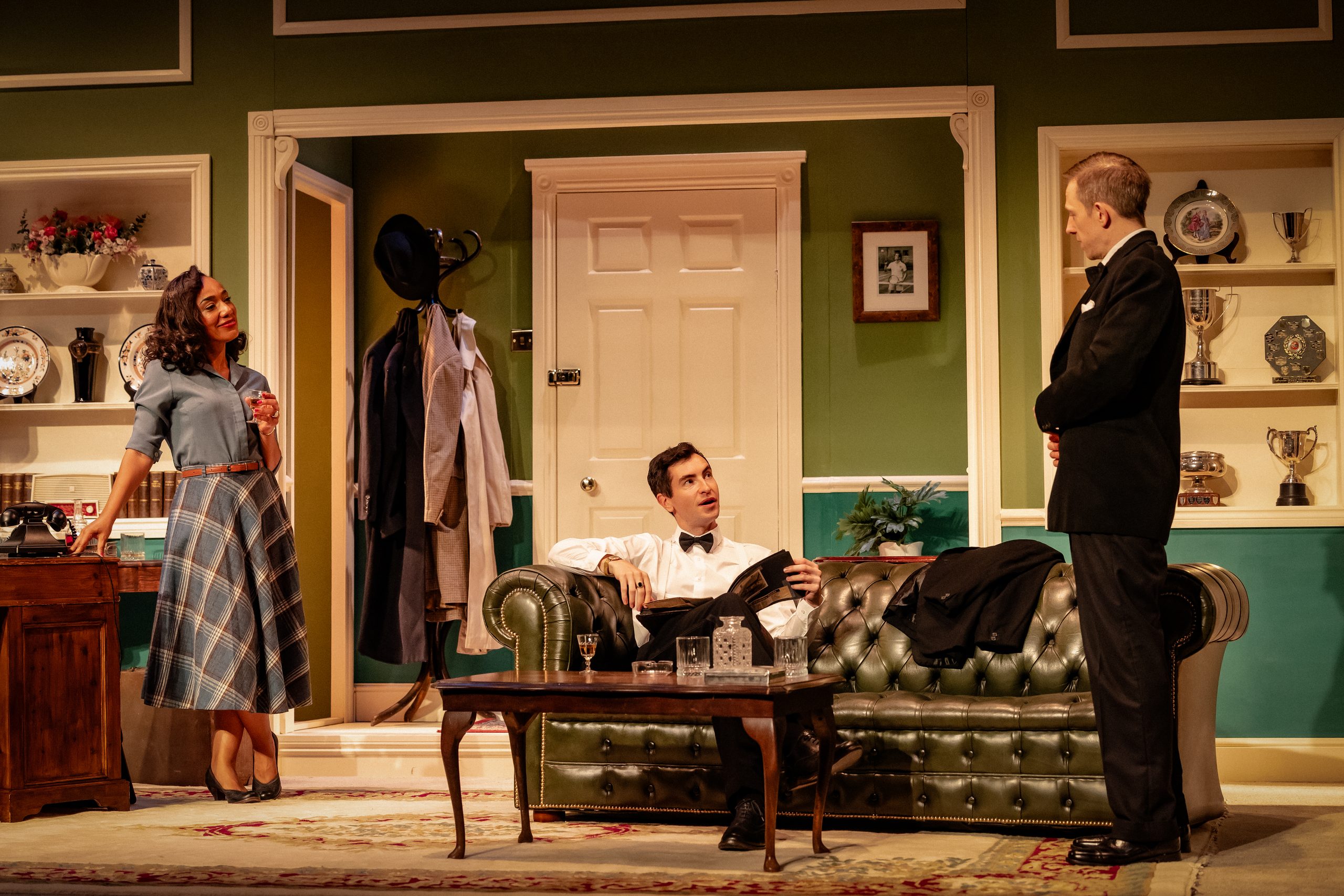
Andy Newell’s set is a gorgeous throwback, not only in visual style, leaning hard on a 1950s townhouse aesthetic, but in its technical construction. It is a robust unit set whose simplicity is strengthened by meticulous attention to authentic detail. From the inlaid shelving units to the glowing fire and the pass-through into the hallway, the audience is never asked to suspend disbelief. The narrative itself lays out a great deal of careful geometry as Tony explains, in precise detail, just how the light from the door will cast a shadow for our killer to lurk in. Our belief in the success of his plans relies entirely on a design that delivers on this promise, and I was thrilled when, at the height of the tension, we saw a Rube Goldberg machine of phone calls, lights and shadows appear exactly as described.
Paul Debreczeny’s lighting design hits the true Goldilocks sweet spot, with just enough noir to make the audience feel as if the “camera angle” has developed a bit of a Dutch tilt without becoming a pastiche of the genre. The use of practical lighting will always bring me joy, and there were enough working light switches, glowing lamps and fire flickers to keep my brain tickled throughout. It’s these kinds of touches that bring so much depth to a production, and when the final scene begins and those practicals slowly dim, we can feel the noose tighten around us. Likewise, Jack Cowlam’s sound design offers texture through radio broadcasts and light piano music alongside the occasional diegetic sound. However, I wouldn’t be me if I didn’t mention that I would have loved just a little more of a score. There is something about a good note-bashing in a particularly tense moment that can take a thriller from great to stratospheric, and I feel like a trick was missed here.
All the gorgeous set and lighting design in the world does little for a domestic thriller if the acting isn’t of the highest calibre, and I am pleased to say that the performances really delivered. Pete Ashmore as Tony is the Platonic ideal of the charming but scheming husband, and his extensive near-monologue towards the end of Act One had me on tenterhooks. Max, played by Simon Pothecary, had a snappy (and convincing) transatlantic accent that felt perfectly tuned to a 1952 radio drama. Tanya-Loretta Dee’s Margot was tragic in a “reaching for mother’s pills” kind of way, the sort that always left me scratching my head as a kid and asking: how can she be capable enough to have a secret affair and strong enough to put up a good fight when her life is on the line, but so fragile that she can barely contain her vapours when the menfolk are in the room? This kind of weak-strong vixen is a staple of the genre, and Dee toed the line perfectly. Inspector Hubbard, played by Katy Dean, had fantastic patter and a Columbo-esque desire to ask just “one more question” that was immensely satisfying. This is a cast that understands the assignment: this isn’t a modern remake of a classic, but a homage to a genre-defining thriller that looks to recreate the soundstage feel of mid-century screen drama, and they do it with Golden Age style.
In a time when less and less straight drama is being brought to the stage, it is refreshing to see a production company that isn’t afraid to remind audiences why we need more than musicals. When the lights dim and the stakes are life and death, collectively holding our breath with a room full of strangers offers an experience no living-room viewing can replicate. After all, a fear shared is a fear doubled.
Dial M for Murder is a deliciously old-school thriller that proves you don’t need blood, gore or spectacle to keep an audience gripping the arms of their seats. Sometimes all you need is a telephone, a shadowy room and one very bad husband with a very good plan. For this night owl, it was a delight to spend another evening in the dark with an old favourite. Enjoy an evening of white-knuckle suspense—just try not to root for Tony too hard.
Dial M for Murder plays at Harrogate Theatre until Saturday 12 September. Tickets are available here.
Sean Sable is a Yorkshire-based freelance writer and editor specialising in Young Adult and Horror fiction, frequently at the same time. When she isn’t buried under a pile of books and manuscripts, she is looking for her keys and having extensive one-sided conversations, in Swedish, with her deaf cat. You can find her online at: www.seansable.co.uk
Trending Now
Review: A Christmas Carol at Leeds Playhouse
You may also like