“…a beautiful evening of grand emotions and glorious music…”

Eugene Onegin by Tchaikovsky, based on the verse novel by Alexander Pushkin, Leeds Grand Theatre
By Sean Sable
Pushkin and I have a lot in common: we are both Russian men who died almost two hundred years ago. But apart from that obvious connection, we are both writers who are a little obsessed with characters who define the world around them by the ideals laid out in romantic novels. I won’t plug the book I currently have in the query trenches, but in it, I examine a Byronic heroine who cannot get close to the man she loves because she cannot risk shattering her illusion of him as the perfect Mr Darcy – safe, pastoral, trapped in the pages of flawless love (even if it is against his will and his reason). In Eugene Onegin, Pushkin (and later Tchaikovsky along with Shilovsky) examines what it is like for a shy young girl, obsessed with the love found in novels, to be confronted by the image of the Byronic hero, only to discover that moody, brooding and rebellious can easily become shallow, hurtful and self-centred. I love a good love story, and even more so when the writer puts the couple through their paces. Tchaikovsky gives us his thesis through Onegin’s poetic best friend Lensky: “life is no romantic novel… honour is but a sound, friendship an empty word”. And as Onegin proves, the Byronic hero is considerably less appealing when the consequences are real.
First performed in 1879, Tchaikovsky’s Eugene Onegin was adapted from Alexander Pushkin’s novel in verse, with the composer and Konstantin Shilovsky transforming the story into what Tchaikovsky referred to as a series of “lyrical scenes”. This new Opera North production, a co-production with Irish National Opera and Opera Queensland, is directed by Patrick Nolan, who has moved the action from imperial Russia to the Soviet Union of the 1980s. The updated timeline follows the USSR through Perestroika and into the emergence of the wealthy post-Soviet elite. The story tracks Tatyana, a shy young woman whose head is full of romantic novels, who falls hopelessly in love with Eugene Onegin, the sophisticated and rather jaded friend of her sister’s fiancé. When she confesses her love in a letter, Onegin rejects her, and his subsequent behaviour at her name-day celebrations sets in motion a tragedy involving his friend Lensky. Years later, when Tatyana is married and established in fashionable society, Onegin discovers that the tables have turned.
I’ll admit I walked in a little unconvinced of the set’s central premise. Along with the updated timeline, we were set to be transported to a Soviet-era gymnasium, complete with all the utilitarian joy therein. And there is no attempt to disguise it: bare wooden risers, peeling plaster and a perfunctory hammer and sickle. But when rehearsals began for the town’s Olympic celebrations, I warmed to the concept. Somewhere between Lenin flags and coloured card displays, it started to feel like a place with more life than I’d expected. But the trick isn’t just in making an Eastern Bloc gymnasium feel not-dire, but in transforming it into a party and finally a palace. I am pleased to say that set designer Leslie Travers pulled off a hat-trick. With the stands moved to the side and rope lights added, the name-day celebrations have all the joy of a small-town party. Later, when the risers are split and a modern-art-inspired chandelier descends, the stained plaster begins to look convincingly like marble. I may have arrived sceptical, but I certainly left persuaded.
Throughout much of the performance, Malcolm Rippeth’s lighting remains understated, but that simply means that when it steps forward, it does so with real impact. When Tatyana sings of a new morning and her desperate fear that Onegin will not return her love, the space takes on an almost heavenly golden glow. The rope lights for the name-day party are a neon-like explosion of joy. However, the Constructivist-esque light fixture in the palace is, perhaps, the biggest lighting success of the night. That one audacious statement piece utterly transforms the space.
Costumes designed by Elizabeth Gadsby punched above their weight all night, and I can genuinely say that they were the linchpin of the visual design. From the restrained calico smock dresses of the first act to the gloriously flammable shell suits of the second act, every costume channelled a moment in Russian history impeccably. Oh my, as a woman of a certain age, seeing a man in an all-black ensemble with a black blazer and sunglasses indoors… be still my heart. In the third act, there were enough glittering sequins to get Dolly Parton’s blessing, and the gorgeous white-to-black ombré of the women’s gowns brought real meaning to the champagne hues of Tatyana’s understated class. She was, as the libretto points out, glowing like a star.
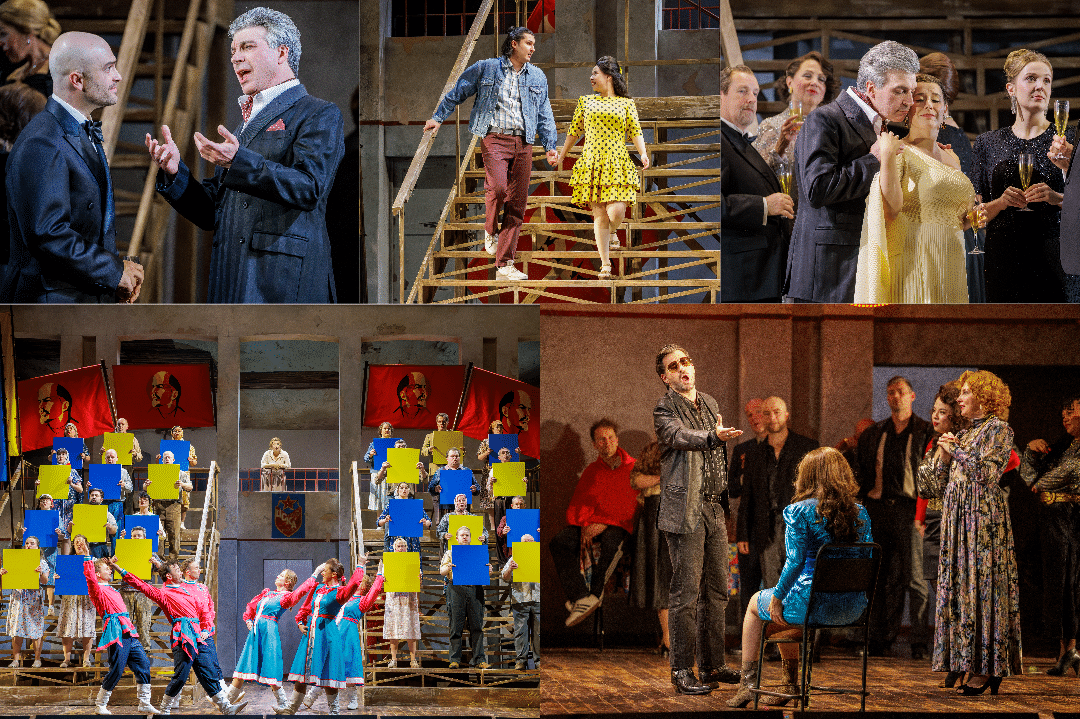
The voices on offer last night were up to Opera North’s usual extraordinary standard. Verity Wingate’s Tatyana has a bold, robust soprano that feels like it has been hewn from oak. John Brancy’s Onegin had a compact, sharply defined baritone, perfect for his sneering cynicism in the first act, then opening up in the third whilst retaining its crisp, percussive edge. Given my love of rich, dark-toned voices, it comes as no surprise that Joshua Bloom’s bass as Prince Gremin had me ready to jump to my feet. But as a reviewer known for her love of baritones, I am about ready to lose my street cred here. My absolute standout of the evening was Caspar Singh’s Lensky. As his poetic tenor reached the zenith of the duel aria, I had a little wobble of joy and sadness that I still feel when I think about it. And, as always, Opera North knows how scale is done with an impressive and diverse chorus.
It wouldn’t be an Opera North production without some of the best live orchestral playing going, and under Garry Walker’s musical direction, the Orchestra of Opera North didn’t disappoint. In one of the most emotionally raw moments, when Tatyana’s Letter Scene builds from a delicate, racing heartbeat of strings into a torrent of sound, I was fighting the urge to wolf-whistle the brass section. And again, in the crashing climax of the St Petersburg ball, the power of the full orchestra hit like a gut-punch.
There is so much to admire in last night’s performance that I almost don’t want to mention the minor wrinkles. Whilst I adored much of Wingate’s Tatyana, I felt that her interpretation of shyness, so convincing in the first act, had become rather static by the second. Her downcast eyes and inward posture began to lack a sense of interiority when she was sidelined at her own party. Perhaps this is down to the change in timing. In the original story, the first and second acts take place relatively close together, whereas the newer timeline gives us a shift forward of a few years (if the costumes are any clue). In the original, the consistency of body language would have made better sense, but in the “modernised” interpretation, I expected a maturation of her shrinking violet shyness into something that winks at the midnight orchid who comes out in the third act. I also hold a slight personal preference for the ambiguity of Onegin’s change of heart in the third act, but I felt that this interpretation perhaps believed in his “redemption” more than I did, leaving me with a bit of a “yeah, right” eyebrow arch.
Whilst Pushkin might have opined that real-life romantic heroes don’t exist, that hasn’t stopped Opera North from assembling a wonderful company of singers to help us pretend otherwise. Eugene Onegin is a beautiful evening of grand emotions, glorious music and some spectacularly poor decisions. Leave your love letters and romantic novels at home and head to Leeds Grand. The heartbreak is much better with a live orchestra.

Eugene Onegin plays at Leeds Grand Theatre until Thursday 29 October. Tickets are available here.
Sean Sable is a Yorkshire-based freelance writer and editor specialising in Young Adult and Horror fiction, frequently at the same time. When she isn’t buried under a pile of books and manuscripts, she is looking for her keys and having extensive one-sided conversations, in Swedish, with her deaf cat. You can find her online at: www.seansable.co.uk
Trending Now

Review: Enlightenment at People's Theatre
Review: A Christmas Carol at Leeds Playhouse
You may also like