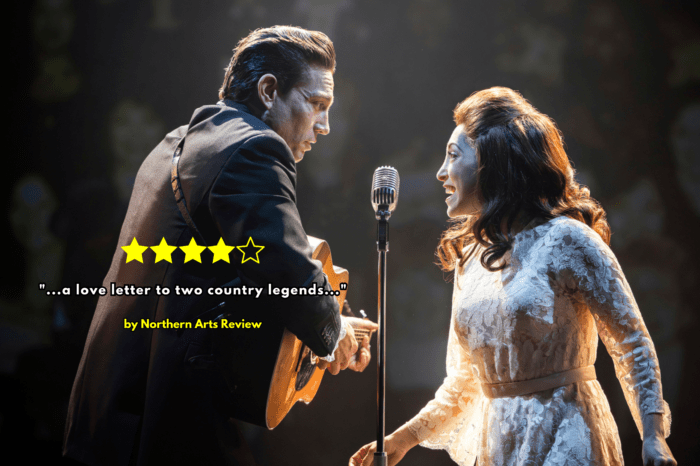
“…quite simply outstanding…”

To Kill a Mockingbird by Harper Lee, Leeds Playhouse
By Sean Sable
As a long-time fan of Aaron Sorkin’s writing, I went into To Kill a Mockingbird already knowing exactly what I was going to get: a courtroom drama written with a kind of open-eyed wit that sits in that strange valley between sarcasm and awe. And I wasn’t wrong—but that didn’t make the evening any less gripping. Sorkin’s script has a way of holding you in your seat and pulling focus onto the characters until everything else fades into the background. To Kill a Mockingbird is a story that claims your full attention from the moment the lights go down and doesn’t let up until the cast says, “All rise”.
In this sympathetic reworking of Harper Lee’s tale of 1930s Alabama, we follow Scout and Jem (along with their friend Dill) as they remember the summer their father, Atticus Finch, defended Tom Robinson, a Black man accused of raping Mayella Ewell. The trial unfolds in fragments, weaving in and out of flashbacks of childhood: summers of make-believe, whispered rumours of the recluse Boo Radley, and the harsh realities of prejudice and injustice. The verdict is inevitable, but what matters is the journey to get there: Atticus trying to live by his own ideals, Calpurnia pushing back against them, and Scout learning what it means to “step into another person’s skin.”
There are significant deviations from the original text, but Sorkin’s instincts for theatre are sharp, and here he has broken up the heavy courtroom speeches, shifted the timeline a little, and moved Scout’s narration into a chorus-like role that better serves the stage adaptation. The story moves at a brisker pace without losing weight. Atticus is written with more conflict, and Calpurnia has been given a stronger voice; two welcome choices in 2025 as the story continues to honour Lee’s intention whilst moderating the white-saviour trope to speak more directly to modern audiences.

I’ve never seen a Sorkin play that didn’t demand acting of the highest calibre and last night’s performance was no exception. The acting was quite simply outstanding. Anna Munden’s Scout captured a child’s awkward physicality so convincingly that I almost forgot I was watching an adult, while Dylan Malyn’s Dill absolutely melted the audience with his lost-boy eagerness. Richard Coyle’s Atticus was restrained, with an accent pitched carefully to his character’s education and class. His performance built patiently, keeping control until it mattered most, and the result was convincingly fiery. And then there were the Ewells. It’s never easy to play characters this despicable, and I’ve always thought Bob and Mayella Ewell must pose a particular challenge. How do you find the humanity in them at all? Yet, Oscar Pearce and Evie Hargreaves played Bob and Mayella with such raw ferocity that their courtroom outbursts made my skin crawl.
Across the board, design supported the story without competing for attention. Miriam Buether’s rolling set pieces transformed fluidly—from the full Finch porch (complete with rocking chairs) to a grand courtroom that dominated the stage. Changes were frequent, almost scene by scene, but never interrupted the flow. Ann Roth’s costumes were a triumph of subtle period detail: from Atticus’s linen suit, perfectly cut for the time, to Scout’s denim dungarees and Jem’s slightly too-big belt hoisting up his hand-me-down trousers. Her design choices deftly sold the illusion of children’s bodies inside adult frames without descending into pantomime.
Lighting and sound were more subdued, and Jennifer Tipton’s lighting rarely called attention to itself. Similarly, sound design was minimal and well executed, but I did find myself wishing for a little more diegetic sound to evoke the hum of an Alabama summer: crickets on the porch, perhaps, or birds in the trees. But that may be a matter of personal taste, and the production chose stillness over atmosphere, keeping the focus squarely on the dialogue, which does come at the audience with Sorkin’s characteristic velocity.
What makes this production so effective is that everything serves the script, allowing the full weight of the story to land without distraction. It confronts us with the injustice of a system stacked against Tom Robinson and still asks what kind of people we choose to be in the face of moral dilemmas. To Kill a Mockingbird was never only about one trial in one small American town. It’s about how injustice seeps into communities, and whether we, like Atticus, can face it with dignity and compassion. This is why, sixty-five years after the book’s first publication, we still need the sting of this story’s verdict.

To Kill a Mockingbird plays at Leeds Playhouse until Saturday 04 October. Tickets are available here.
Sean Sable is a Yorkshire-based freelance writer and editor specialising in Young Adult and Horror fiction, frequently at the same time. When she isn’t buried under a pile of books and manuscripts, she is looking for her keys and having extensive one-sided conversations, in Swedish, with her deaf cat. You can find her online at: www.seansable.co.uk
Trending Now

Review: To Kill a Mockingbird at Leeds Playhouse

Review: Night Collar at St Helens Theatre Royal
You may also like