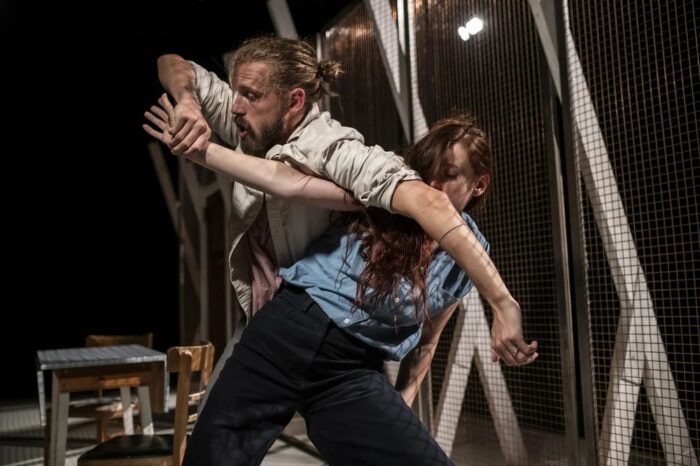
Christine and Lois Mackie on mothers and daughters, the importance of drama & Moustache-gate
By Sean Sable
Rona Munro’s award-winning prison drama Iron is a story of absence and reconnection. Fay has spent 15 years serving a life sentence for killing her husband and during that time, her daughter Josie has never visited. When Josie finally walks into the prison, the two women are forced to confront the memories, questions and long-suspended relationship between them.
In Christine’s production company Best Girl Productions‘ new staging, the estranged pair are played by a real-life mother and daughter. Christine Mackie, familiar to television audiences from Coronation Street and Downton Abbey, and her daughter Lois Mackie share a stage for the first time, bringing their own closeness to a play about separation. The production opens at HOME, Manchester, from 15-19 September before travelling to Hull Truck on 23-24 September and The Dukes, Lancaster, from 30 September-3 October.
Sean Sable caught up with Christine and Lois during rehearsals to talk about what it was like to dig into such a well-crafted story and the importance of experiencing life from someone else’s eyes.
SEAN: For readers coming to Iron fresh, what is the play about, and what was it about Rona Munro’s writing that grabbed you?
CHRISTINE: From the start, you know that Fay is in prison for killing her husband, but you don’t know why. You don’t know her motives, whether it was self-defence or not, so as an audience you become a sort of judge and jury as the play goes along.
What fascinates me is that she’s been there for 15 years and has never had a visitor. That’s a long time, not just to live like that, but to survive it. She didn’t speak at the trial and she’s never really spoken about what happened. There’s something strangely principled about the way she’s dealt with it.
Then Josie suddenly arrives saying, “Yeah, but I need answers now. I need to know. I need something.” She doesn’t initially come because she wants a relationship with her mother. She has a very specific objective. But then, because this is Rona, they begin to find one another and get to know each other again.
The language is very accessible, very ordinary and everyday, but when they talk about their memories and the life they had before, it becomes so poetic and beautiful. In some ways, I find those images even more affecting because you’re seeing them within this incredibly constrained environment.
Rona just packs a punch. She doesn’t hold back. The play goes from the most brutal aspects of human behaviour to humour and tenderness, and she keeps you with these people all the way through.

SEAN: You came across Iron while you were working on Best Girl. Was there immediately a sense that this could finally be the play for the two of you to perform together?
LOIS: We came across the script towards the end of touring Best Girl and taking it up to Edinburgh, and you can’t read that play and not go, “Oh my God, why aren’t we doing this? Look at this on a plate.”
There could have been opportunities before this for Mum and me to be onstage together, and that would have been fun and lovely. But we might have ended up as Nurse Number One and somebody over here who never speak to one another and have no relationship whatsoever within the play. That would have been fine, but I’m so glad we waited.
With Iron, we actually get to play the mother and daughter at the heart of the story and, to our knowledge, it’s the first time Fay and Josie have been played by a real mother and daughter duo.
So there’s already something there for us to draw on. We have all of that history and familiarity between us, while these two women are trying to work out what remains after 15 years apart. It gives you layers before you’ve even started.
SEAN: Fay and Josie haven’t seen one another for 15 years, whereas the two of you are extremely close. Does that real-life closeness make creating the distance between them easier or harder?
LOIS: I think it’s all possible because of the closeness, actually. We already have this foundation of love and trust and support, which means we can go into the rehearsal room and play fully and safely. We can try things, get things wrong and just see what happens.
Then there’s everything else: knowing the play, creating the backstory for the characters, the direction we’re getting from Sam, and how beautifully Rona has drawn them.
And although Fay and Josie haven’t seen one another for 15 years, they aren’t complete strangers. Even with that huge distance, there’s still a familiarity. There’s something there already that’s tangible, even if it’s buried really deep down and they can’t quite find the words for it at first.
CHRISTINE: They each have a head full of memories of the other person. Lois has all these memories of me throughout her life, and I have the same of her.
So when you get to those little chinks of connection between Fay and Josie, we have all this stuff underneath that wants to break through, just as the characters begin to want to connect again. The longing is there. That motor’s running all the time.
And Rona doesn’t make that reconnection easy or sentimental. It isn’t, “Right, I’ve got you now.” It’s tentative and respectful, and quite revealing. For Fay, particularly, opening herself up to Josie means making herself vulnerable again. She’s survived for 15 years by not doing that.
SEAN: What is something you hope audiences will walk away with that they might not be expecting?
CHRISTINE: I hope they care about all four people in the play, not just Fay and Josie. George and Sheila, the two prison officers, have their own story as well.
Because really, the four of us are in the joint. We’ve got two officers, one prisoner and one visitor, but we’re all in there. Everyone is being watched and monitored, and everyone is affected by that environment in a different way. So it is absolutely a four-hander.
I think that’s part of what drama gives us. You get to stand in somebody else’s shoes for a moment and ask yourself, “What would I do?” You might come in with a very definite idea of how you feel about the prisoner, or the officers, or the daughter who hasn’t visited her mother for 15 years, and then something shifts as you get to know them.
If people leave caring about somebody they hadn’t expected to care about, or questioning one of those first assumptions, that would be wonderful.

SEAN: The play was written in 2002, but Britain’s prison system is in a very different place now. What does Iron still have to say about punishment, and particularly the treatment of women in prison?
CHRISTINE: I think we have some responsibility there. The play was written in 2002, but we’re playing it now, and obviously we’re very aware of how acute the crisis in the prison system has become.
But some things are still very recognisable. There’s something particular about the way women in prison can be treated, as though they haven’t just committed a crime, but somehow committed a crime against their sex as well. There can be this sense of, “You’re a woman, you shouldn’t have done that.”
And then, of course, there’s a tendency to medicalise or infantilise women which is quite different from how someone would be treated in a male prison.
What’s marvellous about having George and Sheila in the play is that you get to see some of that through the way Fay is treated. But the officers aren’t bad people. They’re working within the system too, and they’ve found ways of making that system work for them. It’s a hard system to work in.
Although the play was written more than 20 years ago, it still holds up a mirror and asks us to look into it.
SEAN: The punishment in Iron also reaches far beyond Fay herself. Josie has effectively lost both parents. Did that idea of secondary trauma particularly resonate with you?
CHRISTINE: Without question. Josie loses her father, and then she loses her mother as well because her mother disappears into prison. Everything changes. That kind of secondary trauma can take a lifetime to come to terms with, if you’re lucky.
When we did Best Girl, which was semi-autobiographical and came out of losing my dad to suicide, one of the things that really struck me was the connection audiences made with it. They hadn’t necessarily been through that particular experience, but they understood the unfinished conversation. The thing they wanted to say to somebody, or resolve with somebody, and never got the chance.
When my dad died, nobody really talked about any of this. We didn’t have that language around trauma in the way we do now. Looking back, what Annie in Best Girl was experiencing, and what I had experienced, was secondary trauma.
And Josie has that without question. Fay is serving the prison sentence, but Josie has been living with the consequences for those same 15 years. It becomes a sentence in itself.
SEAN: Serious drama has become a harder proposition for theatres financially, but you clearly feel strongly about its value. Why do you think we still need plays like Iron?
CHRISTINE: Everybody is very aware of the financial constraints and the risks at the moment, people are having to make choices about where their money goes, and theatres have to think about what they can afford to put on.
But the absolute basic principle of drama, of standing in somebody else’s shoes for a moment, is so important to me. You can look at somebody else’s situation and learn from it. It can inform you, affect you, maybe make you think twice about something.
And Iron is a serious play, but it’s full of love and humour and hope and honesty. Honesty is tough—as tough as violence.
There are lots of different colours in this play. You can laugh and then be confronted by something very difficult. You can feel for somebody and then have that feeling challenged. That’s what good drama does and why everyone needs it—perhaps now more than ever.
SEAN: What has building Best Girl Productions taught you about creating work and building relationships with theatres? What do you see for your future?
CHRISTINE: There are fewer outlets now for finding work within established repertory companies, so a lot of work needs to be self-made, or made and then toured. At some point, if you want to keep making theatre, you have to take matters into your own hands.
Best Girl Productions happened almost by accident. When we took Best Girl to Edinburgh, we needed a company name, so that’s what we became. But afterwards I thought, actually, I like theatre so much that I want to keep doing this for as long as I can. Why not try to build something?
We’ve been very fortunate. After Best Girl, and then Kin, we had really lovely responses from the theatres we toured to. Now some of those places want us back, and we have actors and creatives who want to come back and make something with us again. That’s the joy of it.
We’re very new to the game in that way, but I want to keep building those relationships and making work that can sit confidently alongside companies that have been doing this for a very long time.
There are other things I’d like to explore too. I’ve been writing for Vignettes, and I have a script called Race for Life that I’d really like to turn into a short film. I’ve also got a couple of plays in my head that I think might be ripe for revival.
So we’ll see. Just carrying on for as long as I can carry on before I’m carried off, I suppose. Creativity and kindness. Let’s go.
SEAN: You also have a long relationship with Hull Truck. What does it mean to be bringing Iron back there?
CHRISTINE: I’m a big fan of Hull Truck. I’ve worked there a few times and I’ve got such happy memories of the place.
I toured there with Whisky Galore!, which had been at Oldham Coliseum, and Hull was the notorious night of Moustache-gate.
I’d decided I was going to play the dashing Dr MacLaren with this lovely 1930s moustache, and I had about four of them backstage so I could keep replacing it. But on this particular night it simply would not stay on. In the end, we had to finish the scene with different people physically holding the moustache in place. It was just not having it!
Then I went back for Dancing Through the Shadows, which was made as Hull was building towards its UK City of Culture programme. It was about the bombing of Hull during the war and the feeling, quite justifiably I think, that the severity of what happened to the city had never really been acknowledged. It was quite a moving piece, and I really enjoyed being a part of it.
So, I’ve got a real affection for Hull Truck. They have such a strong relationship with their community and with the work they make and support. To be going back now with something we’ve made ourselves feels very special.
Sean: In some ways, this tour feels like a series of homecomings. Lois, what does it mean to be bringing Iron back to The Dukes?
LOIS: The Dukes really does feel like a homecoming for me. I was in the youth theatre there, and The Elephant Man was my first proper show, so it was a really important place for me when I was starting out.
I’ve been back since with Best Girl, which Mum wrote for me, and now I’m coming back again with Iron. Each time has marked a completely different point in my life.
What makes this one particularly lovely is that Mum and I are finally onstage together. So there is something very full-circle about taking a play about a mother and daughter back to a theatre that has been part of my own story, and part of ours, for such a long time.
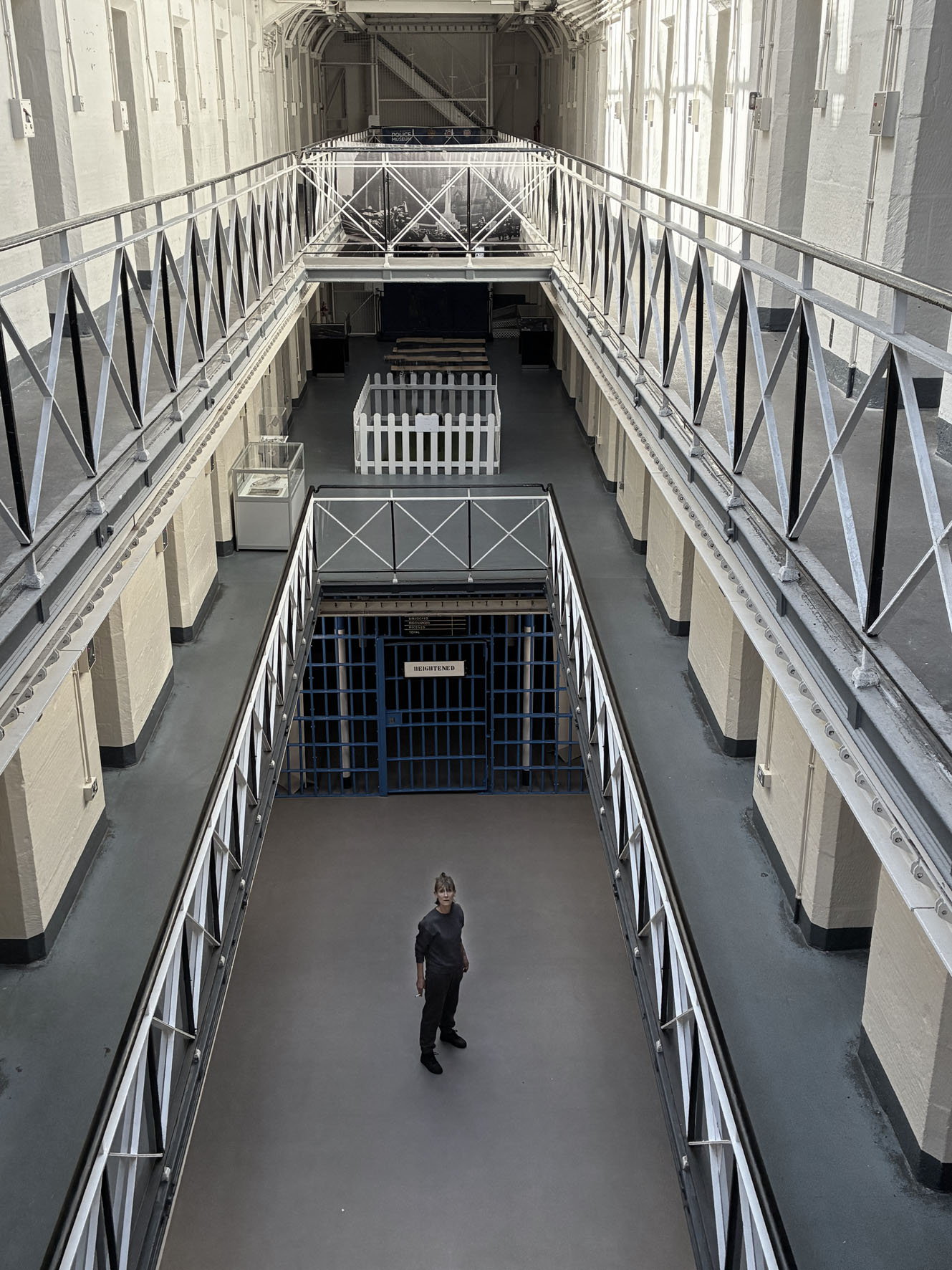
IRON opens at HOME in Manchester on Tuesday September 15 and plays until September 19, tickets are available here.
Hull Truck (23rd-24th September, tickets are available here).
The Dukes in Lancaster (30th September-3rd October, tickets are available here).
Sean Sable is a Yorkshire-based freelance writer and editor specialising in Young Adult and Horror fiction, frequently at the same time. When she isn’t buried under a pile of books and manuscripts, she is looking for her keys and having extensive one-sided conversations, in Swedish, with her deaf cat. You can find her online at: www.seansable.co.uk
Trending Now
Review: A Christmas Carol at Leeds Playhouse
You may also like