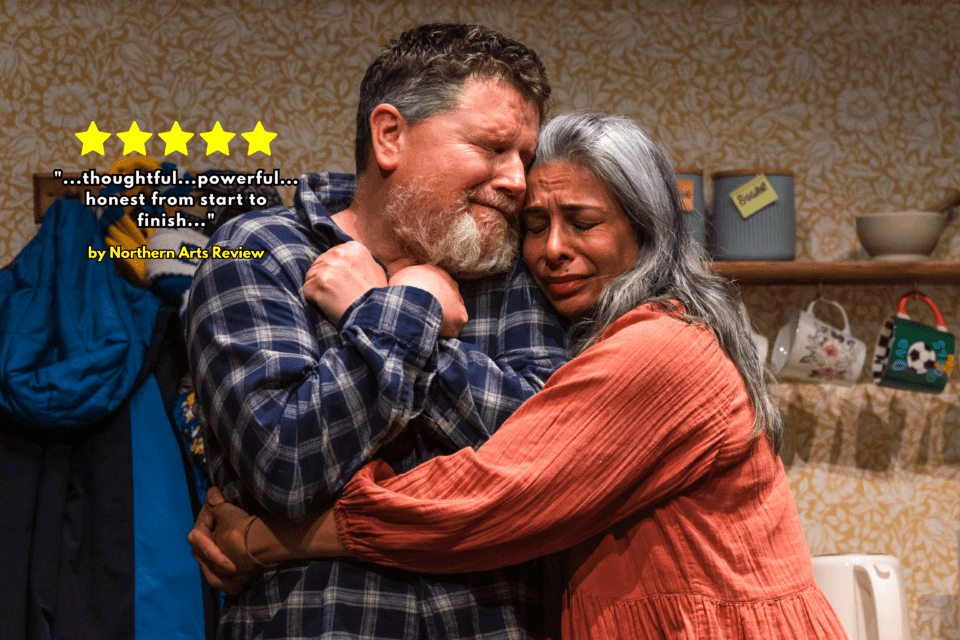
“…thoughtful…powerful…honest from start to finish…”

Through it All Together by Chris O’Connor, Leeds Playhouse
By Sean Sable
Some stories are told in flashbacks, whilst others are told in Post-it notes on the fridge, slowly multiplying as memory fades. Through It All Together, a new play by Chris O’Connor, follows a Leeds family as they navigate a dementia diagnosis and the emotional seesaw that is Leeds United football. But this isn’t a simple football play. It’s a family play with football woven through, like stitches holding together memory, comfort and routine. More than anything, it is a play about how football can be the easiest thing to talk about when everything else feels too difficult to say.
Spanning two years, the story centres on Howard (Reece Dinsdale) and Sue (Shobna Gulati), long-time Leeds United fans, and their adult daughter Hazel (Natalie Davies). Howard has been recently diagnosed with dementia. As the condition progresses, the family is forced to have hard conversations about independence and what quality of life really means for both Howard and his “girls”. At the same time, Leeds United—under the new management of Marcelo Bielsa—can finally see promotion in their sights. The juxtaposition is painful: a narrative of decline pressing against a narrative of hope and return. Still, it’s not the broader contrast that hits the hardest. The real power of the story is in the little details of life—cupboards labelled with Post-it notes, a radio playing the match, a family trying to keep things normal as life becomes anything but.
I appreciated how the play holds space for all three family members. Sue isn’t a stock carer figure, existing only to be long-suffering. Instead, she’s funny, sharp, often exhausted but always loving. Hazel doesn’t come in weeping with grief; she’s frustrated and unsure of her place in it all. Her instinct is to pull away, to protect herself with barbed logic: “It don’t matter—he won’t remember it anyway.” And Howard, crucially, isn’t just “the man with dementia.” He is a whole person with frequent moments of humour, insight and agency. The result feels honest, and all the more moving for refusing to go schmaltzy.
Around the core story, we are entertained by a host of side characters: pub regulars, podcast hosts, support group attendees and coordinators. These scenes are hilarious and well-placed to give the show texture without pulling focus. Moments like the laugh-out-loud ‘Shark Pants’ adverts offered just enough lift to keep the play from being dragged under by its own weight. Just when we were feeling a little too tearful, we would be treated to the boys at the pub bickering about the shame of being a glory hunter. Additionally, they offered a useful lens for how football reaches beyond one household and brings a whole community together. This is seen most clearly when one supporter (played by Everal Walsh) drops to his knees, begging God to bring back the football because it’s his lifeline.
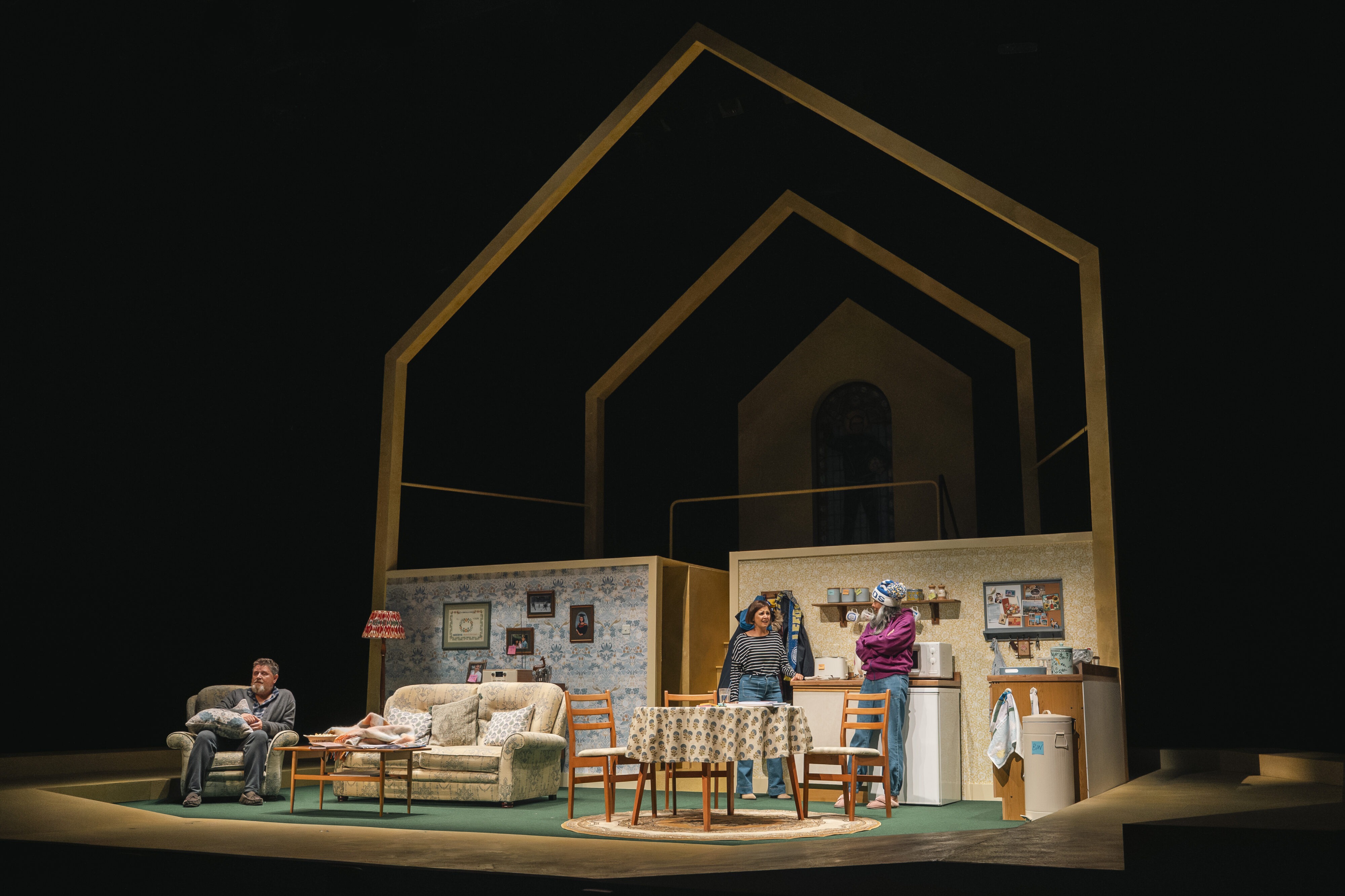
The set makes smart use of space. A familiar, lived-in house sits at stage level, while an open, elevated platform above is framed in an almost church-like aesthetic. Sitting in the middle we see a stained-glass-style window of Bielsa, which lights up occasionally, getting some of the biggest laughs of the evening. The lighting and sound are both well-judged. Nothing flashy, but still very thoughtful. I especially liked how they handled moments of confusion or overwhelm, using blue gels and subtle audio distortion to mark those scenes without tipping into heavy-handed “effects.”

The entire cast’s performances were superb. Shobna Gulati gives Sue a loving intensity that only builds as her world shrinks. Natalie Davies brings Hazel to life in a way that feels honest, even when her reactions hit a nerve. The multi-role cast (Dean Smith and Everal Walsh) are delightful, switching between characters and physicalities with ease. At the interval, I overheard a theatregoer remark that it was like having twenty characters hiding in two men.
The standout performance in a group of standout performances came from Reece Dinsdale, who brings weight, warmth and “big dad energy” to Howard in the first half and a heart-rending vulnerability in the second. In the moments of confusion where he was caught between laughter and tears, I couldn’t help but be reminded of my grandmother’s struggle with vascular dementia. The wide, puzzled eyes and child-like regression of dementia are expressions you cannot forget once they have touched your life.
The Leeds fans were out in force for last evening’s performance, and they absolutely loved the in-jokes and winking references. But don’t feel like you need to be a football (or Leeds United) fan to understand this play. It’s really about how people stay connected when other things fall away and how shared language, whether it’s a chant or a half-time routine, becomes the thing you hold onto.
Through It All Together doesn’t rely on shock or spectacle. It’s a thoughtful, well-constructed play about ordinary people facing an incredibly difficult reality. What makes it powerful is how recognisable it is. The dialogue feels real, the humour lands without undercutting the emotion, and the performances are honest from start to finish. If you’ve ever supported someone through illness (or just tried to keep a family afloat during uncertain times) this will speak to you. It’s the kind of play that deserves a full house. Not just because it’s good, but because it’s rare to see dementia portrayed with this much care, dignity and truth.
Through it All Together plays at Leeds Playhouse until Saturday 19 July. Tickets are available here.
Sean Sable is a Yorkshire-based freelance writer and editor specialising in Young Adult and Horror fiction, frequently at the same time. When she isn’t buried under a pile of books and manuscripts, she is looking for her keys and having extensive one-sided conversations, in Swedish, with her deaf cat. You can find her online at: www.seansable.co.uk
Trending Now

Review: To Kill a Mockingbird at Leeds Playhouse

Review: Night Collar at St Helens Theatre Royal
You may also like