“…a thought-provoking adaptation…”
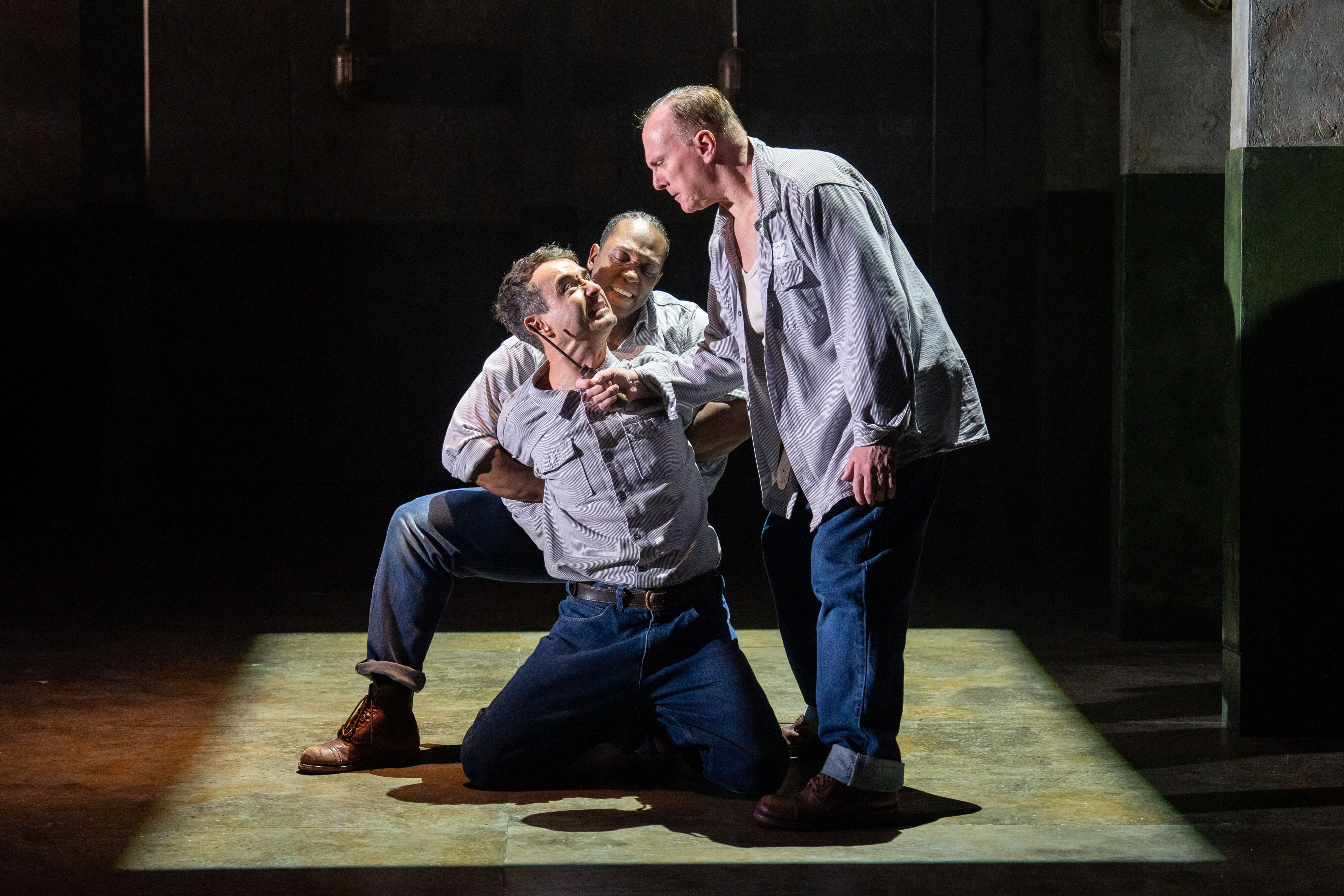
Shawshank Redemption by Owen O’Neill and Dave Johns, Leeds Grand Theatre
By Sean Sable
I’m going to make a confession, but I need you to hear me out. Ready? I didn’t like The Shawshank Redemption the first time I encountered it. Hang with me, now—I was about twelve and I had discovered the magic of horror novels. I was a spooky kid who loved spooky things, and most of all, I loved Stephen King. When other little girls were asking for Sylvanian Families, I was asking for hardback copies of Misery. So, you can imagine when King’s short story collection, Different Seasons, arrived under the Christmas tree, I was well chuffed. Until I read it. What were these heartwarming tales doing hogging all the space inside a book that should have been chock-a-block with dread and gore? I had no time for Andy Dufresne. None.
A few years later the film came out, and my friends dragged me to the cinema. I didn’t want to go, I said. That story is boring, I said. Peer pressure won, and of course, how could I resist the charms of Tim Robbins and the iconic Morgan Freeman? The older, slightly more patient version of me could finally sit with the subtleties of a different kind of horror: the terror of being imprisoned for a crime you didn’t commit, and the dignity of finding a way to “get busy living”. These days, The Shawshank Redemption is easily considered one of the best films ever made, and as I walked into the Leeds Grand Theatre to see the stage adaptation of the famously Oscar-snubbed classic, I knew whoever was behind it had their work cut out for them.
It’s important to note that Owen O’Neill and Dave Johns’ adaptation, directed by David Esbjornson for Bill Kenwright Ltd, draws from King’s 1982 novella Rita Hayworth and Shawshank Redemption rather than Frank Darabont’s Academy Award-nominated screenplay, and this is more than a licensing footnote. The novella is a different beast from the film: cumulative and interior, it is a story almost entirely dependent on Red’s voice for its emotional landscape. In the film, Darabont answered the question of interiority by inventing scenes that gave audiences direct access to Andy’s experience. The play, working from the earlier source, is left to find its own solution. The result is a production that is a little uneven, highlighting the strengths and weaknesses of the adaptation process.
A prison is, by definition, a blank and functional space, and the production leans into that blankness. Gary McCann’s set is a two-storey prison courtyard in a squared-off U shape, pushed back from the apron, with a gantry running across the upper level. In a kind of “stage within a stage” fashion, the set acts as a nesting space for smaller vignettes. Backdrops descend from the ceiling, and tables are pushed into the middle of the open courtyard space, almost as if the prison itself sits watchful of the events as they unfold.
The curtain rises on three men standing in their pants, belongings at their feet, cold spots slicing angles in the shadows. They are stripped—dehumanised. It’s an arresting image, entirely in keeping with the success of Chris Davey’s lighting design. Throughout the evening, the lighting drives the atmosphere: warm washes during moments of playfulness in the prison library, long shadows as the Warden calculates a prisoner’s extra-curricular punishment.
Costumes are period-faithful and functional, in line with expectations set by the 1994 film. Think denim jackets and high-waisted jeans with deep cuffs. Whilst the technical work was successful overall, Andy Graham’s sound design was less reliable. Music played at key moments throughout, marking the passage of time, the songs immediately familiar and often adding an additional layer of commentary to the scene itself. I was pleased to find ambient sound in some scenes: the clanking of prison doors, the soft twitter of birdsong. However, that ambient texture came and went without discernible logic, leaving many moments feeling a bit naked by contrast. A prison terrorises you with near-constant sound, and I would have loved to see that thread realised to its full potential. Some volume issues, particularly during Red’s narration, were also a challenge.
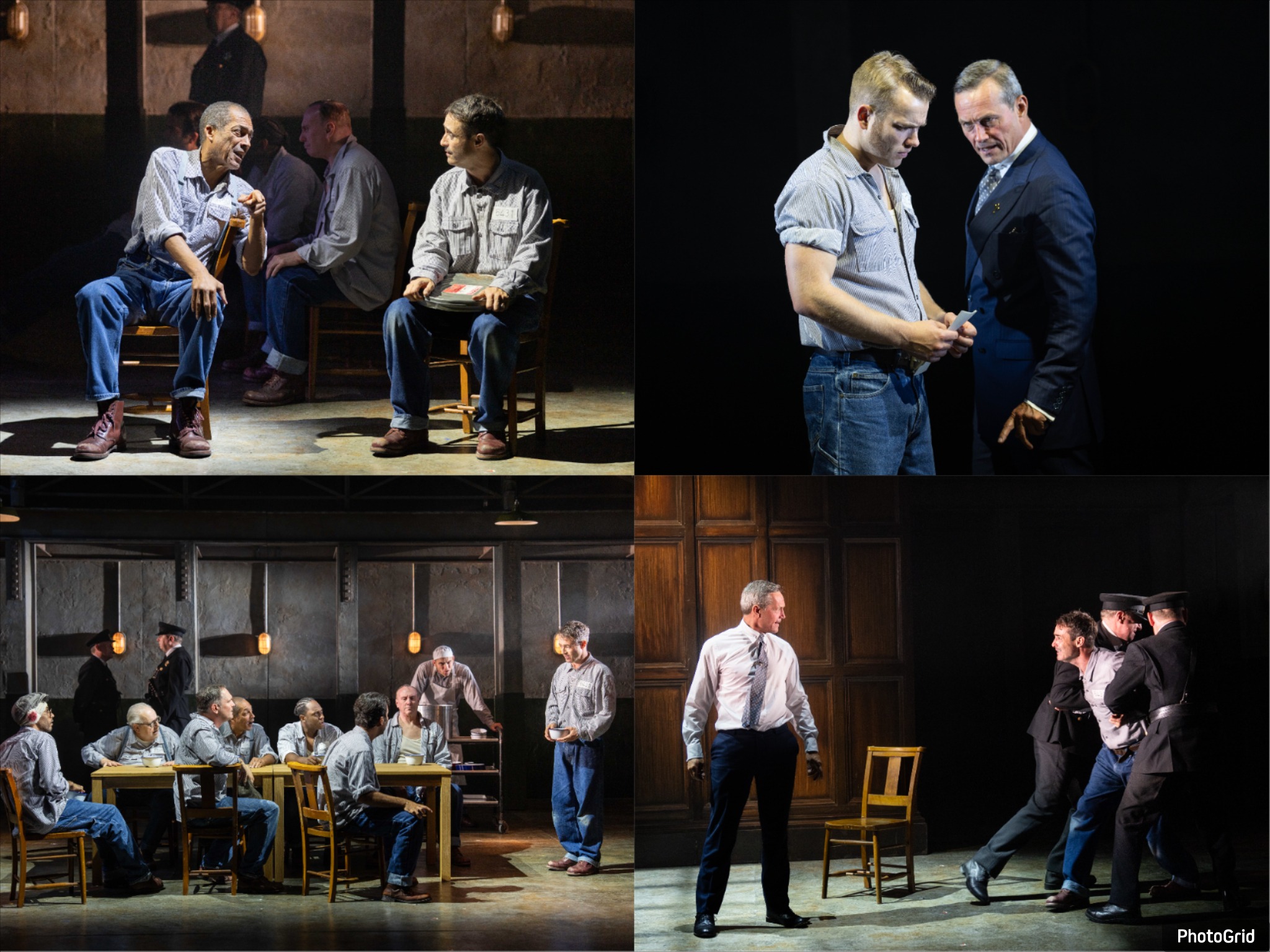
Ben Onwukwe’s Red is a welcome psychopomp for our descent into the hell of prison life. His narration has a genuine earnestness that draws you in and promises a story that will keep your attention rapt. Kenneth Jay’s Brooksie was the standout of the evening, his shuffling, quiet resignation tugging at every string in my heart. When he fears leaving the prison for the wider world, I was desperate for him to stay in his cosy little library, where he is a man of purpose and dignity. Ashley D Gayle’s Rooster has a high-energy menace and a laugh that makes your blood run cold.
Unfortunately, Joe McFadden’s Andy never quite landed for me. Red’s own narration tells us that Andy is a man who carries himself above the prison, whose self-possession sets him apart from the other inmates. The physicality in McFadden’s interpretation reads closer to the opposite: shoulders pulled up, chin tucked, he had a slouching quality that read as shrinking rather than self-contained. In the novella, Andy is underestimated by the other prisoners, a fish out of water whose lack of a troubled background brings him into the prison innocent to its internal rules and caste system. McFadden’s Andy is beyond naive, his mostly unmodulated line delivery arriving wide-eyed and simple. At times he breaks the trance with high emotion, but the schism feels uncontrolled rather than a man nearing breaking point. It’s a performance with its own logic, but I’m not certain it’s the right one for this story.
The adaptation’s relationship with its source material is uneven, and perhaps this is to be expected. The film had liberties a stage production does not, and King’s novella isn’t immediately adaptation-friendly. Still, the production found its successes. Red’s relationship with Andy is more measured at the start, an interpretation that offers more scope to their arc. Additionally, Red is reimagined as a trainspotter, a hobby that collides with Andy’s rock carving in one of the evening’s more poignant moments. At other times, the production struggled. Twenty years pass inside Shawshank, and the grinding horror of those years is, in many ways, the whole subject of the story. The score attempts to telegraph some of this through musical transitions, but there is no sustained visual or dramatic sense of the years pressing down on the characters. I felt the scenes, but I never quite felt the years. I also found myself wondering whether unfamiliar audiences might struggle with a storyline that lacks clear directional signposting—too external to be a personal journey, yet too internal to have dramatic flair.
The Shawshank Redemption is a thought-provoking adaptation with genuine moments of warmth. Fans of the film will find enough of the world they love to make the trip worthwhile, and those who enjoy dissecting the nuances of adaptation will have plenty to chew over on the way home.
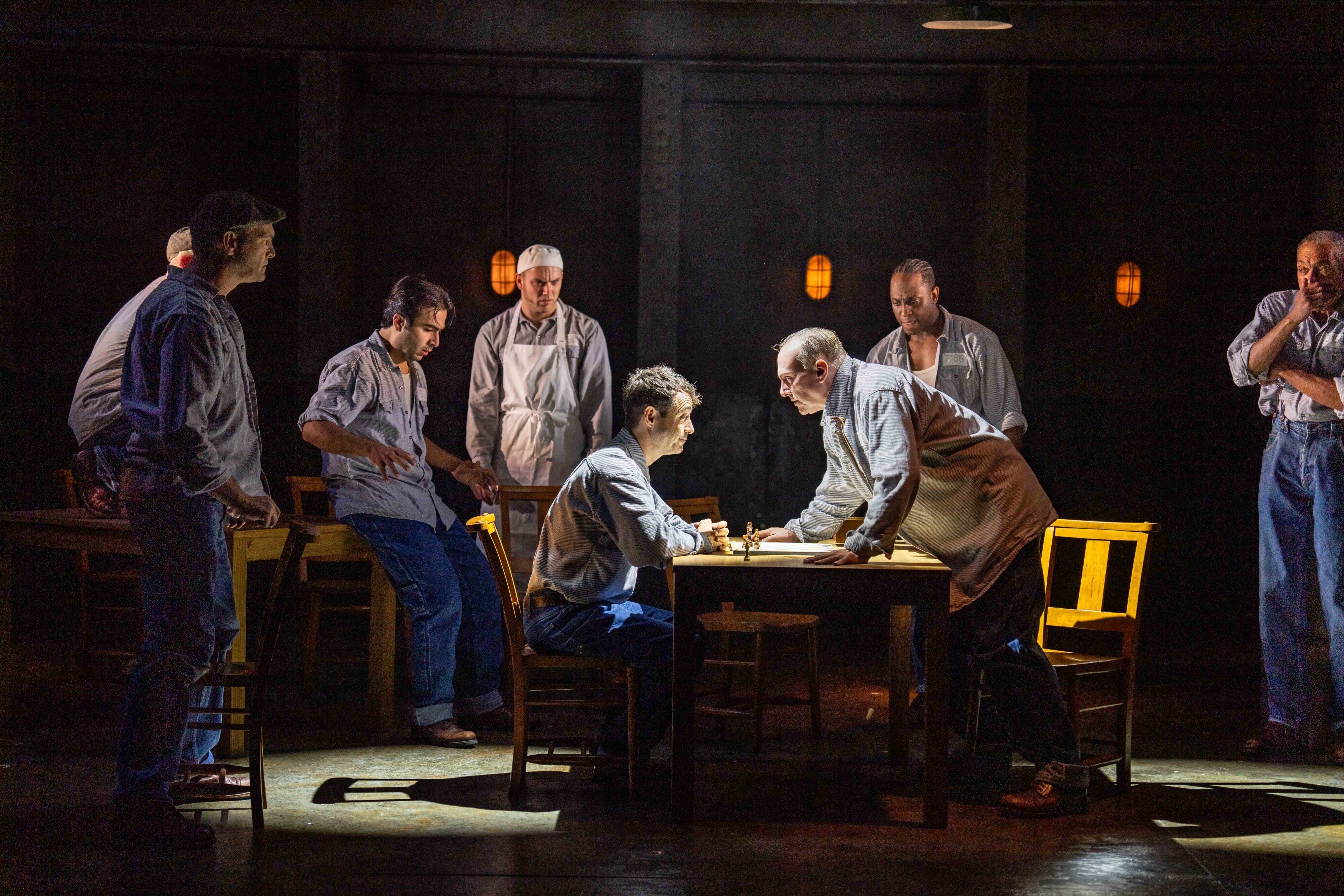
Shawshank Redemption plays at Leeds Grand Theatre until Saturday 23 May. Tickets are available here.
Sean Sable is a Yorkshire-based freelance writer and editor specialising in Young Adult and Horror fiction, frequently at the same time. When she isn’t buried under a pile of books and manuscripts, she is looking for her keys and having extensive one-sided conversations, in Swedish, with her deaf cat. You can find her online at: www.seansable.co.uk
Trending Now
Review: A Christmas Carol at Leeds Playhouse
You may also like