“…big-hearted and musically accomplished…”
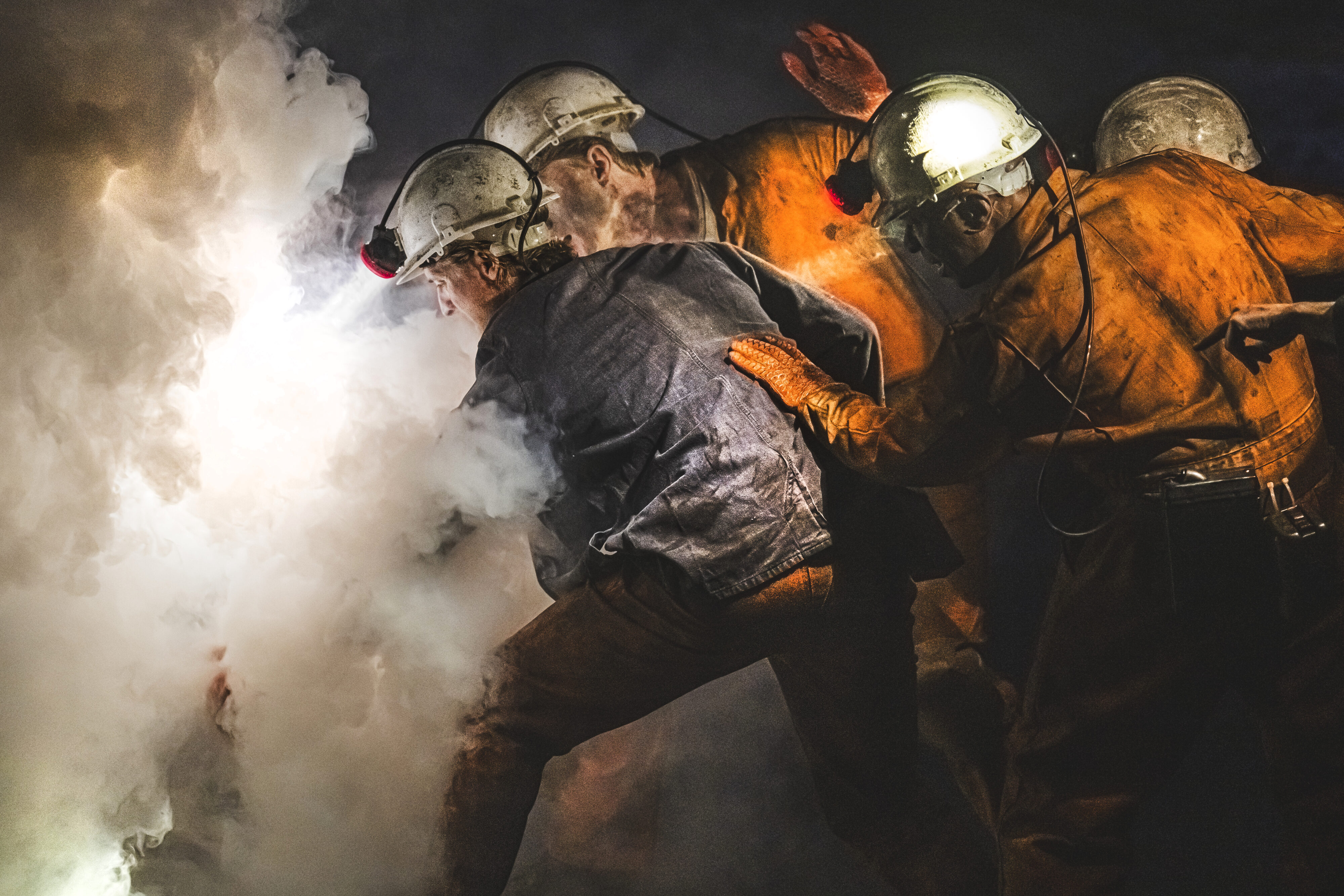
Brassed Off by Mark Herman adapted by Paul Allen, Leeds Playhouse
By Sean Sable
When I was a kid, my older sister was something of a piano prodigy. She could play by ear at six, and would regularly regale people with her ability to parrot back anything she heard, even TV jingles. By eight, she was playing Mozart. Me? I was the younger sister who hung around the piano, perhaps more than a bit jealous of her long fingers and natural gift. I, too, wanted to play the piano. But in a financially stretched household, there was barely space to nurture one budding pianist, let alone her very un-prodigy-like little sister. Instead, when I was ten, I was presented with my grandfather’s trumpet. He was a multi-instrumentalist and professional session musician, and whatever one might tell you about the vagaries of embouchure, he was primarily a saxophonist who also played the trumpet, cornet and a few other shiny things that sat somewhere between the woodwinds and the brass. My very-ungrateful-self sulked away with an extraordinarily expensive trumpet (so valuable my trumpet teacher would swap it out during my lessons) that I absolutely did not want to play.
But over time, it grew on me. I fell into a real rabbit hole of jazz music, fostered by a lovable and slightly clueless trumpet teacher who shared my obsession with Huey Lewis and the News. That love remains with me today and even though I haven’t picked up a horn since my mid-20s, I can still listen to the brass section play for hours. So, when I was asked to review Brassed Off for Leeds Playhouse, I was thrilled by the chance to hear two spectacular bands play alongside a meaningful and moving script that reflects the hardships faced by the North during the 90s.
Paul Allen’s stage adaptation of Mark Herman’s 1996 film arrives at Leeds Playhouse in its 30th anniversary year, directed by Amy Leach. It is an in-house production, and the company is not a small one. We are treated to a selection of musicians drawn from two Yorkshire brass bands, Horbury Victoria and Wakefield Metropolitan. The story is set in 1994 in the fictional mining town of Grimley, where Danny, veteran bandleader and former miner, is fighting to hold his brass band together as the colliery prepares to close. Around him, several stories overlap: his son Phil, whose two-year prison sentence after an earlier strike has left the family barely keeping the bailiffs from the door, and a young miner named Andy, who is falling for Gloria, the flugelhorn player who has returned to Grimley to survey the pit’s viability.
Katie Scott’s set fills the Quarry Theatre’s considerable height with a multi-level steel colliery, complete with gantries, a pit wheel overhead and a shaft elevator below. It is backed by a six-foot wall of coal-black rock that suggests the coalface. I often find myself enamoured by the sets designed for the in-house productions at Leeds Playhouse and Brassed Off reminds me a great deal of Amy Leach’s previous productions: Animal Farm and A Christmas Carol, both of which lean into height and industrial aesthetics. All three productions have this climbing-gym quality to them that offers real structure with a great deal of imaginative diversity. In the case of Brassed Off, it is a deep-boned structure that the story can turn into whatever it needs to be. Lockers wheel in for shift changes. A child’s bed is added to create a bedroom, later morphing into a hospital room. A kitchen rolls out for domestic scenes. Town and pub signs drop from the flies to suggest travel without fuss. Most importantly, benches are brought in for the band rehearsals.
Jai Morjaria’s lighting is layered and dimensional, almost entirely eschewing simple tonal washes. Instead, we are treated to a smörgåsbord of practical lighting, from miner’s helmets to caged industrial lights, with colours that shift to warn us of the danger ahead. Fantastic use of narrower lighting and spots helps carve up the large set into more intimate spaces, and a neutral wash gives a working men’s club feel to the rehearsal space. In a dramatic moment in the second half, the lights cut to black and we are left with only faint backlighting to suggest the pain and horror of the scene. It is one of the most effective uses of near-darkness I have seen in some time.
John Biddle’s sound weaves machinery and dramatic underscore below the brass throughout, and in one of the production’s most emotive moments, Danny puts a record on for his grandson Shane before the sound transfers invisibly into the main system. It is a tiny shift that moves the love of music from something private to an experience shared with the audience. In that moment, we are all Danny’s grandchildren being invited to enjoy the music alongside him.

The cast is packed with top-tier talent and several of the actors are so well embedded with their characters that they feel inseparable. David Birrell’s Danny has a warmth and stubbornness that evokes the energy of a favourite teacher we all knew growing up—the one we wanted to please, and whose respect was hard-earned but meaningful. Robin Morrissey’s Phil left me absolutely blubbering in the second act. His connection to the character is so natural and so well-observed that it felt like watching the life story of someone I’d met before. Danielle Henry’s Sandra absorbs the weight of Phil’s failures with a loving sadness that made my heart wrench. And I must take my proverbial hat off to Stuart Naylor, performing as Shane on the night I attended. He had a natural cheekiness and enthusiasm that reminded me a bit of my own son when he was young.
There were several superb actor-musicians in the main cast, including Frazer Hadfield, whose Andy plays a beautifully worn cornet with impeccable skill (I was genuinely distraught when, in the story, they think he lost it). Maddie Hansen’s Gloria performs the Aranjuez adagio, the flugelhorn arrangement made famous by the Grimethorpe Colliery Band in the original film, on what appeared to be her own instrument: a matte-finished flugelhorn of evident quality. Her solo work is melodic with a rich, almost sax-like smoothness that had the audience swaying. Lead and supporting roles play trombones, tubas and euphoniums. Under Jonathan Mitra’s musical direction, the two supporting bands achieve a subtlety that twenty-odd brass players in an enclosed space cannot always manage, and it keeps the music front and centre without becoming a sound hazard. Of course, none of the primary cast are trumpeters, but I’ll let that clear oversight go.
This production is dedicated to the memory of Duncan Beckley MBE, who helped bring these two Yorkshire bands into the fold for earlier stagings of the script and whose work shaped the version of this show that exists today. There is something very fitting about a band leader being remembered by the music he made and the musicians he inspired, and I felt perhaps a little bit of his energy in the story of young Shane, who represents the next generation of music makers.
Brassed Off is a big-hearted and musically accomplished production that understands, as brass bands always have, that music is never just music. It is everyone who ever played in one, and everyone who ever listened. Book your tickets and be a part of the band.

Brassed Off plays at Leeds Playhouse until Saturday 11 July. Tickets are available here.
Sean Sable is a Yorkshire-based freelance writer and editor specialising in Young Adult and Horror fiction, frequently at the same time. When she isn’t buried under a pile of books and manuscripts, she is looking for her keys and having extensive one-sided conversations, in Swedish, with her deaf cat. You can find her online at: www.seansable.co.uk
Trending Now

Review: Enlightenment at People's Theatre