Tim Foley on jobsworth astronauts, the SETI biscuit tin, and why he doesn’t need Anne Hathaway on the moon.
By Sean Sable
Tim Foley is a Bruntwood Prize-winning playwright whose work has a habit of smuggling big ideas into intimate spaces. Best known for It Walks Around the House at Night and his audio drama work for Doctor Who, his latest project, Life Out There, is a sci-fi comedy about four reluctant astronauts searching for a new planet to call home and whether humanity deserves one. Produced by Ransack Theatre and ThickSkin, the show premieres at The Lowry in Salford on 1 July before a tour that culminates in a one-off live radio drama performance inside the Space Dome at Jodrell Bank Observatory. Sean Sable caught up with Tim ahead of opening night.
For anyone coming to Life Out There without knowing anything about it, can you tell us a little bit about the central story? The title suggests alien life. Is that what the show is about?
You’re right, people might automatically assume that it’s about aliens and discovering alien life, but it really is about the life out there—in space—for four astronauts. They’re on a mission to find a new planet to settle on, and they’re jobsworths. Most of them don’t even want to be there. The story begins with a central dilemma: their boss has gone missing and they’re deciding whether to wait for him a little longer or go home. Obviously, they’re in space and it’s quite a big deal if they were to just abandon him, but they’ve got to think about themselves, their own lives and their own resources. Unusual things begin happening and as the story progresses, we move from something that feels a little like The Office or Parks and Recreation to something quite epic and philosophical.
At its core, it’s a story about what it is like to be removed from everyone, and I think I know where that preoccupation came from. When we were first developing it, we were just out of the lockdowns, and I think we were ready to explore how being so isolated made you walk away a different person. It isn’t a COVID play by any means, but I do think this story might be trying to articulate something about that experience of isolation.
The play deals with the ethics of space exploration and what we leave behind. Where does that sit in the story?
In the play, the astronauts are looking for a second Earth because our planet is in such poor shape that everyone is scrambling to get off. They are out there looking for a second chance. And whilst space exploration can oftentimes be about hopeful discovery, there is also this underlying idea that it could herald a new chapter that is quite frightening. With all the talk of surviving Earth’s climate breakdown by living on Mars—which is likely a little unrealistic and probably never going to happen—it almost feels like we’ve been writing off Earth as a result. And if we do that, new questions arise: what do we leave behind and what do we take with us?
Artemis II came home in April, right in the middle of the show coming together. Did you find that a meaningful herald?
We were delighted when that happened, because the show has been in development for a number of years. And it feels like as we’ve been developing the show, both the science has changed and people’s perception of space travel has changed. I feel we’ve gone through a phase of people being excited about space, and then people thinking space was the remit of billionaires — like Musk or Bezos — and there was something ominous about space. And with something like Artemis II, I feel like we’re coming back around again to that hopeful exploration. It’s just four people, basically, in a tin can going out there. It’s brave and very human.
You say that the show has been in development for years in collaboration with Ransack. Can you tell us about that process?
I really enjoy working with Ransack. They’re kind and creative people, very collaborative in the room, and they’re people I come back to time and time again because we make great stories together. We started with big ideas, big pictures, big gestures, and then slowly filtered it down—sorted the wheat from the chaff, started putting in detail. We’d always wanted to do something a little epic in scope and centred around space, but we weren’t entirely sure where we wanted to go with it. At one point we were joking that we’d just do an adaptation of a Charles Dickens book and whack ‘in space’ on the end. Then we tried some narratives that were more like action movies—really frenetic and fast-paced—and I think a bit of that survived in this final version. But you can’t help it. Being in space is so huge and transcendental that you eventually want to explore how it makes people feel and how they live up there. That’s where the ideas kept pulling us.
The Jodrell Bank date turns the show into a live radio drama. As someone who writes a lot for audio, what does that mean for the piece?
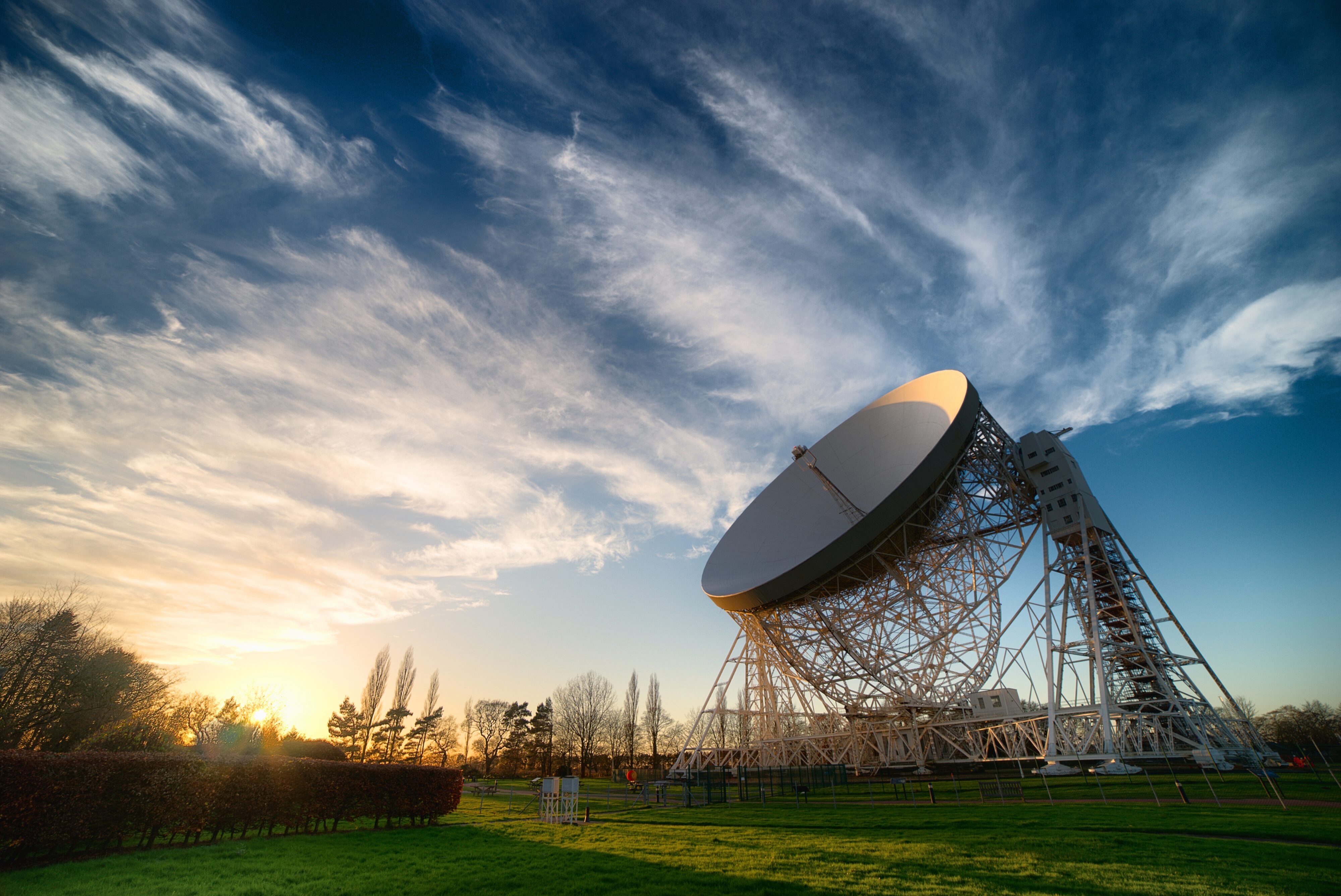
Sci-fi and radio are such a beautiful marriage, because you get to do even bigger things than you thought were possible. And as a big sci-fi nerd, Jodrell Bank is where Tom Baker’s Doctor fell to his death and regenerated into Peter Davison. So, I am over the moon to be doing something there. It’s very cool. We approached them initially as scientists and researchers, because they’re local to us and we were intrigued about looking for habitable planets. Then, they talked about the fact that they love to support artistic stories. So, we realised we could do something quite cool together.
What was it actually like to visit Jodrell Bank during research? That must have been very exciting.
Visiting Jodrell Bank was one of the highlights of the research process. They were like, “Would you like to see SETI?” And I was like, “Oh my gosh, absolutely!” I was picturing giant labs with loads of people in white coats and maybe giant server rooms. Then they just took us to a box, maybe the size of a biscuit tin, with a red light on, and we were like, “That’s SETI.” Of course, computers have moved on and being able to fit SETI in such a small space is an extraordinary achievement and a bit of a fun surprise.
You’ve described yourself as an absolute sci-fi geek. What are the influences that shaped how you think about the genre, and how does that feed into your work?
Of course, I love Doctor Who because it isn’t just sci-fi, is it? It’s every genre. It can be horror, it can be romance, it can be comedy. It can be really experimental in its form. I think it’s quite a true adage that if you grew up watching Star Trek, you went on to become a scientist, and if you grew up watching Doctor Who, you went on to become something in the arts. It’s a show that just demands you be imaginative. And when I do a scene and it’s set in the TARDIS, I’m just like, oh my gosh, it’s happening. Every time.
That excitement to create these science fiction worlds absolutely folds into my work. I love taking ideas from other mediums and putting them through a theatre lens because, yes, we’re doing a big sci-fi epic and sure, we don’t have CGI or Anne Hathaway on an alien moon or Christopher Nolan directing. But you can do far more weird and wonderful things in a theatre setting.
That said, it’s really good that our director is not a sci-fi geek because explaining the concepts to him reminds me not to allow the story to descend into technobabble. That translation process makes sure we keep everything accessible and very human.
Tell us about the four people we’re going to meet on stage.
We’ve got Sophie Steer and she was in one of my very early plays back in 2017, so it’s amazing to be working with her again. Then there is Samuel Gosrani, who actually did a couple of the early workshops with us, and we were smitten with him from the start. Brianna Douglas plays the role of Baby; she’s a gorgeous presence in the room and she’s a local actor, which we love. And finally, we have Alastair Michael, who is one half of Ransack. I’ve written for him before, on Jurassic at the Soho Theatre, and he is one of my favourite people to write for. The four of them are a dream come true for a writer, because they’re really good at helping me hone the script. Any piece of new writing is forever in flux and it’s really special to have such talented voices in the room with you.
Life Out There plays at The Lowry, Aldridge Studio, Salford, 1–4 July; The Engine Room, Wigan, 6–9 July; and Jodrell Bank Observatory (one night only, live radio drama in the Space Dome), 16 July. Tickets are available here.
Sean Sable is a Yorkshire-based freelance writer and editor specialising in Young Adult and Horror fiction, frequently at the same time. When she isn’t buried under a pile of books and manuscripts, she is looking for her keys and having extensive one-sided conversations, in Swedish, with her deaf cat. You can find her online at: www.seansable.co.uk
Trending Now

Review: Enlightenment at People's Theatre
Review: A Christmas Carol at Leeds Playhouse
You may also like