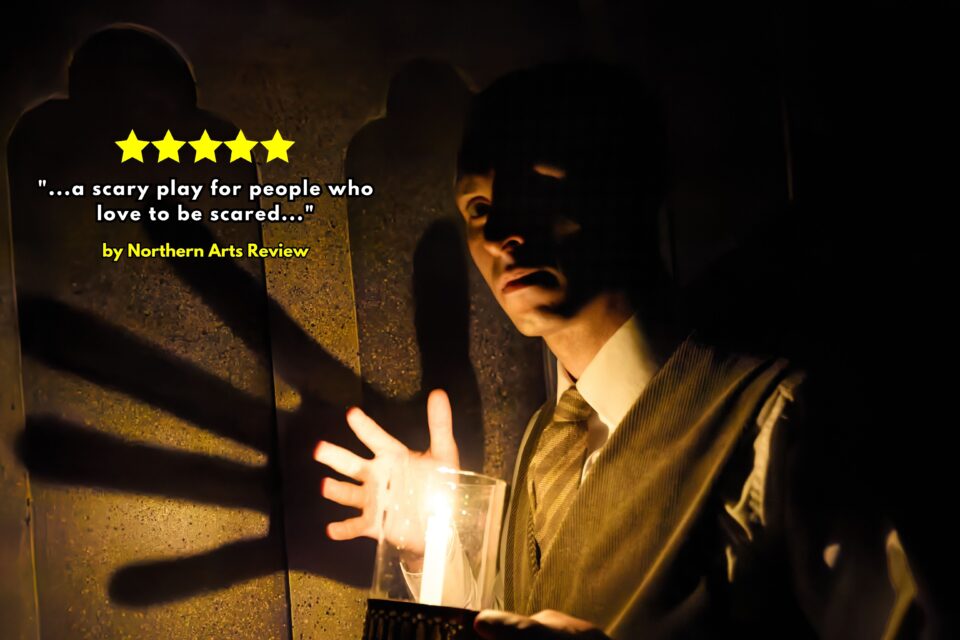
“…a scary play for people who love to be scared…”

The Woman in Black by Susan Hill adapted by Stephen Mallatratt Grand Opera House York
By Sean Sable
Being scared is my special hobby. Some people like to fix cars or take cross-country bike rides. I like to sit under a toasty blanket, with the fire going, and scare the daylights out of myself with a spooky ghost story. And the more gothic, the better. I want drippy candles, moaning houses and things that go bump in the night. When I go to the buffet of atmosphere, I like to take seconds. So it is no surprise that I have read the book The Woman in Black a fair few times, seen the film and have attended previous productions of the long-running play. And you would think that after all that, seeing the play again would be boring or that the edges of the fright might have dulled. But there you would be wrong. The current touring production of The Woman in Black has more than enough chills to tingle the spine of even the most ardent of horror lovers.
The Woman in Black was adapted by Stephen Mallatratt from Susan Hill’s much-lauded1983 gothic novel and holds the distinction of being the second-longest-running non-musical play in West End history. The story follows Arthur Kipps, a solicitor haunted by a traumatic experience from his past, who enlists the help of a young actor (The Actor) to exorcise his demons by staging the events that unfolded at the remote Eel Marsh House. What starts as a kind of therapeutic storytelling exercise gradually transforms into something far more sinister, and the deeper the story goes, the more the vengeful Woman in Black makes her presence known.
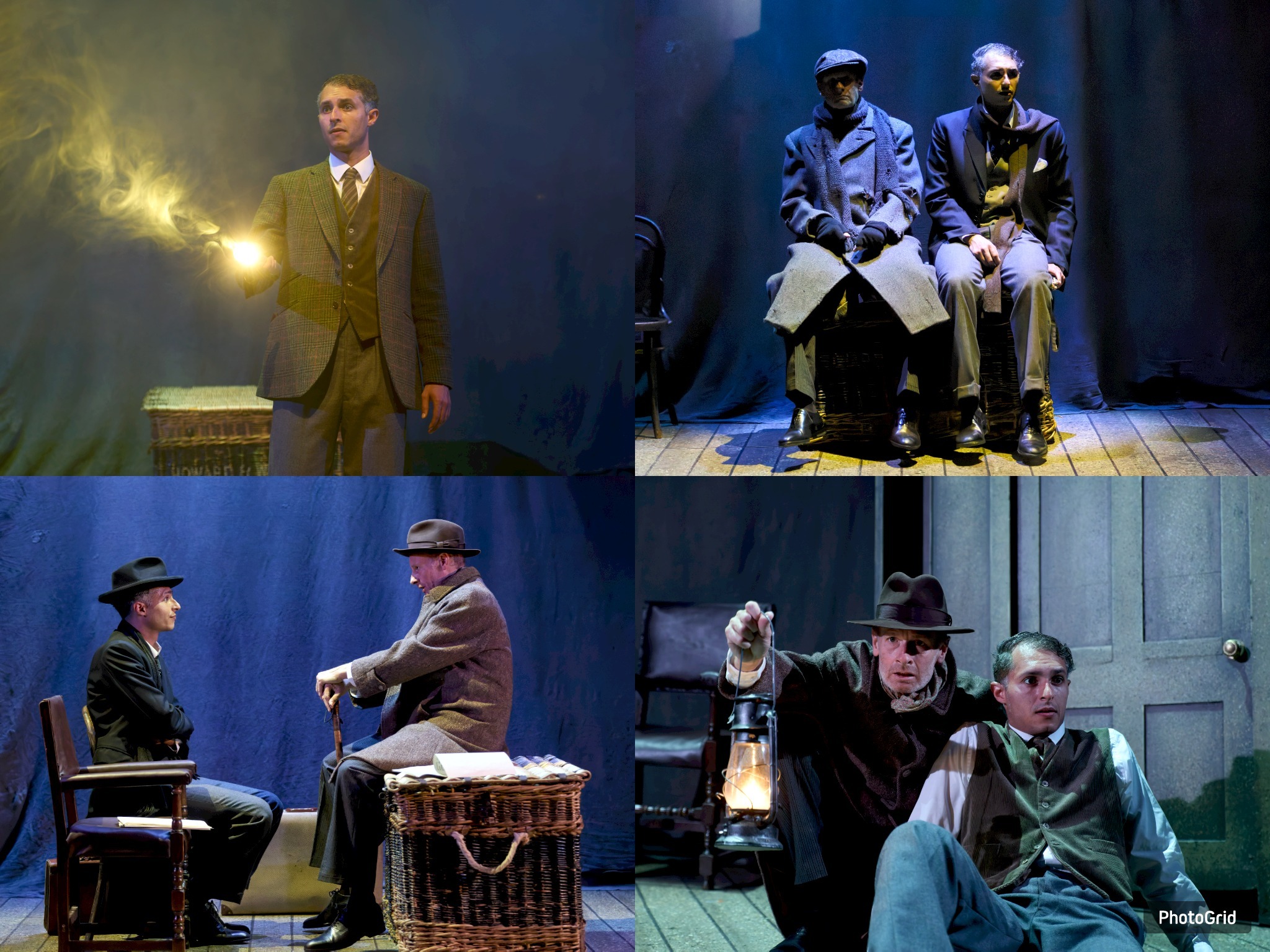
The production is well known for its fairly minimal staging, with much of the play-within-a-play taking place in a theatre rehearsal space. At its core, The Woman in Black understands the concept of “doing more with less.” As The Actor points out to Arthur, stage design doesn’t need complex set pieces to transport you to another world. Instead, just a few props—wicker baskets, a rocking chair, a writing desk—become long causeways and isolated corridors. The same basket that moments ago held costumes suddenly transforms into a pony and trap. This kind of creative gymnastics is one of the joys of live theatre and this production understands how to give just enough to suggest a scene and then sit back and let our imaginations do all the work. Why scare us with tricks, when we can scare ourselves?
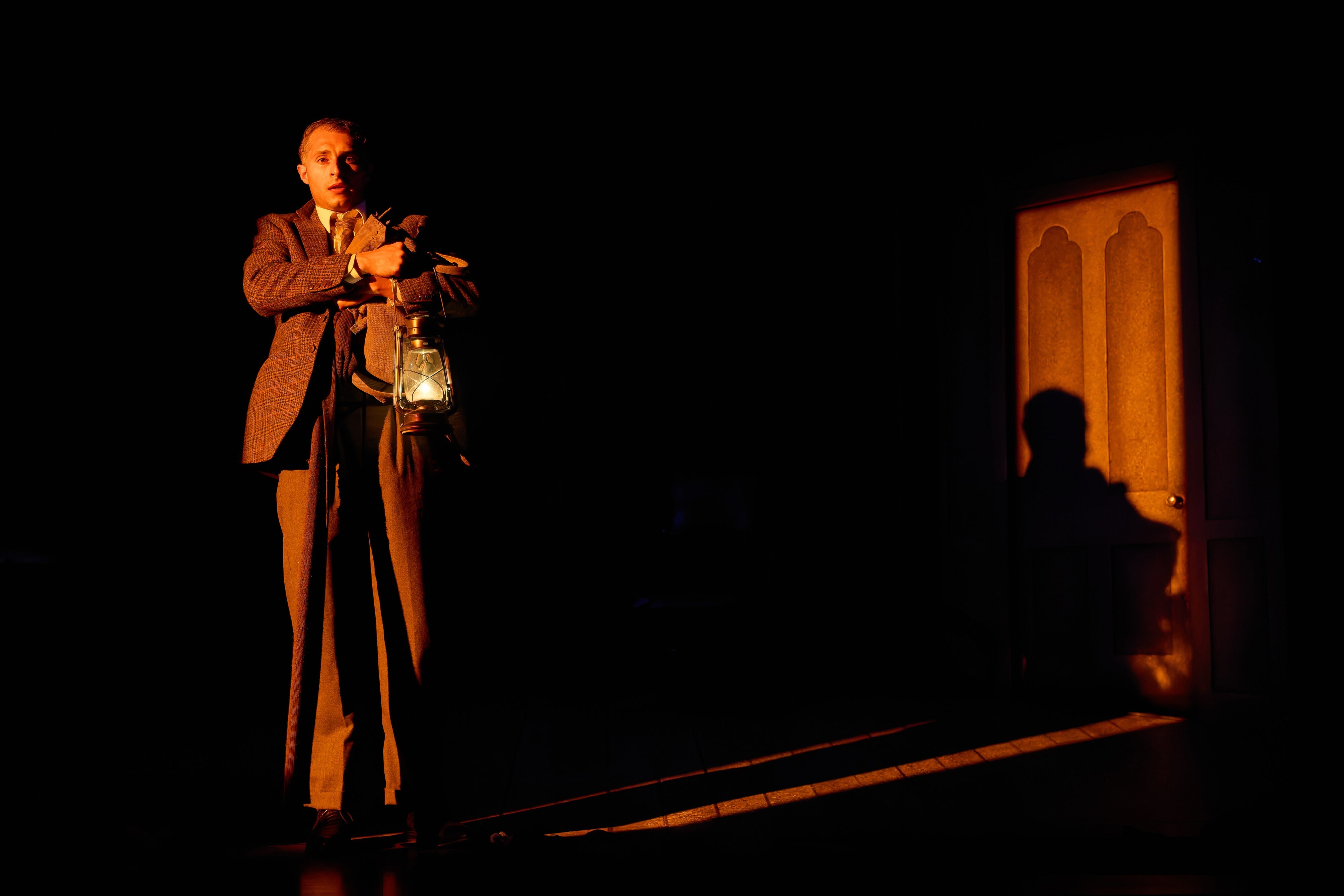
One of my biggest takeaways from the night was the sense that this was not, as one would think, the two-hander that we are sold. No, there was a sneaky third actor—the lighting. I am hard-pressed to remember a time when so much care went into creative lighting techniques. They did so much heavy lifting in every scene. We begin with the house lights up and a neutrally washed stage. Then, as the story deepens, the house lights dim, the lighting narrows and the shadows begin to take shape. Then, the real fun begins as the lighting carves environments out of liminal spaces. A cross projected on the back wall and the shape of a stained-glass window projected on the floor become a church. The dappled light of a tree becomes a graveside. The flickering of a hurricane lamp stretches shadows like the fingers of Nosferatu. And as all good masters of horror know—it isn’t just about what you do with the light. It’s what you don’t do. Plunged into near-complete darkness, the audience came alive, anticipating the fear that awaited when the lights came back on.
And what good is mastery of light without a firm grip on sound? In the play, The Actor introduces recorded sound and explains how sound effects and atmospheric background sound can transport the audience to a new time and space. Of course, the production practises what it preaches, offering a rich world of sound that firmly settles us in Crythin Gifford and the haunted halls of Eel Marsh House. There is a common trend in modern theatre to move away from immersive sound effects. I find this to be a pity and productions like this are excellent examples of why audiences deserve fully-realised soundscapes. The creak of an empty rocking chair or the clip-clop of steps up a lonely staircase completely changes our sense of safety. And, as importantly, sound is also about silence. Knowing when to cut the sound entirely and leave the audience to their own devices is an art this production has mastered.
The two actors at the heart of the play were absolutely top calibre. Daniel Burke as The Actor brought a fantastic sense of delicacy to the younger Mr Kipps. It is a role that demands a kind of boyish fragility—a sense of being unwise to the dangers ahead—that heightens the dramatic irony. With youthful exuberance soon replaced by soulful eyes, Burke carefully dimmed his character’s shine at just the right tempo. John Mackay, playing Arthur Kipps, was an absolute chameleon. Watching him go from a character who self-proclaims that acting is “not his forte” to suddenly shapeshifting into multiple characters with different physicalities, accents, and mannerisms was incredibly impressive. The costume changes were minor, often just an apron or a small adjustment, but the resulting transformation was instant. The play is devoid of constant verbal signposts telling us who he is playing so we have to understand instantly when he moves from one character to the next, which he executed flawlessly.
I want to avoid giving away details of how the spooks and frights are staged, because it is a play that is best experienced without expectation. But it is worth saying that, despite knowing the story as well as any sane human should, it still frightened me (and most of the audience, if the screams and nervous laughter are anything to go by). The Woman in Black is a scary play for people who love to be scared, so bring a friend, or two, to keep yourself safe in the dark.
The Woman in Black plays at Grand Opera House York until Saturday 17 January. Tickets are available here.
Sean Sable is a Yorkshire-based freelance writer and editor specialising in Young Adult and Horror fiction, frequently at the same time. When she isn’t buried under a pile of books and manuscripts, she is looking for her keys and having extensive one-sided conversations, in Swedish, with her deaf cat. You can find her online at: www.seansable.co.uk
Trending Now

Review: To Kill a Mockingbird at Leeds Playhouse

Review: Night Collar at St Helens Theatre Royal
You may also like