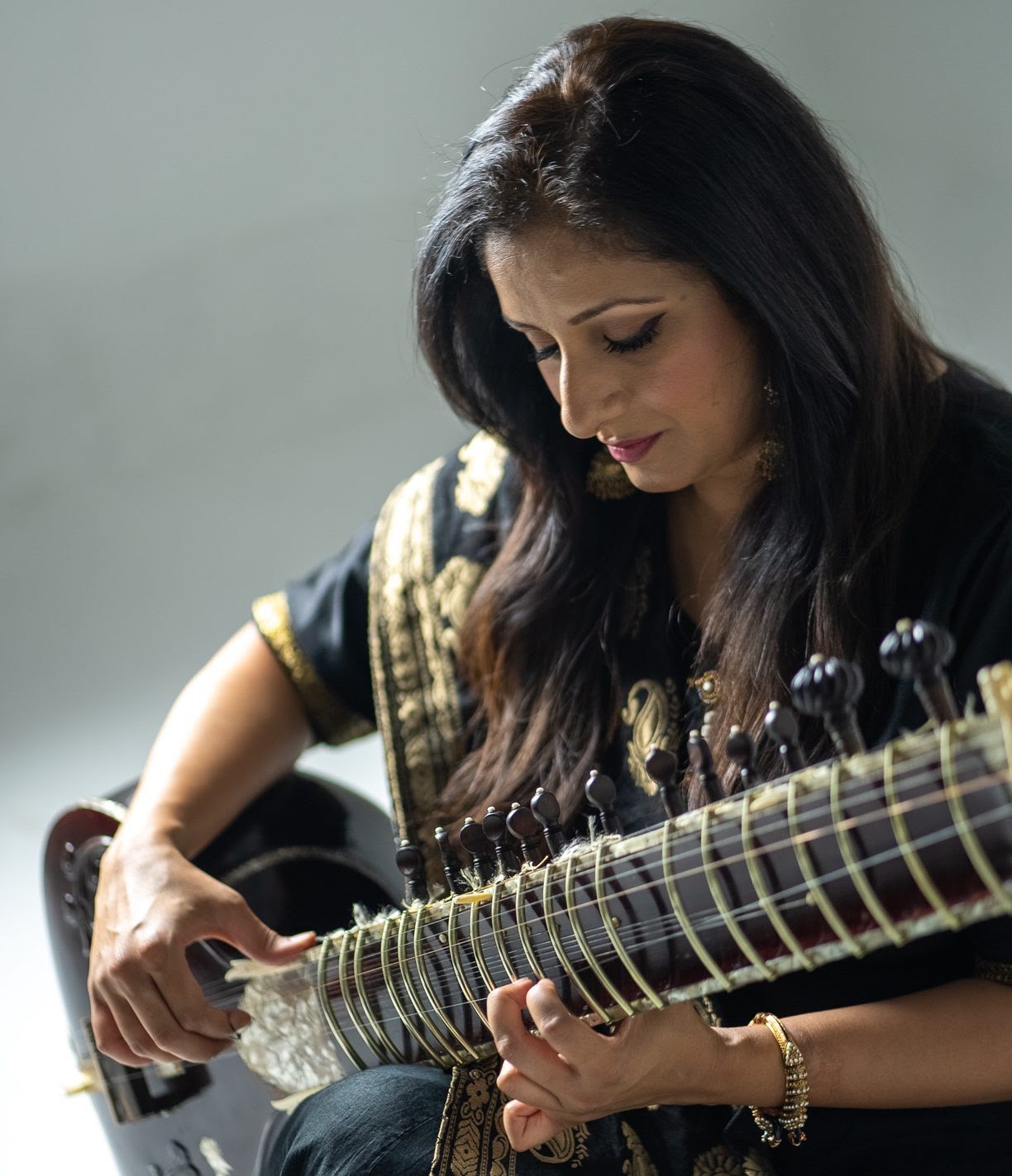
Sitar virtuoso Roopa Panesar on her lifelong love of Indian classical music, her latest concert and how she changed careers from chemical engineering to music.
By Ken Powell
Northern Arts Review Chief Editor, Ken Powell, jumped at the chance to chat with renowned sitar virtuoso, Roopa Panesar, having had a passion for Indian classical music for more than 30 years and playing the sitar himself – albeit badly, as he confesses to anyone who will listen. Ken bent Roopa’s ear about the problems with backache preventing him from playing the sitar regularly and better (that’s his excuse and he’s sticking to it). Then Ken finally settled down to talk about Roopa’s classical music background, her views on how the style is doing today and her forthcoming concert at the Tung Auditorium in Liverpool on Friday 27th November.
Roopa is one of the few women to perform on sitar on equal terms with men who traditionally dominate this style of playing. Even though music wasn’t her first career, Roopa has collaborated with Mercury Prize winner Talvin Singh and the Belgian Symphony Orchestra, and graced the stages of WOMAD UK, Birmingham Symphony Hall, Bristol Beacon and London’s Darbar Festival of Indian Classical Music and Dance.
Ken Powell: You were born in London but raised in Leicester where you started learning the sitar. Was musical tuition something you wanted at a young age or was it the expected thing to do?
Roopa: I was trained in the Ustad Vilayat Khan style of sitar, and one of his students, Ustad Dharambir Singh (MBE), just happened to live in Leicester. When I was seven years old, I started learning from him. It was actually something that wasn’t originally my sort of wish as you might say. It was more a case of parents trying to get me playing a musical instrument. The sitar was one that I was drawn to and I went to learn from him. My teacher just saw that I naturally sat with the instrument and was quite keen on playing it. So he was happy to teach me further.
KP: I presume that, if you were just seven years old, you must have been playing a kind of mini sitar? They are big instruments for anyone, let alone a child!
Roopa: That’s right. It was actually almost a full-size sitar. I’m quite tall, so this was probably advantageous at that time, as a child. Normally, it’s a little hard to teach children because of the size of the instrument. Now you can get smaller, quite well-made instruments. My teacher was a bit dubious at the time, but then he saw that I was handling it okay. In the initial stages of learning, that is very much the most important thing: sitting and handling the instrument. As you know, Ken, it’s very physical, isn’t it? Neck problems, back problems – it all comes with the territory, unfortunately. After you hit 30, it all seems to kicks in!

I learned from him regularly and quite rigorously. It was part of a very unique thing that was happening in Leicester, where Indian classical music was being taught to children in schools as part of this system of peripatetic teaching at that time. This was in the late 80s, so it was new at that point.
I was very much into it. We would perform and do showcases, and my interest was developing. Later on, I was also introduced to some of the masters who were visiting the country. Every time they were doing concerts, we had the opportunity to go and just be in the atmosphere.
Life has gone on since then and I’ve been playing, performing, learning all that time – and now teaching as well!
KP: I get the impression from biographies of you online that you trained as a chemical engineer and then seemed to just immediately say, “No, I’m going to play sitar instead.”
Roopa: Yes, well, it was fairly soon, to be fair. I did indeed actually go to university and qualify as a chemical engineer, and then I worked in industry for a couple of years. I then had my daughter and somehow during maternity leave, lots of music and concert opportunities were simply opening up for me, so the transition to becoming a full-time musician just happened naturally.
KP: And it was never a thought for you to just go straight into music and not do the whole degree thing? That wasn’t an option originally?
Roopa: Not really. I’ve had tremendous support from my family, which was essential for me to tread on this path. I wouldn’t have been able to do all of this without the support because I didn’t come from a musical background as such. My parents love this music, but when they were children, they were never encouraged to do it because it wasn’t deemed a fruitful career in any sense. So, it was a passion for them and they wanted their children to get into music.
But, on the side, we were very much encouraged to do a mainstream education as well, something that could cover the earning aspect of life. So, for that reason, chemical engineering happened. But if I look back at it, I think it feels like madness. There’s not much about me that’s a chemical engineer, really!
KP: There are other degrees you could have done. Chemical engineering is quite a hard one to go for!
Roopa: Yeah, that’s right. Looking back, there could have been plenty of degrees that could have helped my path as a musician. Music technology! I don’t know, something like that. But I would say I’ve almost fallen into a musical career. It just became the direction at that time and then I didn’t look back. There was so much musical opportunity coming my way and I was really absorbed in different projects and all sorts of performing.
KP: I always feel very much a cheater when I perform on the sitar because I know enough about music to know I play poorly, but I’m very aware that the traditional Indian way of doing things is that you have about 20 years of tuition before you’re allowed to give your first performance. Was it anything like that for you? Or was there a point where you actually stopped tuition and you were playing independently?
Roopa: That’s an interesting question, because I would say that the training is still continuing. It’s kind of a lifelong process in Indian Classical Music. My guru and I both happen to live in Leicester, so it’s amazing. I’m so fortunate I get to spend time with him and I’m still always learning by just being in his presence. The shape of how that learning happens can look quite different now – it might be discussions of ideas or sharing new thought processes and insights.
This is music that develops as you mature. Life experiences, thought processes and depth which happen as we mature just add to this music. Indian Classical music is based on ragas, these melodic frameworks, and your perspective and your vision of these change, I would say, as you go through life.
My training probably looked a little bit different because, not being in India, I didn’t have this rigorous training for a certain amount of time and then being presented on stage, as you mentioned. I was having rigorous training, but my teacher was also very encouraging of the idea of getting children on stage and performing and getting stage fright out of the system at an early stage.
Performance is also a means to progress, because when you prepare for a performance there’s so much development that goes on in having to present. So, my teacher was very keen for that to happen for his students. We probably got on the stage earlier than we needed to, but it’s helped.
KP: From the PR material and information about you, it sounds like you took a real interest in jazz as well. Is that part of your music generally?
Roopa: I’ve collaborated with some wonderful jazz musicians. I’m not trained in jazz per se, but there is certainly an ease with which jazz musicians and Indian classical musicians can come together and work, because of all the improvisational elements.
I have worked mainly with jazz musicians who have trained in Indian classical music such as Jesse Bannister, Giuliano Modareli and Al McSween. In fact, some of my recent works “The Crossing” and “ATMA” have included some of these amalgamations of sound worlds.
KP: So you’ve not been bluesing away on the sitar, though, or anything like that?
Roopa: We have had fun in jam sessions on occasion!
KP: I’ve often bluesed away on the sitar – probably to the horror of my former teacher – and knocked out a blues riff and things like that, because I do have some training in jazz from my days of doing a music degree.
Funnily enough, my first introduction to Indian music came those days as well. At university, we did a world music module, and the lecturer there played Raga Lalit on the first day. That remains my favourite raga to this day. I instantly know it when I hear it, and I fall magically in love with it all over again. There was just something about it that, as soon as the notes started playing, I thought, I know I don’t understand anything about this music and I know nothing about it, but I absolutely adore this sound. This is moving my soul and has remained with me ever since.
So both the Indian music and jazz came at the same time for me, really.
Roopa: Wow. Yes, the depth is there in common, isn’t it? Interesting, because Raga Lalit has that little chromaticism in there as well, which probably could lend itself a bit towards a jazz treatment.
KP: Yes, though I’ve also discovered, for some reason, I can’t play it on sitar! It seems like it’s quite a complicated raga to learn, to be able to handle the notes correctly, whereas I can handle the more basic ragas. It turns out that the best thing I can do is just listen to Raga Lalit rather than try and play it.
Okay, so you’ve collaborated with jazz musicians. What about other styles of music? Have you just remained purely in that North Indian tradition or do you venture out into other styles?
Roopa: I would say that my inherent passion and focus is on the pure form of sitar playing in this style. I love it and I will always love it. I remain devoted to that.
But yes, along the way, I’ve enjoyed collaborating with lots of different styles. There’s jazz. I’ve worked with orchestras. I’ve worked with other North Indian Classical and South Indian musicians and some of this collaboration culminated into my last album “ATMA (The Soul)” which was an album reflecting emotions of love, loss, separation and gratitude.
Sitar has always lent itself quite well to collaboration, I would say. Whilst I’m very interested in it and I love working with musicians from other styles, I am also deeply rooted in the traditional classical style.
KP: How then do you feel about crossover styles? If we go back to thinking about George Harrison with the Beatles and probably first introducing the sitar to Western audiences in any kind of large-scale form back in those days. Was this good for the classical world or a bad influence?
Roopa: You know, when it’s done well, I love it because I’ve heard the sitar appearing even in pop music or R&B music. I think it enhances something and adds something and you may think “Wow, I wasn’t expecting that. I didn’t even know my ears could enjoy that.”
So I think it can be beautiful. Everybody loves to hear new sounds and sounds/cultures coming together. We have to thank the Beatles and Pt. Ravi Shankar for doing those collaborations. Everybody may have different feelings about it, but the point is that they introduced that sound to the West, as you say, where people had no idea what these instruments were. Because of that, it opened doors for Indian classical musicians or Indian music in the West, and so that’s been awesome, really.
KP: What is the state of Indian music in the UK today? Obviously, you’re right in the thick of it and I’m aware there’s lots of different things going on, like encouraging young people to play in the Indian tradition and so on. Is the style alive and well or is it an ongoing battle to introduce people to this music?
Roopa: I think that it’s doing really well. My generation would have been the first generation to learn in this country and become performing musicians.
I would credit my teacher, Ustad Dharambir Singh, for a lot of the work that he’s done in bringing Indian Classical Music to the UK. He’s trained many musicians who are now international performers. This has all happened outside of India which is fairly groundbreaking.
There are now major festivals and organisations for Indian Classical Music in the UK and people feel really excited to attend these and be a part of them.
KP: Do you play any other instruments or did you stick to the sitar?
Roopa: Well, sitar is probably one of the most difficult instruments to play so I have dedicated my life to it.
I do also play some surbahar, which is kind of a bass version of the sitar. So it’s played in a much deeper, more meditative way.
KP: I’m surprised to say you don’t play the tabla as well because I always feel like, with musicians in the Indian tradition, the tabla is an instrument everyone has to know. Somebody’s got to play it when everybody else in a group is playing some other instrument. So everybody learns it so someone can always bash out a tala when needed!
Roopa: It isn’t necessary for me to play tabla but certainly to have good knowledge of rhythm as a significant part of this music is based on rhythmic time cycles and the ability to improvise within time frames which are usually held down by tabla.
KP: You have a concert coming up which is at the Tung Auditorium, I do believe, in Liverpool. What can your audience look forward to? What’s this concert all about?
Roopa: Well, we’re presenting a sitar recital in quite a traditional form. I’m going to be accompanied by the outstanding tabla player, Kousic Sen.
It’s a very meditative experience to come to an Indian classical performance. I’ll be presenting ragas which are played in the evening and the late evening, because all ragas evoke different emotions. They’re designed to be played at different times. There are different seasonal ragas as well.
I’m going to be presenting some of the tradition. It’s a very festive time. Diwali, the major Indian festival, has just occurred and this whole month is quite festive. Then we move into Christmas. So I think there’s a very special feeling in the air.
I’m looking forward to being in that auditorium with everybody and sharing this music.
KP: How long will the concert go on for? What’s the estimated time for it?
Roopa: I think that we have two halves, probably about 45 to 50 minutes each, something like that.
KP: No three-hour ragas then!
Roopa: I don’t think the venue will allow it! Ha-ha! We are ready to do it but maybe we will present some different flavours of this music this time.
KP: Will there be something there for people who have never experienced this kind of music before? Will somebody who’s just thought, “I’ll go to this concert. I don’t know anything about the sitar, but I’ll go and see,” be able to get something from this? Will they be able to understand it, in your opinion?
Roopa: I think, more than understanding, it’s more about feeling it, and there will be something there for everybody.
The fact that somebody’s new to it and they’ve come already means that they’re already open enough to experience it and feel it. So I would just invite everybody to be open. Keep that openness and we’ll go on the journey together.
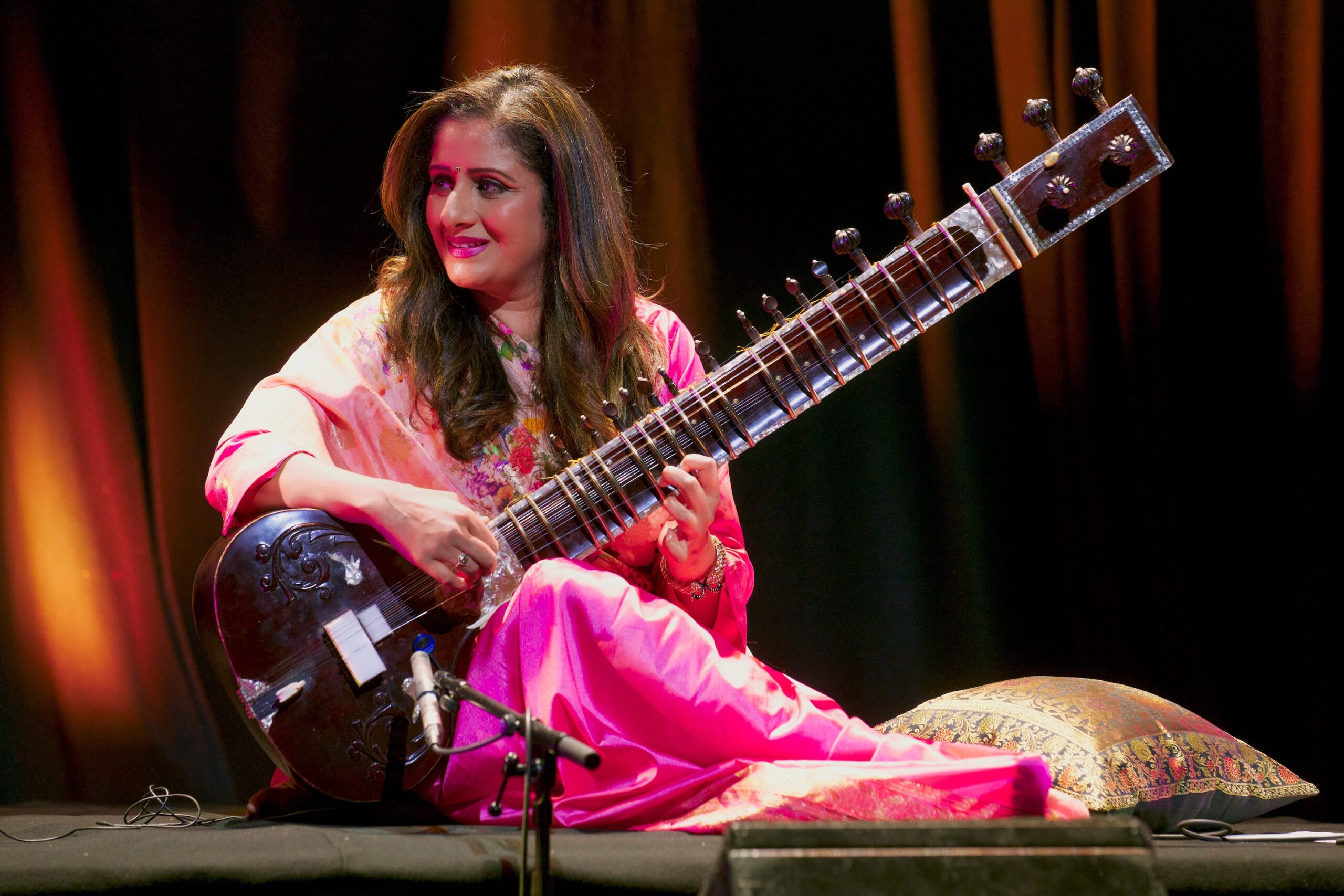
Roopa Panesar performs at The Tung Auditorium on Friday 27 November. Tickets are available here.
Ken Powell is chief editor for Northern Arts Review and is also a bestselling author and writer for various publications around the world. A former school teacher, he continues to write educational books along with fiction and travelogues. You can find all his books and various websites here including his popular TEDx talk about the Global Village. He lives with his family in a wonderfully isolated village in West Cumbria where he enjoys drinking tea, chatting with the birds and winding up his dog. You can support his work (or just buy him a coffee) here.
Trending Now
Review: A Christmas Carol at Leeds Playhouse

You may also like