“…poignant and emotionally challenging…”

Punch by Jacob Dunne adapted by James Graham Leeds Playhouse
By Sean Sable
I don’t often love talking about my home life growing up because it doesn’t fit comfortably into the tropes. For my early years, we were poor. Very poor. Making tomato soup from ketchup packets poor. But my teenage years were marked by the veneer of lower-middle-class stability, and that always makes things a bit messy. My change in circumstances still left me poor, but a kind of poor that doesn’t always look like poverty. Instead, it looked like the kind of home where the adults had their own problems and the kids mostly (okay… always) worked it out for themselves. And there was this stretch of my teenage years where I spent far too much energy trying to impress the wrong people. I was in chaos and I was looking for the “security” of more chaos.
Fortunately, I got out. A few good teachers and a friend or two made sure I made it to university and landed on my feet. But I very nearly didn’t, and sitting in Leeds Playhouse watching Jacob Dunne’s story unfold, I kept feeling an uncomfortable proximity to it. Not the violence (that was rarely my kind of chaos) but the logic of it. The way a kid who starts life happy and secure can slide into a version of himself that even he doesn’t like, and how that slide can happen with a speed that looks, from the outside, like a choice—like a punch.
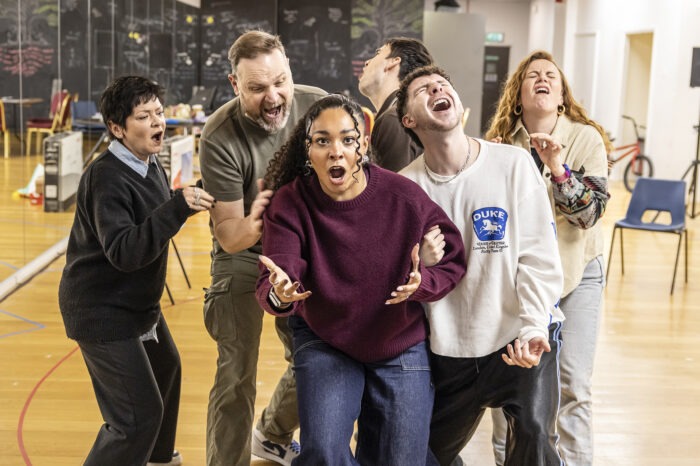
Punch is James Graham’s adaptation of Jacob Dunne’s memoir Right from Wrong, directed by Nottingham Playhouse Artistic Director Adam Penford and produced by Nottingham Playhouse in association with KPPL Productions, Mark Gordon Pictures, and Eilene Davidson Productions. Back home at Nottingham Playhouse this spring following a journey that took it to the Young Vic, the West End and Broadway simultaneously, it returns with an entirely new cast before transferring to Plymouth, and arrives carrying four Olivier nominations. Punch tells the true story of Jacob, a teenager from the Meadows estate in Nottingham, who grew up navigating the pressures of the “aspirational working class”, an unsupported AuDHD diagnosis and a social hierarchy that placed violence at the top. On a night out in the city, he threw a single punch at a stranger. James Hodgkinson, a 28-year-old trainee paramedic, died nine days later as a consequence of that punch and the resulting fall. Jacob served fourteen months in prison, having pleaded guilty to manslaughter. What followed was not what anyone might have predicted: James’s parents asked to meet him as part of the restorative justice programme, seeking answers that the criminal justice system never gave them. The play is dedicated to James Hodgkinson and all victims of one-punch violence.
Anna Fleischle’s set is a homage to the banality of urban infrastructure. At the top of the mostly circular structure, a crescent of graduated concrete steps curves up to a railing; a pedestrian underpass tunnel runs through the centre. Looking like a cross between a skate park and a 1960s government building courtyard, it is the liminal bric-a-brac of city life. The backdrop displays a lightly painted cityscape that disappears into the darkness when not illuminated. On the floor below, we see another, fainter cityscape painted in muted greys similar to stone tiles. The city—Nottingham—is everywhere. Above, below, around, cinching tight at every turn. It represents a system they are all trying to live inside and perhaps to outrun.
The near featurelessness of the set allows for a wide variety of reinterpretations. It can become the homes in the Meadows, the sharing circle of a support group, or the imposing walls of a prison. With hardly any furniture, the production relies almost entirely on stagecraft to sculpt a sense of place, and Robbie Butler’s lighting does a significant portion of that transformation. As a lover of good technical craft, I must admit to having pages of notes on all the clever techniques Butler used—stadium overheads for the cricket match, dancefloor colours bleeding into police searchlights that sweep out across the audience seating, the city windows lighting up and peering down, observing the transgressions of the world below. The lighting expands and contracts in synchronicity with both movement and sound so that scenes feel as if they float from space to space without a hint of friction. One of my favourite moments of the production happened when Jacob found himself incarcerated, seated on a plastic chair, stripping naked in a single sliver of light. There was so much isolation, fear, judgement and reflection in that narrow beam.

The sound design and composition by Alexandra Faye Braithwaite works in close conversation with the lighting. The diegetic sounds of pubs and nightclubs give way to a tonal underlying score, sometimes droning, percussive, humming. It sits beneath scenes without ever truly becoming a traditional soundtrack. The attention to detail was magnificent and when James’s mother replayed a voicemail from her son, it was modulated to just the right “overheard” volume that twisted into your chest.
The costumes, designed by Fleischle alongside the production, are invisible in exactly the right way. Adidas zip-fronts, grey trackies, “fancy” polo shirts with a slightly popped collar, thick chain necklaces, jeans. These are the people I grew up around, perfectly observed, never wandering into “hello, fellow kids” territory.
Jack James Ryan as Jacob carries the first half of the play in an almost continuous monologue that has the rhythm of spoken word poetry without quite committing to metre. His words sit at the juncture between urban cadence and stream-of-consciousness, with a propulsive quality that is impossible to look away from. The whole cast of six plays somewhere between two and four roles apiece, and the transitions are fluid enough that I could have sworn six was twelve. Finty Williams as Joan, James’s mother, is my particular standout. There’s a cardigan-tugging, heartsore quality to the way she plays the role that I recognised both as a child and as a mother myself. Matthew Flynn’s David has a more contained grief. There’s a moment in the restorative justice session where Jacob spills water and David simply mops it up and refills the cup in silence. The entire audience shifted in their seats at the discomfort of recognising the mundanity of grief.
Although the emotional connection of the cast to their characters was undeniable and the performances were excellent, some of the accents needed tweaking (and a good map to locate the Trent and the Pennines). It is a small niggle, but in a production this rooted in a single place, I found it occasionally distracting.
For most of the performance, the pace steams along like a freight train heading straight for a collision. Later, when Jacob is released from prison, we get a quietness that feels as if we are taking a breath. The pace is slower, more deliberate, allowing us to be thoughtful. This is so important in a play that wrestles with such weighty themes and trauma (please do check the trigger warnings before going). We need this space to grapple with our own complex emotions. We wonder if we could be like Joan, James’s mother, and find it in ourselves to forgive. Unfortunately, it is in the final act that I struggled just a little with the pacing. As Jacob’s redemption is mapped out step by step, it loses some of the storytelling elegance that precedes it.
I’m never going to lie to you—I cried like a baby throughout much of the play. I cried for James’s death, his parents’ grief and for the senselessness of the tragedy. I also cried for Jacob and the slow unravelling of his life and his family. And finally, I cried because I know, in my bones, how thin the line is between descending into chaos and finding a way to look outward and find something better. Punch is a poignant and emotionally challenging story that examines the intersection of loss and compassion and asks us if we are ready to forgive.

Punch plays at Leeds Playhouse until Saturday 11 April. Tickets are available here.
Sean Sable is a Yorkshire-based freelance writer and editor specialising in Young Adult and Horror fiction, frequently at the same time. When she isn’t buried under a pile of books and manuscripts, she is looking for her keys and having extensive one-sided conversations, in Swedish, with her deaf cat. You can find her online at: www.seansable.co.uk
Trending Now

Review: To Kill a Mockingbird at Leeds Playhouse

Review: Night Collar at St Helens Theatre Royal
You may also like