“…gripping to the end…”
A Doll’s House by Henrik Ibsen adapted by Chris Bush, Crucible Theatre
by Phil Scown
It was with some trepidation that I travelled to The Crucible for ‘A Doll’s house’. With a running time of 2hrs 50 minutes (including interval), would the post-Dickensian language make the play drag? Would it have anything to say in 2024?
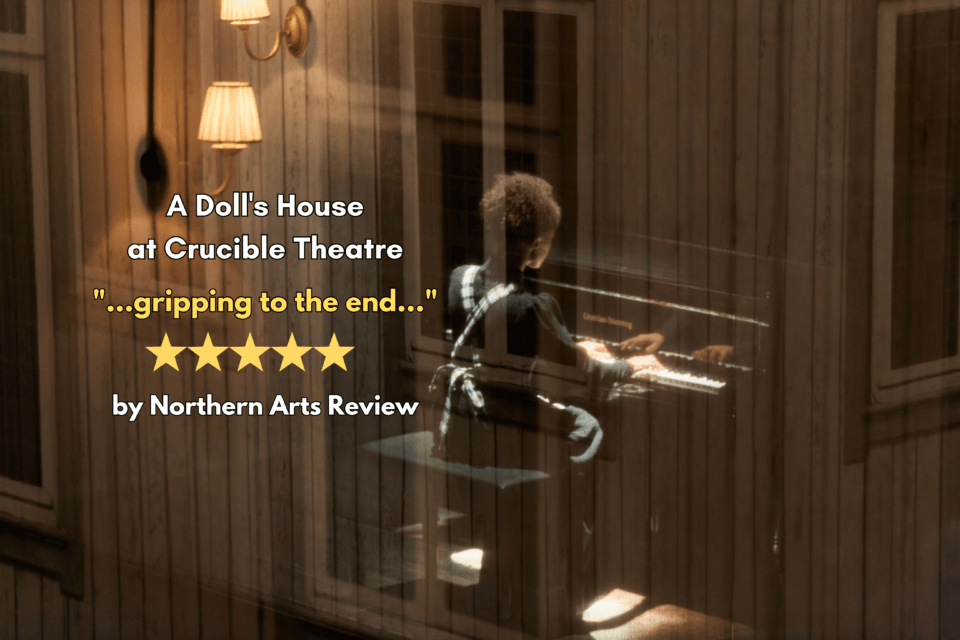
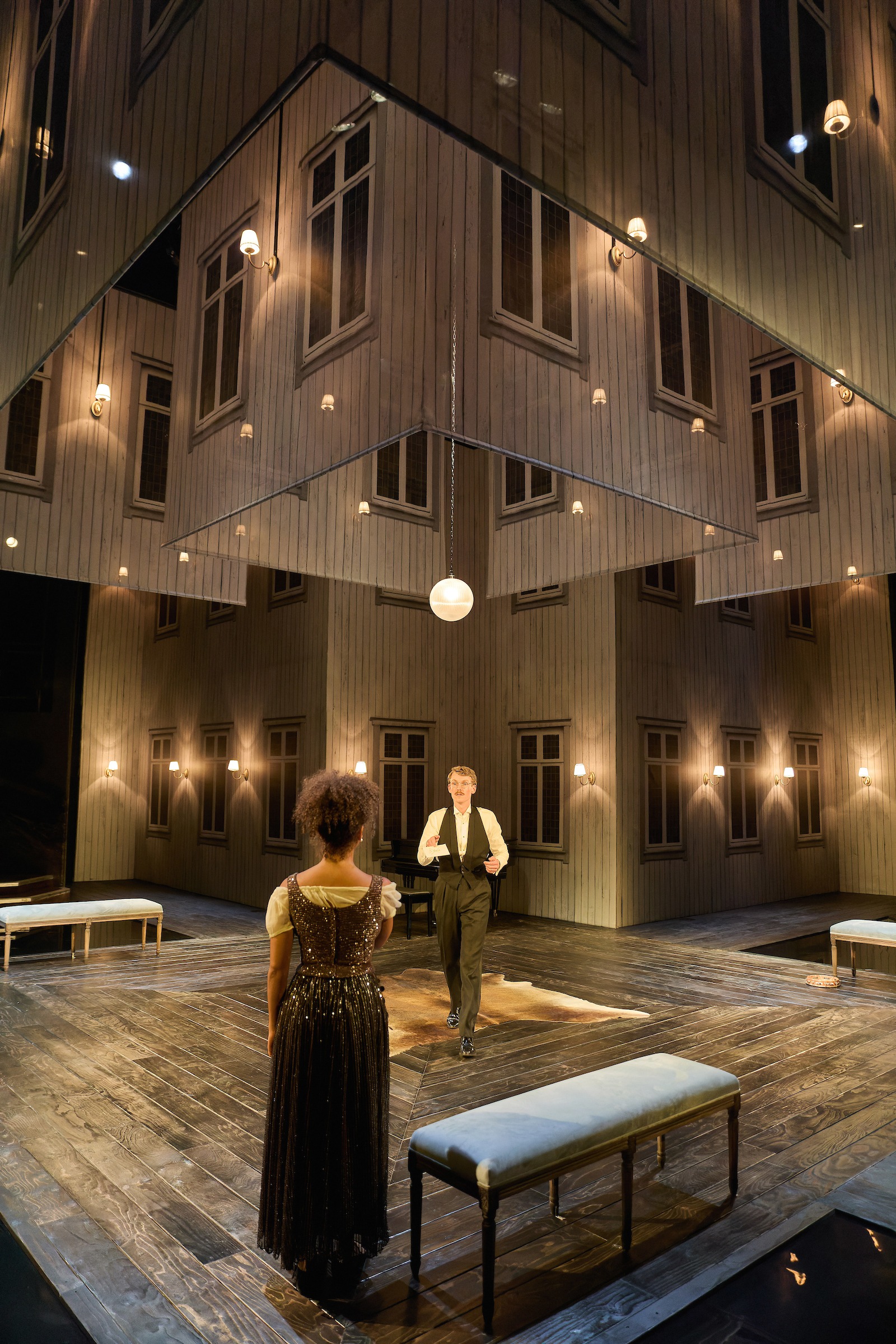
Entering the auditorium, the effect is stunning. The Doll’s House fills the stage, almost up to the front row. It’s a larch-clad construction. Subtle lighting effects indicate that it is snowing; it is winter. As the play starts there is music playing – someone inside is playing a piano. The walls that appeared solid are now translucent. This is our introduction to The House as the seventh character.
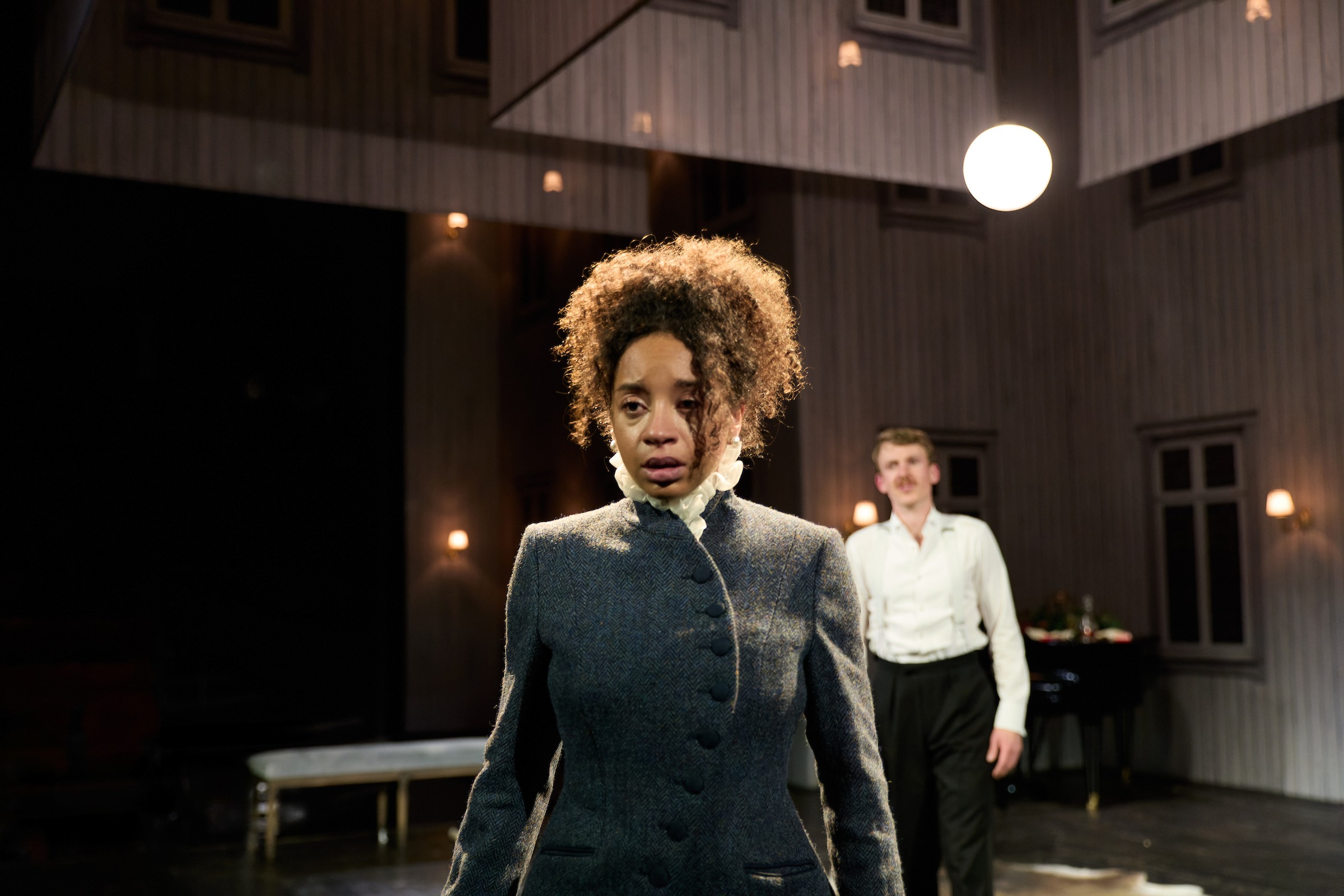
Nora (Sienna Kelly) enters laden with Christmas presents; it is Christmas Eve. A conversation with her husband, Torvald (Tom Glenister), follows, making clear the husband-wife power relationship. He is responsible for money and she is overspending, but the conversation is, in his eyes, light-hearted. She is his little squirrel, a bird. He views her as a fragile thing of joy, but of no significance in her own right, even as the mother to his children. The play centres very much around their relationship.
The plot develops when Nora’s childhood friend, Christina (Eleanor Sutton), turns up at the house. Christina’s husband has died, she is penniless and childless, and in need of employment. Might Torvald be able to take her on at the bank, she has relevant experience? Nora can vouch for her with her husband.
There is a fly in the ointment. Torvald has had a few years of mental health issues as the result of overwork in a previous occupation as a lawyer. This is one of the threads of the play that still has relevance today. To help him recover, Nora had to do something that puts her in danger at the hands of Krogstad (Eben Figueiredo), who is threatening to blackmail her. As the play progresses, gradually the significance of The Doll’s house is revealed.

The female roles are revealed to be orphans. Christina and Nora were friends in the same orphanage, with Nora’s fortunes changing when she was adopted by a man of influence, leaving Christina behind. All women are subject to the controls of men. The fortunes of each of them are down to luck – which man has control over their lives.
There is some humorous relief from the character of Dr Rank (Aaron Anthony). The name is a misnomer. He is a family friend, and very cheerful. I am reminded of Simon Callow in Four Weddings and A Funeral. The doctor visits frequently and maintains his cheerfulness despite serious problems of his own that mirror those of Nora and Torvald.
All of the characters work well, a result of good casting and direction. Nora, on stage almost all of the time and central to all elements of the play, has the most demanding range. She is the air-headed ‘Christmas shopper’, the blackmail victim, the friend, the little wife, and the outraged wife too. She’s also the character that brings the play together and Sienna Kelly is superlative in this role. Christina, as friend and go-between, and ex-lover of Krogstad, has to play the friend suffering misfortune, and the ex of Krogstad wanting to be reconciled with him. Torvald plays the bank manager well. He is suitably uptight and prudent and controlling in this role, and utterly believable. Anna holds the household together, and, as pianist, plays atmospherically, adding to the mood to the play. Dr Rank is facing death with fortitude and humour, and provides a catalyst for Nora. Krogstad, last of the six, works well as the unsympathetic blackmailer. He is easy not to like but does this without being a pantomime villain. There is more to him than this. The seventh character is The House. A masterpiece of construction and illusion, being both solid and ghostly. Lighting has a considerable role to play in this. Well done to the whole team.
This play has tension, drama, laughter, though not all may have been intended by Ibsen. Is the play overlong? Short answer: no it isn’t. The play’s language has been brought up-to-date to make it easily understood by modern audiences. The duration was no problem at all, we found it gripping to the end.
A Doll’s House plays Crucible Theatre, Sheffield until Saturday 12 October 2024. Tickets can be booked through the Box Office in person, over the phone on 0114 249 6000 or at sheffieldtheatres.co.uk.
Phil Scown has been a regular theatre-goer since his student days many years ago. Mysteries, thrillers, ghost stories, comedies and musicals are all part of his theatre diet. Phil writes short stories in a variety of genres, some of which have become screenplays. He likes to tour England, Scotland and France, nowadays by car rather than motorcycle. At other times Phil likes to cook and to drive his Caterham, though generally not at the same time.
Trending Now

Review: To Kill a Mockingbird at Leeds Playhouse

Review: Night Collar at St Helens Theatre Royal
You may also like