“…exceptional performers…”

In The Brain by Hofesh Shechter, York Theatre Royal
By Sean Sable
Every two years, the doors open to Shechter II: the only paid professional development programme of its kind for emerging contemporary dancers in the UK. With only eight places and over twelve hundred applicants from forty-one countries, the 2026 cohort was always going to be a showing of extraordinary talent. This year’s company is composed of Matilde Agostinone, Teige Bisnought, Nagga Baldina, Skiye Nataliah, Federica Fantuzi, Woojin Kwon, Armand Lassus, and Ella Roberts. Together, along with composer and choreographer Hofesh Shechter, they bring In the Brain to York Theatre Royal, the first full-length work built around this cohort.
The work was developed from CAVE, a fifteen-minute work he originally made for the Martha Graham Company in 2022, exploring nightlife and the energy of human gathering. Here, it expands into a full fifty-five minutes. The programme notes promise that it is an exploration of club culture, but I can tell you now: that’s only the beginning.
When the piece starts, we are in complete darkness. The light on one side of the stage rises so slowly it feels almost geological. The sound is unearthly, more organised than atmosphere, but not yet rhythm. Breath, wind, bubbling, beeping—it sits somewhere between futuristic and alien language. Eight dancers appear: swaying, undulating, twisting in and out of one another like vines. Their barely-lit bodies enter and escape narrow channels of light as their reflections double their actions on the polished black floor. Slowly, the sound shifts: a rhythm, then a chant. Their movements are fluid, but never thin. Each step has weight and body as they flow together to an increasingly frenetic beat.
The performance moves in waves rather than sections, each wave building on the one before. We start with something almost elemental, shift into something more concrete and eventually reach a critical mass. Then finally, rupture and rebuild. As the pitch increases, the dancers move so quickly my mind can only experience them as a glitch—a flicker where the frame rate had slipped. The ensemble dynamic is excellent, locking in step and then breaking into smaller—freer—vignettes. I keep coming back to one moment: all eight arched on the floor, feet tucked underneath, bellies pushed skyward, moving in and out, like the breathing of lungs. The pulsing had the tiniest hint of asynchronous squeeze that felt visceral and hypnotic.
At times, they lose their identity into a shared consciousness that strips their distinctiveness away as they become a hedonic mob. At other times, they tear away into solos as the others watch on, often in conversation with the soloist. Near the end, the onlookers form a hollering semicircle reminiscent of a nightclub dance floor as each dancer takes their turn in the spotlight.
The production is simple, with the heaviest lifting done by the masterful lighting design. From near darkness to spots that slice up the stage, there is always an impression of unity. The music informs the light, and the two inform the dance. For roughly three-quarters of the piece, the lighting runs close to darkness. This has the effect of decompressing the dancers somehow, stripping back the weight of their humanity and allowing them to become more presence than person.
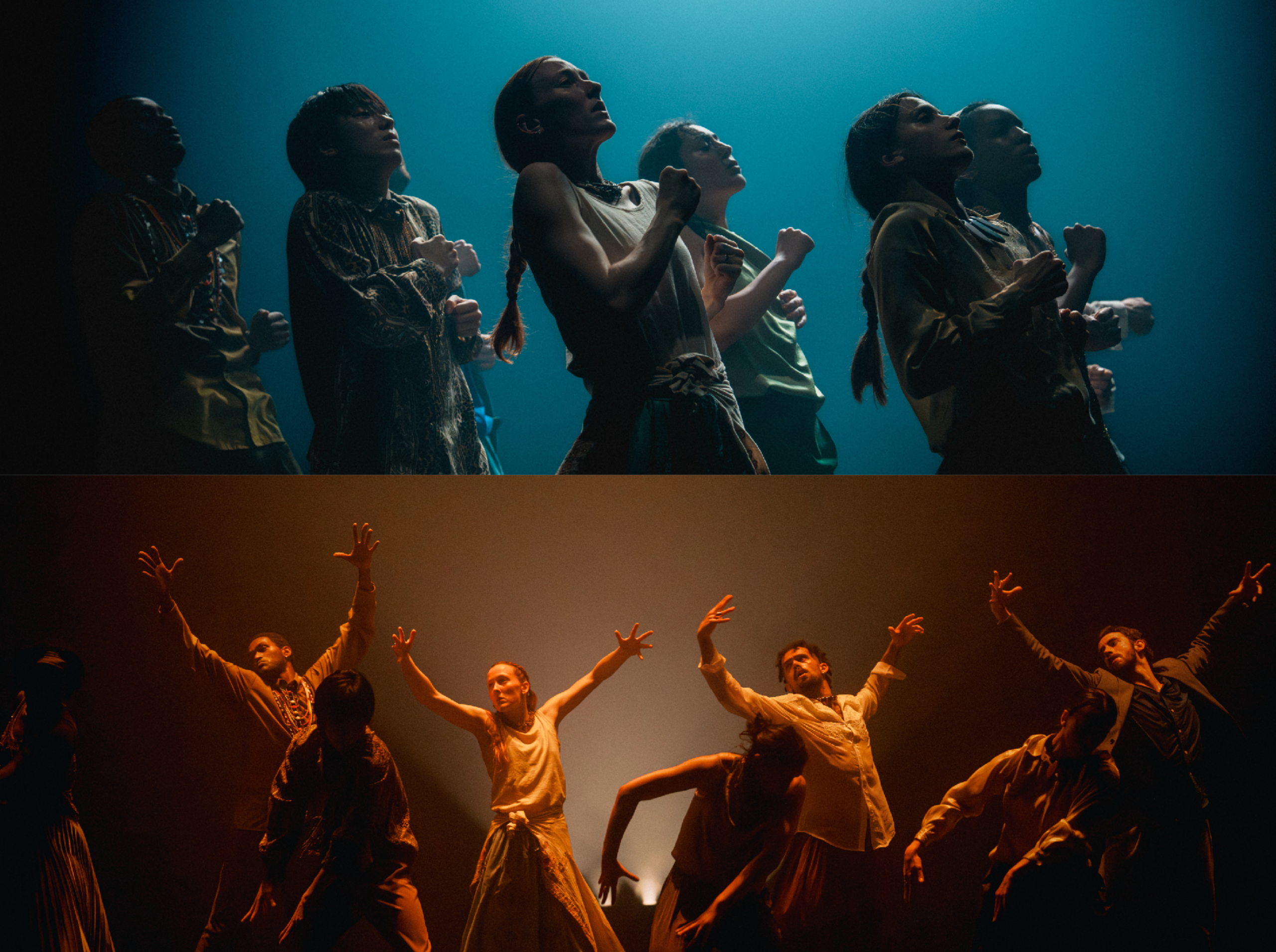
The costuming is business-casual streetwear in loose, outsized cuts, often layered. Each dancer is suggested by an individual colour, and the whole palette shares a muted stone-grey undertone that keeps it roughly cohesive. In both the clothing and the pair work, there is a sense of androgyny that never demands gendered organisation.
Shechter composed the score himself. The cinematic score builds from its unearthly opening tones through to deep percussion, oscillating between untethered sound and passages of both ritualistic and near-liturgical chanting. At times, I found myself wanting to close my eyes and just experience the music on its own.
The concept bills itself as an exploration of nightlife, raves and clubbing culture, but what I experienced sat parallel to that story. Yes, the freedom and unity are there, and the build-up towards a needle-drop catharsis is palpable. But alongside that story is a process of metamorphosis. Organisation emerges from a primordial soup; chaos becomes brief glimpses of order. Overarching it all is a prolonged feeling of anticipation. We await a becoming. Whether my experience is part of Shechter’s vision, I can’t know. But I think that there is something in the idea that a rave and a transcendence are a distinction without a difference.
There’s something delicious about catching exceptional performers this early in their careers, when the world hasn’t quite caught on yet. It feels like a shared secret—one you don’t want to keep to yourself. In the Brain runs at York Theatre Royal through 13 June before heading south for its London premiere. Go before everyone else finds out.

In The Brain plays at York Theatre Royal until Saturday 13 June. Tickets are available here.
Sean Sable is a Yorkshire-based freelance writer and editor specialising in Young Adult and Horror fiction, frequently at the same time. When she isn’t buried under a pile of books and manuscripts, she is looking for her keys and having extensive one-sided conversations, in Swedish, with her deaf cat. You can find her online at: www.seansable.co.uk
Trending Now

Review: To Kill a Mockingbird at Leeds Playhouse

Review: Night Collar at St Helens Theatre Royal
You may also like