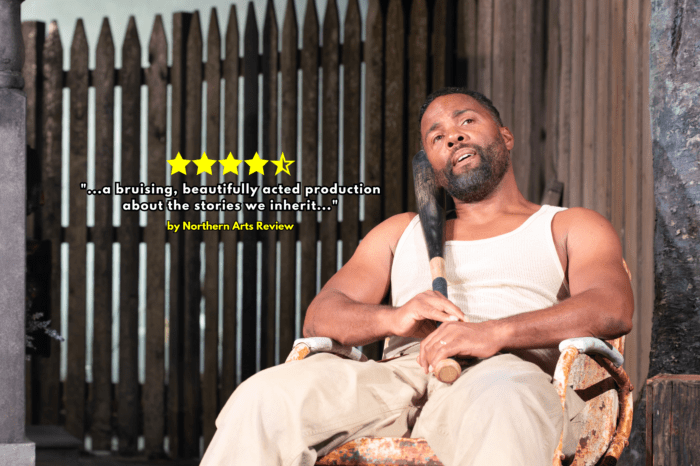
“…theatre at its finest – a real six out of five stars…”

Animal Farm by George Orwell adapted by Tatty Hennessy, Leeds Playhouse
By Sean Sable
“It’s our farm now.”
This declaration of victory at the beginning of Animal Farm unravels into a brutal story of corruption and betrayal. George Orwell’s classic novella has been adapted for the stage countless times, but few versions have so hauntingly captured the visceral brutality of its themes. Under the direction of Amy Leach, Tatty Hennessy’s adaptation trades Orwell’s satirical detachment for something far more pressing. Raw and deeply unsettling, this production cuts deep and reaches to the marrow quickly. From its electrifying opening whip cracks to its shattering conclusion, this must-see production doesn’t just retell the story of Animal Farm—it makes you complicit.
At its heart, Animal Farm is a cautionary fable about power—how easily it’s seized, how ruthlessly it’s wielded and how eagerly it’s accepted. First published in 1945, Orwell’s novella is a biting critique of Stalinist Russia. However, it is difficult to find a time in modern history when it has felt more relevant than now. With a grinding, industrial, prison-like aesthetic, this adaptation doesn’t simply tell the story of farm animals rising against their oppressors, it brings into focus the fragility of truth and the mechanics of control in a way that feels relentless.
Bringing Animal Farm to the stage comes with its own set of unique challenges. Many productions have relied on elaborate costuming, masks, or puppetry to bring the animals to life. However, Amy Leach’s production does none of this, instead using a clever blend of costuming, sound and movement that make us feel the thin and fragile line between animal and human even more effectively than any prop or costume alone ever could. Leeds Playhouse, in collaboration with Stratford East and Nottingham Playhouse, has crafted an adaptation that is bold and unforgettable. It isn’t difficult to see why Animal Farm has been nominated for an Olivier Award for Best New Production in Affiliate Theatre. This is theatre at its finest – a real six out of five stars production.

It’s rare to see a cast so completely committed to their roles and their physicality in this production is nothing short of staggering. From grunts and snorts to twitches and snarls, the actors didn’t just portray animals—they became them. With every actor in this ensemble an absolute powerhouse, it is almost impossible to choose a standout performance However, I would be remiss not to bring attention to Tom Simper (Squealer) and Joshua-Alexander Williams (Blue). Simper was almost too believable, selling every deception with frightening ease. Joshua-Alexander Williams was so dog-like in his depiction of Blue that his threat of violence felt personal. But it was Gabriel Paul’s Boxer who broke me. His unwavering belief in the system, his blind loyalty, and his final, gut-wrenching betrayal left the theatre in stunned silence. And then there was Tianah Hodding’s Clover—left alone in the spotlight, a single figure in a world that had abandoned her. It’s the kind of moment that lingers long after the lights dim.
The two-tiered set design is stark and oppressive, immediately establishing a hierarchy: A sleek glass fortress above and a grimy metal prison below. From barn to battlefield and from prison to grave, the openness of the set allows for strikingly dynamic staging and worked in perfect synergy with the bold lighting effects. The use of modular metal boxes was particularly effective, transforming from cages to coffins seamlessly.
The actors wear muted, post-apocalyptic costumes with their name/animal stencilled onto the backs, arms and sometimes even skin—an unsettling reminder of identity and disposability. It is this refusal to lean into obvious ‘animal’ aesthetics that enhances the horror. They are not animals. They are us.
I cannot remember a time when sound was so skilfully weaponised. Industrial music grinds and groans beneath the action and a single timpani drum crack mimics the lash of a whip. What begins as a hopeful battle cry, the haunting Beasts of England anthem is stripped away from the animals when they need it the most.
The choreography and movement were brilliantly executed. Violence plays out in slow motion—demanding that we witness every moment of pain, every flicker of fear. We cannot escape.
Yet, in the midst of darkness, there are moments of light. Milo (Em Pendergast), our scooter-riding narrator, swoops in with biting gossip and rapid-fire puns, offering brief but necessary relief. These breaks hit at just the right moment, allowing the audience’s tension to release before it inevitably builds again.
Creative captioning was provided throughout the performance by someone who isn’t named in the programme notes (a real shame) who integrated seamlessly into every scene as one of the cast. Additionally, BSL is incorporated into the stage movement in ways that add depth and meaning for audience members both with and without hearing impairment. This production is a testament to the power of accessibility done right.
It’s impossible to watch Animal Farm without sensing that it’s a blueprint for the modern news cycle. Its warning about the seductive nature of power lands like a hammer blow. This adaptation doesn’t just rehash familiar themes—it sharpens them. Napoleon’s rise isn’t only inevitable, it’s recognisable in the morning headlines. The commandments are shifting before our eyes. And that’s precisely why you need to see this production. Animal Farm isn’t just theatre—it’s a reckoning.

Animal Farm plays at Leeds Playhouse until Saturday 29 March. Tickets are available here.
Sean Sable is a Yorkshire-based freelance writer and editor specialising in Young Adult and Horror fiction, frequently at the same time. When she isn’t buried under a pile of books and manuscripts, she is looking for her keys and having extensive one-sided conversations, in Swedish, with her deaf cat. You can find her online at: www.seansable.co.uk
Trending Now

Review: Enlightenment at People's Theatre
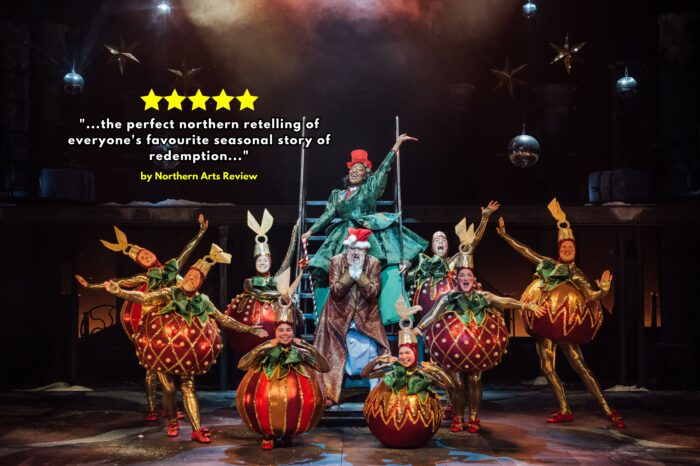
Review: A Christmas Carol at Leeds Playhouse
You may also like