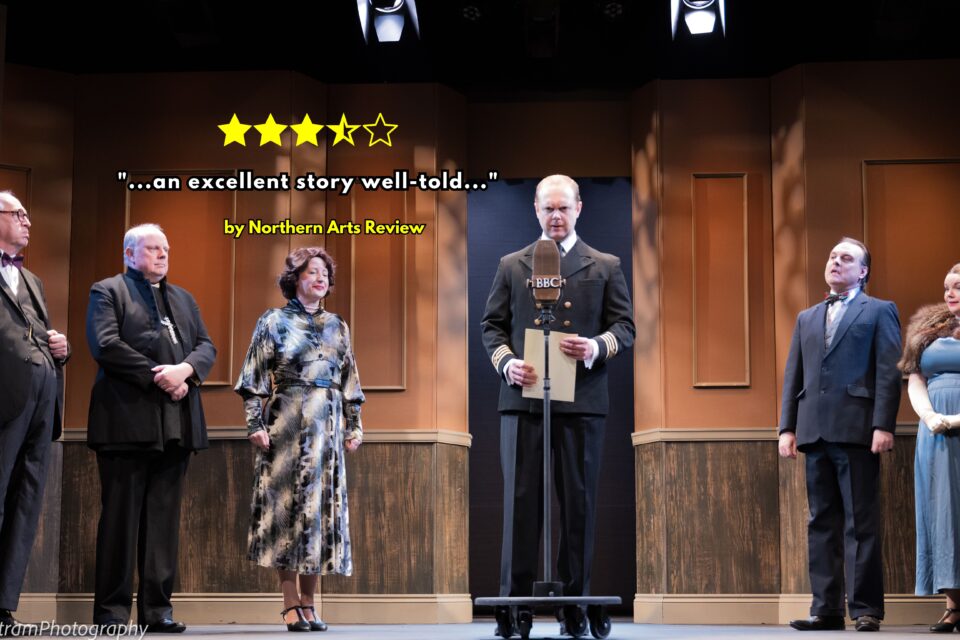
“…an excellent story well-told…”
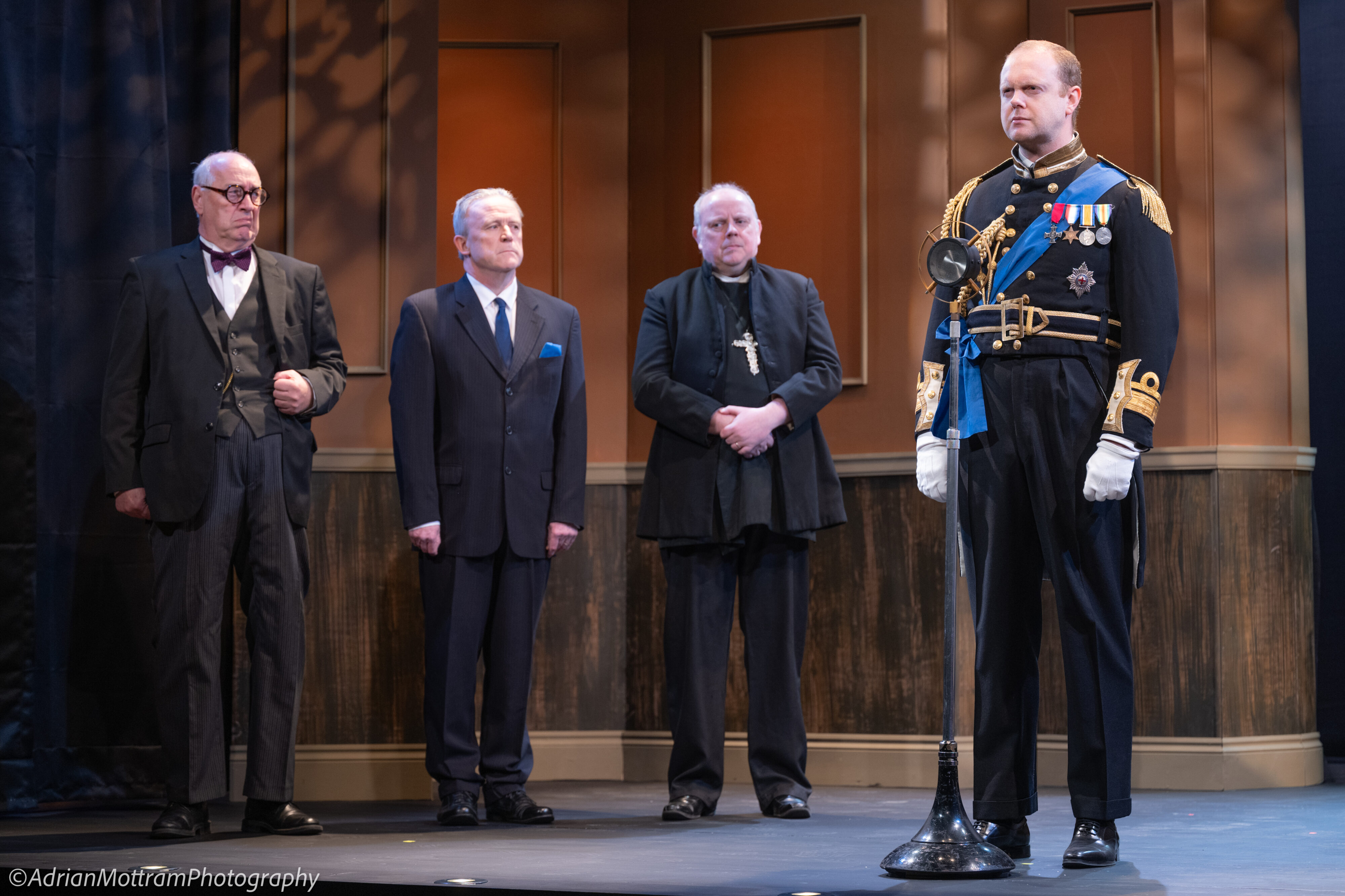
The King’s Speech by David Seidler, Farnworth Little Theatre
By Hannah Molyneux
Set on the brink of war with tensions rising in both Europe and the US, The King’s Speech tells the true story of King George VI’s accession to the throne and the relationship that ‘Bertie’ (James Cooper) fosters with Lionel Logue (Nicholas Eccles) to overcome his stammer.
Because this is an account of real events, the script insists on laying down a great deal of historical context around the imagined goings-on behind the closed doors of Lionel’s office, and this is perhaps why much of the action outside of these scenes feels a little stilted. At times, transitions between scenes are quite jarring, relying on low lights and much shuffling of props to move the action on, but leaving the audience feeling somewhat removed from the story. We are given no space, for instance, to absorb the full significance of Bertie hearing his voice clearly for the first time on Lionel’s recording – a key moment in the story – instead, the lights go down almost instantly and we are shifted onto the next. Perhaps a little more softness and detail from the set – kept deliberately sparse, according to the programme notes, so as to draw more attention to the voices of the characters – might also lend a more organic feel to the movement between different scenes and pieces of dialogue. In a play that is ultimately centred on a human need for validation and the search for self-belief, the sparse set and, at times, abrupt transitions between scenes take away from some of the emotional intensity of the performance.

The real joy of the piece lies in the scenes between Bertie and Lionel, which have a great deal of warmth. Nicholas Eccles’ Lionel Logue is everything you could want him to be – challenging without being confrontational and cheeky without being downright disrespectful. He is open, genuine, and likeable, and Eccles succeeds in conveying a real sense of care and concern from Lionel towards Bertie while also giving us an honest and emotional insight into his own personal and professional struggles.
The exchanges between Lionel and Bertie allow James Cooper the space within to show us multiple facets of Bertie’s character. Here, the guard he has put up for his entire life in gently and carefully unpicked by Lionel. We witness his temper (which might arguably have been even less restrained), his dry and self-aware sense of humour, and his childlike vulnerability. Cooper cuts a kingly figure, yes, but it is as a human that his portrayal of Bertie really shines – he is simply a man longing to be heard who also happens to be a king.
The scenes between Lionel and Bertie are where the action seems to settle for the first time, and the drive and fluency that have been absent from some of the play’s earlier moments return with great effect here. Their exchanges feel natural and authentic, the humour subtle and not over-egged. Crucially, both actors take their time, allowing the space and the silences to speak volumes and resulting in scenes that feel like a breath of fresh air. If it is in Logue’s office that Bertie is able to overcome the pressures of a world whose pace he cannot match up to, then it is also in these scenes that the performance finds a pace that is much more grounding and comfortable.
In the wider cast, Natalie Cooper gives a polished performance as Elizabeth – a princess through and through motivated by her loyalty and devotion to Bertie. As Winston Churchill, Peter Schofield evokes a familiar and steadfast figure, bringing character to scenes that might otherwise have felt too bogged down in matters of the constitution. Esme Mathur is excellent, both as Wallis Simpson and, especially, as Myrtle Logue. Her Australian accent is brilliant, and her gesture and expression go beyond her spoken lines to paint an image of a woman well-used to putting up with her husband’s ambitious and impulsive plans.
In the play’s final moments, with Bertie’s public speaking reputation and the men’s friendship intact, the audience feels satisfied that we have reached a neat conclusion. The performance has done what it set out to do and, in contrast to his first appearance alongside only a member of staff, we have witnessed Bertie overcome his struggles surrounded by love and support. Does the piece as a whole lose some of its power by rushing through its key moments of emotion and intensity? Perhaps. Nevertheless, it remains a thoroughly enjoyable piece of amateur theatre – overall, an excellent story well-told.

The King’s Speech plays at Farnworth Little Theatre until Saturday 24 January. Tickets are available here.
Hannah Molyneux is a proudly Mancunian writer and musician whose day job revolves around community engagement. She is passionate about community arts and the huge benefits they have for people and places. Hannah can most often be found enjoying the great outdoors or optimistically crafting with her children. You can read more of her writing here. You can find her on Instagram here.
Trending Now

Review: Enlightenment at People's Theatre
Review: A Christmas Carol at Leeds Playhouse
You may also like