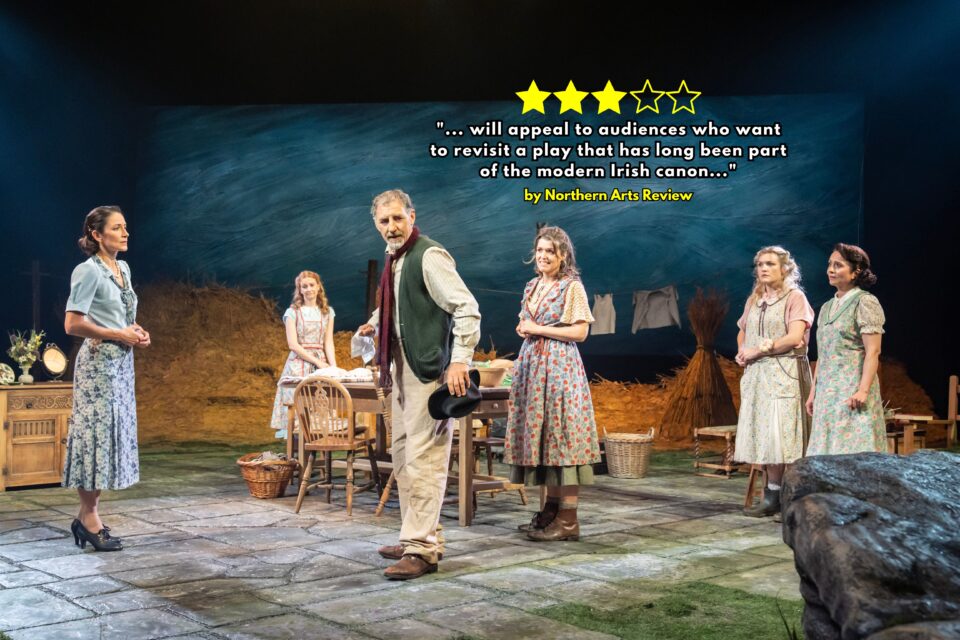
“… will appeal to audiences who want to revisit a play that has long been part of the modern Irish canon…”

Dancing at Lughnasa by Brian Friel, Crucible Theatre Sheffield
By Sean Sable
What does it mean to remember a summer that was both ordinary and life-changing? Set in 1936 Donegal, Brian Friel’s 1990 memory play Dancing at Lughnasa, now revived at the Crucible, tells the story of five sisters (Kate, Maggie, Agnes, Rose, and Christina) living in poverty with their brother Jack, recently returned from Uganda after twenty-five years as a missionary. Christina’s son Michael narrates the story as an adult, looking back on a pivotal summer from his childhood over Lughnasa—the Gaelic term for the harvest season.
Dancing at Lughnasa isn’t a conventional drama, but more like a collage of memories that hang together without an identifiable central conflict. Michael’s recollections focus on the texture of that summer: the meagre meals of scrambled eggs on toast, the unreliable wireless crackling into sudden fits of music, and the brief reappearance of Michael’s unreliable father, Gerry. Each fragment is punctuated with a kind of rolling epilogue that always serves to remind us that hardship and separation lie ahead. The result is less about plot than about the way memory distils a particular time and place.
The production looks striking on the Crucible’s open stage, and Francis O’Connor’s design works hard to create a seamless blend of indoor and outdoor spaces that make the Mundy house feel like a wild and untamed place. Absent of any walls, the kitchen furniture blends into grass and barley fields under a painted blue sky. A circular lighting fixture lowers like a celestial body marking time, as Chris Davey’s cool washes of light lend the atmosphere a liminal quality. Costumes are crafted with a keen eye for detail, particularly the women’s ditsy-print aprons in a variety of styles and Gerry’s tattersall shirt, Fair Isle vest and braces give him a kind of undeniable country boy charm. Unfortunately, the youthfulness of hair and makeup undercut the script’s insistence that the sisters were “too mature for dancing.”
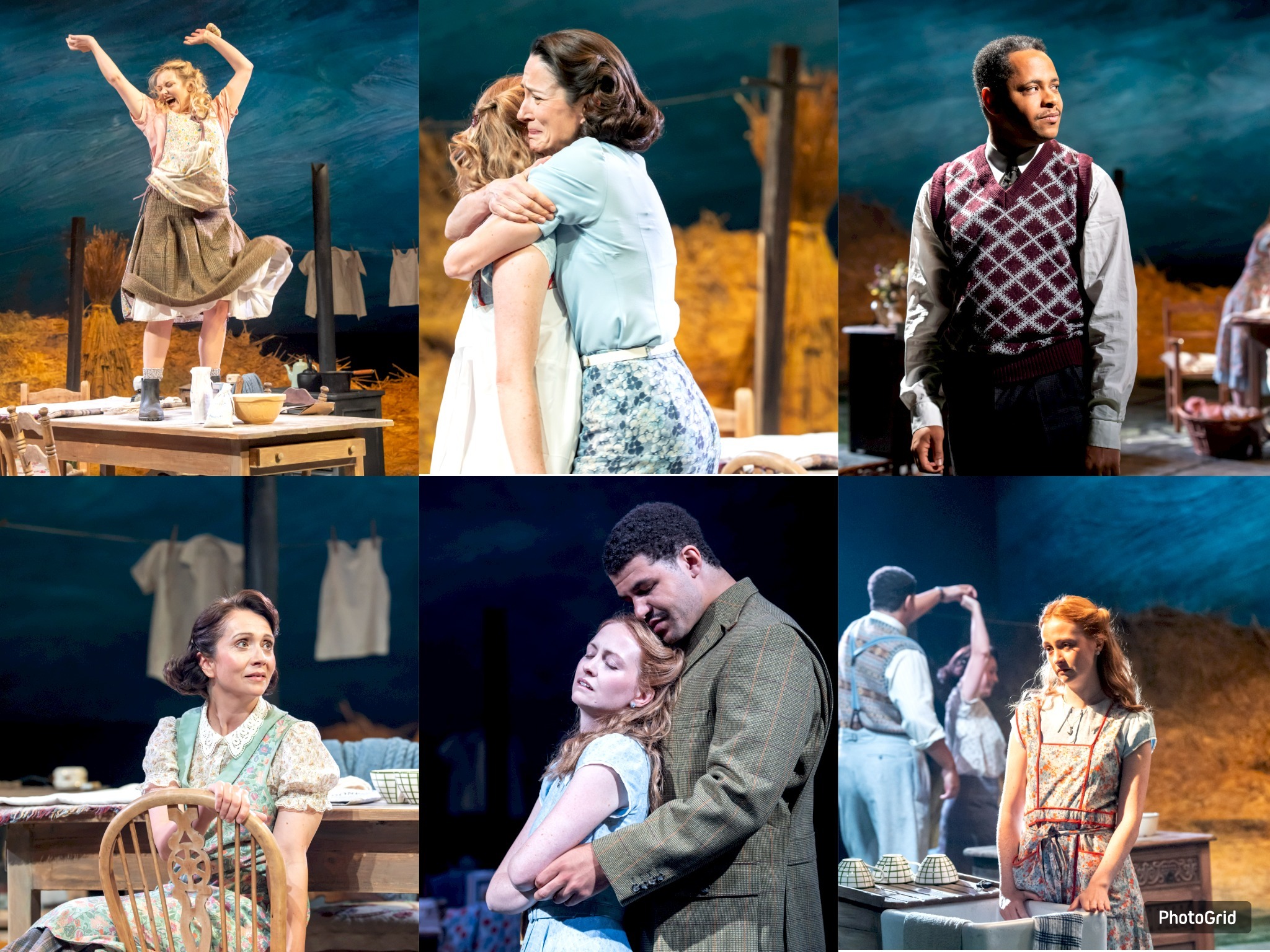
Marcus Rutherford gave Gerry an effervescent confidence that made his romantic appeal evident, even if his on-stage pairing lacked connection. Frank Laverty found sympathy and pathos in Father Jack, a man returned home but half-lost in his own memories. And Siobhán O’Kelly’s Maggie provided much of the evening’s humour. Her quick delivery and rough charm lent the family scenes a liveliness that might otherwise have sagged. Elsewhere, though, the acting often felt forced and unnuanced, with lines lost in projection across the three-sided stage.
The title promises dancing, and there are indeed two key dance sequences. In the first act, the sisters suddenly erupt into wild movement when the radio sparks to life, and later Gerry flirtatiously waltzes with Christina, Agnes and Maggie in turn. For some, these are the emotional heart of the play, symbolising a release of repressed desire and duty. For me, they felt more awkward than cathartic, the energy less joyful and more animalistic than was perhaps intended.
I admit to being troubled by the scenes involving Father Jack’s recollections of Uganda. Friel invented a fictional “Ryangan” tribe, onto whom he projected practices of polygamy, animal sacrifice, and an alleged celebration of “love children”. These details play directly into racist stereotypes of Black women as hypersexual, and of African communities as primitive curiosities. The fact that Jack is viewed as confused (even demented), because he has “gone native”, compounded my discomfort. It implies that his embrace of Ugandan culture is itself a mark of mental decline. In 1990, critics often framed this as simply comic colour or a counterpoint to Catholic repression. But, in 2025, it reads as reductive, using a caricature of African life as an empty foil for Irish nostalgia.
For me, Dancing at Lughnasa felt not so much timeless as time-locked. It reflects a particular strain of theatre from the 1990s, atmospheric and memory-driven. Its place today is perhaps best understood as a slice of that era. This production strives to honour Friel’s legacy, with careful design and moments of strong performance. This story will appeal to audiences who relish slow-burning, reflective theatre, or to those who want to revisit a play that has long been part of the modern Irish canon.

Dancing at Lughnasa plays at Crucible Theatre until Saturday 04 October. Tickets are available here.
Sean Sable is a Yorkshire-based freelance writer and editor specialising in Young Adult and Horror fiction, frequently at the same time. When she isn’t buried under a pile of books and manuscripts, she is looking for her keys and having extensive one-sided conversations, in Swedish, with her deaf cat. You can find her online at: www.seansable.co.uk
Trending Now
Review: A Christmas Carol at Leeds Playhouse
You may also like