“…brilliant and beautiful theatre…”

Bog Witch by Bryony Kimmings, HOME Manchester
By Hannah Molyneux
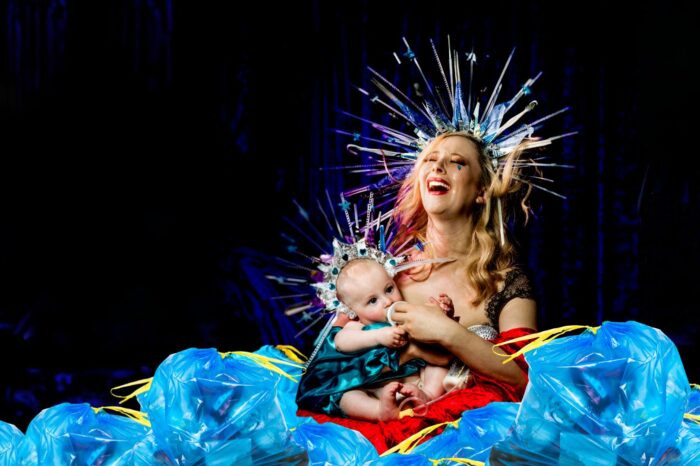
Bryony Kimming’s Bog Witch is the latest in a series of autobiographical works, exploring her search for happiness as she turns her life upside down and moves to the countryside. Told by Bryony herself in a one-woman performance, Bog Witch blends drama, performance art, stand up comedy, and audience participation to create a piece that is emotional, impactful, funny, and full of soul.
It’s opening is eerie and full of anticipation – primal, earthy, Midsommar-esque. Tom Parkinson’s music resounds around the space, chilling and ancient and in stark contrast to ‘city Bryony’ who addresses the audience at first. She has, she tells us, a “soul hole”, which – despite her love of online shopping and never-ending consumption – she attempts to heal by moving with her blended family to a rural farm.
The countryside scenes we are presented with are truly bucolic. One by one, each of the seasons unfolds before us, brought to life in hazy light and gorgeously evocative shadow work that moves gently across the canvas backdrop that also cloaks the entire stage. Branches wave in the breeze, birds and animals flutter and settle and then move off again. Bryony’s arrival into this harmonic, natural scene is surreal and at time chaotic – she is not at home here, not at one with this balanced rural world. The juxtaposition of comedy and raw vulnerability is arresting and we quickly realise that, beneath the rural stereotypes – the baskets, the kaftans, the increasingly wholesome hobbies – is a depiction of a real lived experience of loneliness, isolation, and lack of connection. And, as the voiceover narrates, “life is hard without meaningful connection.” Kimmings seamlessly and skilfully moves between hilarious commentary on country life and tender reflection on her own inner life to create a piece that is as punchy as it is poignant.
Bryony herself is mesmerising – outlandish, silly, vulnerable, down-to-earth. Her energy seems endless and her interactions with the space, the props, and the audience are masterful. She wins the audience onside immediately and holds our gaze unwaveringly for the entirety of the one-act performance. We empathise with her because, though we hate to admit it, we see a little of ourselves in her. Kimmings evokes climate catastrophe without ever preaching about it – she recognises her own shortcomings as a human and the piece brims with conflict between these shortcomings and what she knows and, more importantly, witnesses, about climate change. She never once challenges us directly to examine our own “soul hole”, but we find ourselves doing just that all the same. In expressing and enacting her experiences, she holds up a mirror to ours. It would be a hard person who could leave the theatre without even a single thought for the marks they make on the planet and the places that they find fulfilment.

As the seasons move by, we witness Bryony’s growing concern for the world around her, and the spiralling anxiety that it induces. And as her anxiety increases, so too does the palpable tension in the room. The sound and lighting design throughout is beautiful and powerful, but in these moments sound and light become almost characters in themselves. Building from creepingly insidious to overwhelmingly tumultuous, we are not simply granted a glimpse into Bryony’s mental state but are enveloped in it. We are seized by the enormity of Bryony’s experience – this is not so much storytelling as it is a re-enactment, a re-living of a time in her life into which we are inextricably pulled. The play deals with both miscarriage and animal death sensitively and gently, expressing the reality of loss and grief in the context of the interconnectedness of life and death that Bryony comes to recognise as part of the natural world.
The bog is omnipresent, even if not always physically represented on stage. It represents the fear of sinking and disappearing, and it is the symbol of the perpetual natural cycle of life, death, and renewal. In it there seems to be the acceptance of the balance between holding on and letting go, and the connection that Bryony is searching for. If it’s not a hopeful metaphor, it’s at least a comforting one – it doesn’t promise a happy ending but rather the certainty that life will go on.
Bog Witch is brilliant and beautiful theatre; it offers a story about a woman reconnecting with the natural world, but it delivers so much more. Yes, it confronts us with our place within the ecosystem and our behaviour towards it, but it also forces us to look inside ourselves to question what contentment looks like for us. Is it something we can buy, make, find, or simply grow within ourselves? Between the echoes and shadows lies a story that is deeply human and relevant; it resonates within us and leaves an impression that lingers long after the lights go down.

Bog Witch plays at HOME Theatre Manchester until Saturday 28 March. Tickets are available here.
Hannah Molyneux is a proudly Mancunian writer and musician whose day job revolves around community engagement. She is passionate about community arts and the huge benefits they have for people and places. Hannah can most often be found enjoying the great outdoors or optimistically crafting with her children. You can read more of her writing here. You can find her on Instagram here.
Trending Now

Review: Enlightenment at People's Theatre
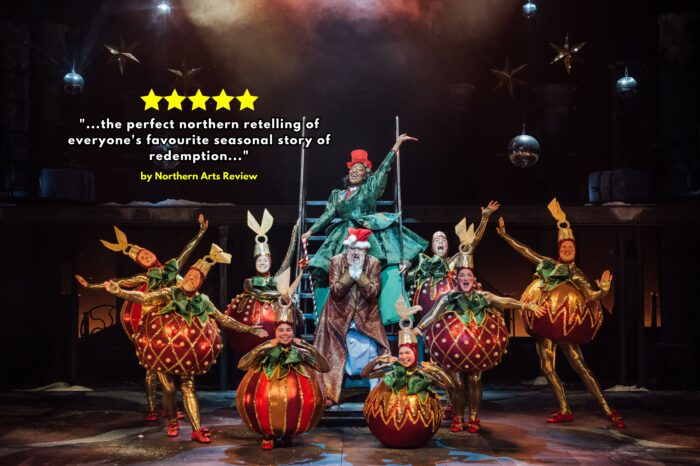
Review: A Christmas Carol at Leeds Playhouse
You may also like