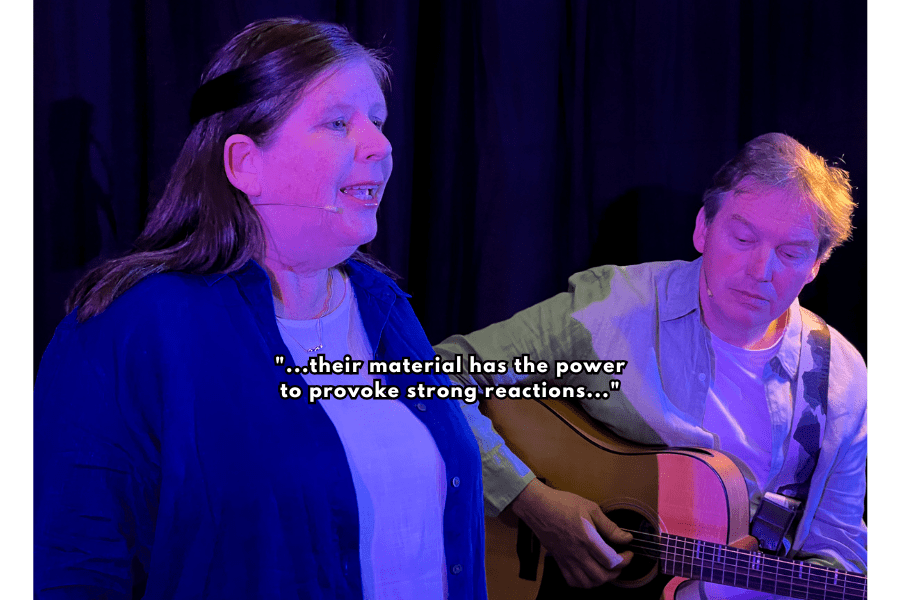
“…their material has the power to provoke strong reactions…”
By Daniel Sumsion
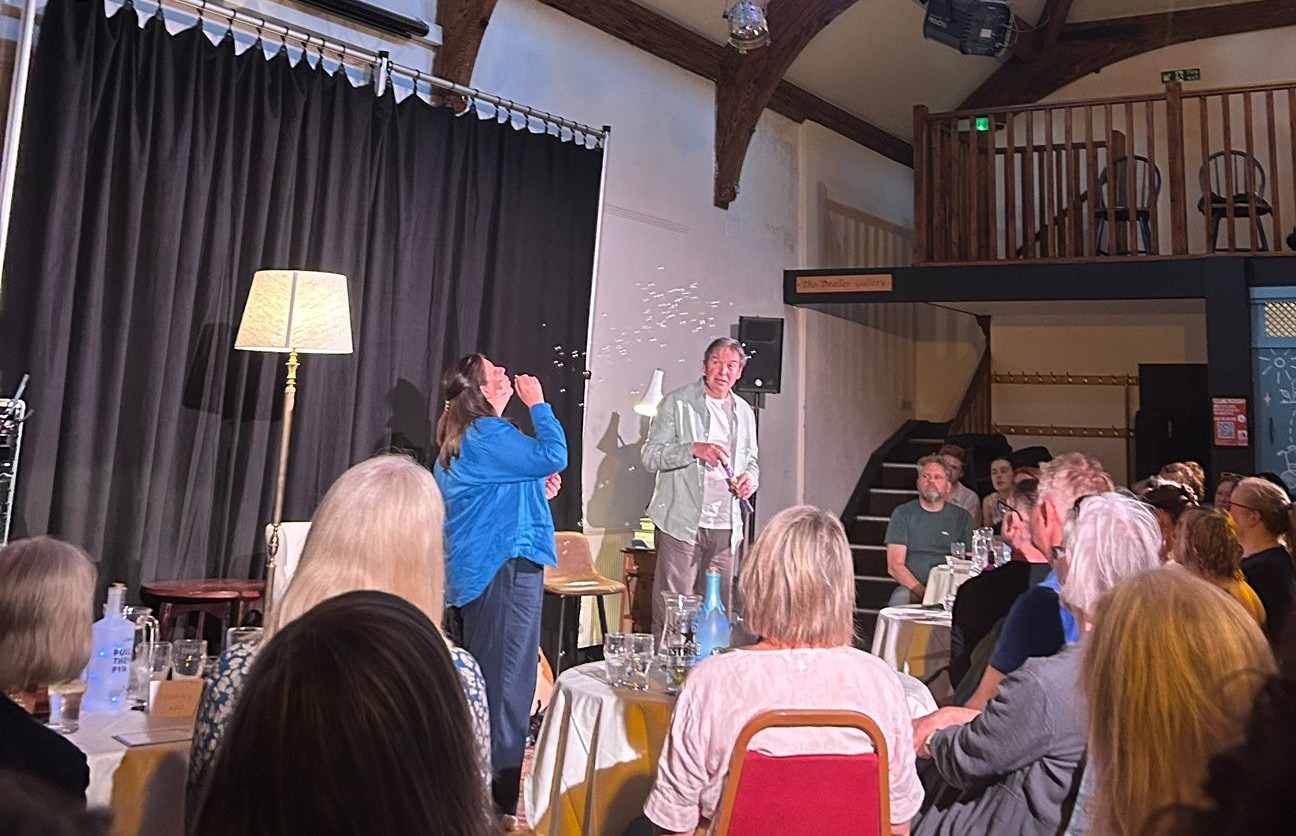
Lately, a strange sort of social experiment has been taking place in village halls dotted across Cumbria’s south perimeter. On show nights, an audience of strangers is invited to spend the evening with a couple who want to speak, and sing, about the worst thing that ever happened to them.
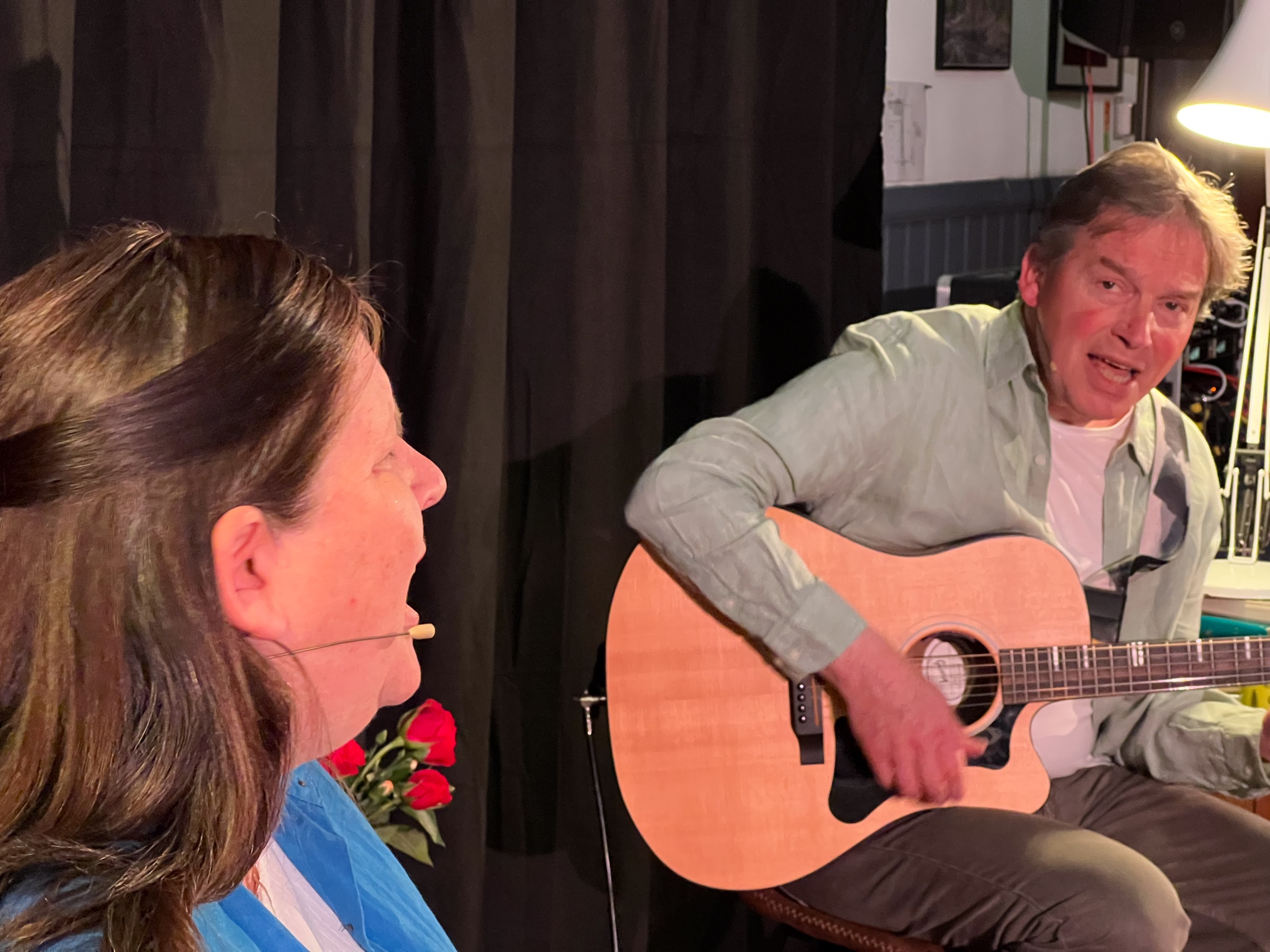
A lamp and two armchairs tell us we might be in their living room. The intimacy threatens to stifle.
Afterwards ticket-holders are encouraged to stay in the space, talk with one another over wine and biscuits, and to meet the performers. The atmosphere is charged. It is a strange, uncompromising, often painful experience. The early results of this unconventional theatrical venture: Broken Chords is playing to audience acclaim, selling out shows, and has just extended its run due to popular demand.
If the show’s premise seems surprising, that’s probably because it originates from a different, more terrible shock. In 2022 Stuart Wickes and Kirstie Pelling lost their son to suicide. Broken Chords traces the years of their lives – as individuals, and as a marriage – in the aftermath of that loss. It’s a truism that everyone grieves differently. Responses to loss often follow a predictable, difficult pattern too. Withdrawal, anger, marital strain – these commonplace effects all feature in Wickes and Pelling’s story. Much less conventional was the couple’s decision to begin writing songs about what was happening to them.
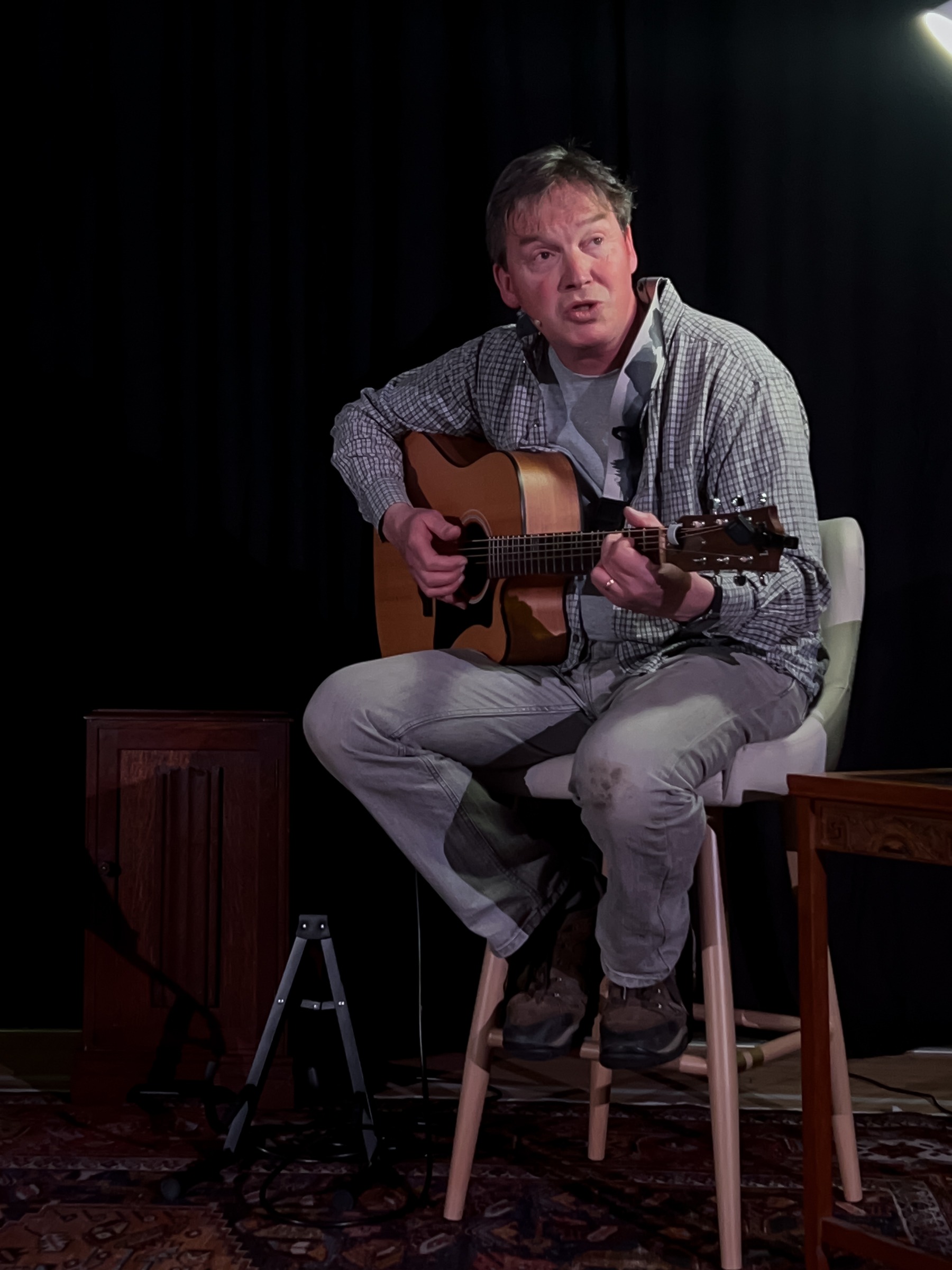
‘Kirstie and I talked for a very long time about doing something creative’, Stuart explained, ‘but we weren’t sure what that was’. For Stuart, who plays several instruments and runs two local community choirs, music was a natural direction to take: ‘probably from the three or four months after Matt died, I’d turned to my guitar and started writing and playing’. Kirstie was already writing poetry, and began finding lyrics to couple with Stuart’s scores. ‘She starts with words’, Stuart tells the audience, ‘I start with music’. Not that this was a simple process. At first ‘I didn’t think I could write songs’, Kirstie told me. Early versions of Stuart’s arrangements also failed to convince their first audience: ‘I’d write a song a month and we would talk about those songs as they unfolded[…]I’d play it to her and she’d say it was shit and I’d go away again’. The show recalls the difficulty of working together. Often they seem to be comprehending each other from opposed positions: Stuart, lost in his guitar, and the privacy of his grief; Kirstie, tilted away from Stuart, appears to be looking for a means of escape. Amidst this impasse, it is the requirements of collaborative songwriting – listening, compromise, accommodation – which move the couple towards a fraught, careful harmony. They embrace imperfect, awkward melodies; their verses are honest and, at times, unrefined. At the show’s crescendo, they boldly sing ‘Our broken chords,/ Ring loud and blue,/ Not perfect tunes,/Just me and you’. The audience is left visibly moved.
The theme of the show is grief, not suicide. Part of its rich offer is in the variety of different angles from which it considers sudden loss: ‘FFS’ is a comic number which inventories the countless clumsy and infuriating indignities the couple confront in their bereavement (an estate agent requests a cleaning fee be paid for Matthew’s room; a ‘self-checkout’ machine sets off a crisis in Sainsbury’s). ‘Hades and Persephone’, performed in solo by Kirstie, shows a grieving woman finding refuge in imagination and fantasy: ‘Give me wings and set me free/ To an otherworldly plane,/ Where I’m free of guilt and shame’. These sequences (the first darkly funny, the second uplifting) relieve an audience which elsewhere witnesses the depths of the couple’s pain.
Early in the show Stuart speaks about entering Matthew’s university bedroom in the days after his death, before his own unaccompanied performance – ‘Hear your voice, yet not a sound/Once certain future, now unknown/How could you leave me, so alone’. ‘We didn’t want it to be a misery fest’, Kirstie explains, though it wasn’t immediately clear how to avoid overwhelming the audience. ‘Andy Airey [one of the Three Dads Walking, who campaigns for suicide awareness after losing his own daughter to suicide] came to see it and he was very clear, that it needed to reflect real life experience, but also that ‘I need to have hope when I walk out of this’’.
Working with the director Joe Sumsion, Kirstie and Stuart began to define the artistic responsibilities of a piece with such delicate material: ‘It needs to have light and shade, and it has to be truthful’. The show’s honesty comes from adhering closely to the couple’s own personal testimony, and resisting the pull towards universalising statements about grief. At their most perceptive, lines are only lightly poeticised – frank, acerbic – leaving the audience with the unmistakable sense of how it was for them specifically. At one point, Kirstie tells Stuart ‘Your grief’s like an unwelcome stranger…that for some unfathomable reason you’re trying to befriend’. He responds, ‘And yours is an intruder that you will do anything to stop breaking in’. In the cloistered atmosphere of the village hall, these caustic couples-therapy sequences can leave you wondering, should I be witnessing this?
Invert the question and you arrive at something Stuart finds more interesting: why shouldn’t we be witnessing this? ‘Behind closed doors, this is what people deal with. They get sad, they get angry, they navigate it as best they can. Why do we keep that private?’. Stuart similarly questions a very British tendency to avoid discussing suicide. ‘From the moment Matt died, I’ve always felt like I should speak about it. Suicide shouldn’t be a taboo. It’s very prevalent in society. Why would I not talk of it?’. The couple hope their outspokenness will encourage audiences to be more open about their own private struggles, and to reach out to family and friends. They would be spirited by the response of Mary Taylor, a woman sitting next to me on opening night, who told me the first thing she wanted to do once leaving was text her son, who lived in Sweden, to ask him how he was. ‘The thing that makes me really think it’s worth doing’, Kirstie reflects, ‘is when someone tells me they’ve gone home and had that difficult, awkward conversation with their child. If I get one of those per show, it’s worth doing.’ Since touring, the show has been met with an overwhelmingly positive response. In Burton Memorial Hall, a visceral energy charged the room. Audience members stayed long after the show, unwilling, it seemed, to break the spell. In the busy atmosphere, Broken Chords looked more like the beginning of a movement than the debut in a limited show-run. So where does it go next?
There are plans for a wider tour of Cumbria, heading up to Carlisle and travelling out to towns like Whitehaven on the county’s remote west coast. The show will have a particular pertinence playing in its home county, which has the second-highest suicide rate in the country. New audiences will bring more unpredictability to this tricky balancing act of a show. The couple know their material has the power to provoke strong reactions. Kirstie tells me they had a heckler the other day. What did they say? ‘Um, you’re so brave’. It could be worse. For Stuart, the show ‘feels a bit like a hand grenade, a powerful, potent thing’. The show certainly has an explosive potential, though I’m certain it’s a much more controlled operation than Stuart’s hazardous imagery suggests. Really, it’s more like a depth-charge, where the show’s effects ripple outward from the initial impact. With growing traction the show’s fallout may become as interesting as the event itself. There are plenty more broken chords waiting to be discovered.
Broken Chords is written and performed by husband and wife team Stuart Wickes and Kirstie Pelling and touring Cumbria, with the next show in Carnforth in July. Tickets are available here.

Daniel Sumsion is a freelance writer from Lancaster. You can find his writing here and contact him at Danielsumsion.contact@gmail.com
Trending Now

Review: To Kill a Mockingbird at Leeds Playhouse

Review: Night Collar at St Helens Theatre Royal
You may also like