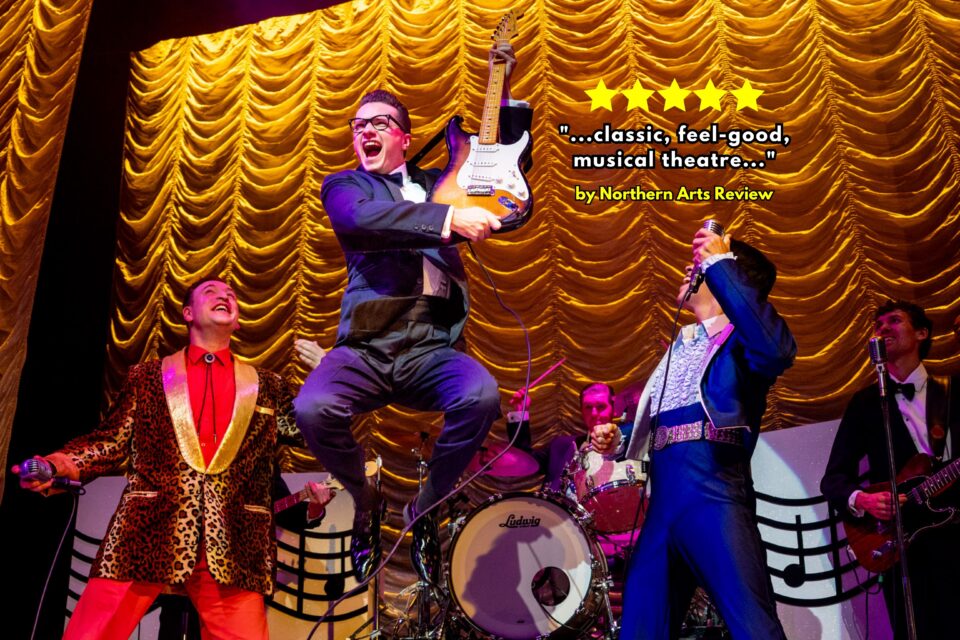
“…classic, feel-good, musical theatre…”

Buddy: The Buddy Holly Story by Alan Janes, Buxton Opera House
By Phil Scown
The Buddy Holly Story is a show with a long history. Since first opening in 1989, there have been over 22 million people in its audiences, so the programme claims. I can believe it. It has the unbeatable combination of a good story, great music, and excellent performances. The whole is much more than the sum of its parts.
The tragedy of the story is well known. We see it unfold from the early days of Buddy Holly and the Crickets, through to the night of Buddy’s tragic death. The show is more than a retelling. There is humour, music, audience participation. It’s a musical where the music is central to the plot. The large-format programme is a mine of information, it also has some good pictures and no adverts – it’s worth buying.
The band start out as country performers on local radio station KDAV. Country music is what the sponsors expect, it’s what they pay for, but it cramps the band’s style and ambitions. Radio opportunities are limited – and so it seems are recording options. After failures with Decca, they eventually get hooked up with Norman Petty (Thomas Fabian Parrish) at his recording studio. Petty’s wife, Vi (Marta Miranda), assists on keyboards (piano and celesta). This is where things take off. The accidental creation of Everyday in the fog of an all-nighter is portrayed as a chaotic mess – but it works. The playing of the celesta by Vi, with its bell-chimes, and the knee-slapping of the drummer percussionist (Jerry Allison, played by Stephen Alexander-Kerr) creates a much-loved classic. In a separate scene, we see – and hear – Peggy Sue arise, partly, from the ‘romantic intentions’ of the drummer, another accidental classic.
There are all the trappings of a rock opera. Problems with management and money, romance, the break up of the band, and the music. There are some subtle themes, and some not so subtle. From the early days on radio and in the studio, there is someone in a suit behind a desk exerting control over the creative process. There are commercial imperatives that sometimes support, and sometimes conflict with, the creative process. We see that Buddy Holly was able to overcome the constraints. If he hadn’t, then he would have been a star of country music. That would have been a gain for the country scene, and a loss to rock and roll.

Racial politics are raised. These first appear as a problem with local radio sponsors in Texas who think the music sounds too… ‘coloured’. They don’t want to pay for it. It’s a throwaway line. Act One finishes with the band’s successful performance at The Apollo Theatre, Harlem. That the concert took place at all is a matter of luck; it seems the booking agent thought the band was comprised of black musicians. Remember, these were days well before social media, before affordable magazines printed in colour. Records were distributed in plain paper sleeves. No white act had done the Harlem Apollo before. There is comedy in the scenes before Buddy Holly and the Crickets go on, with expectations that they will get booed off stage. Of course they bring the house down. It’s a roaring success.
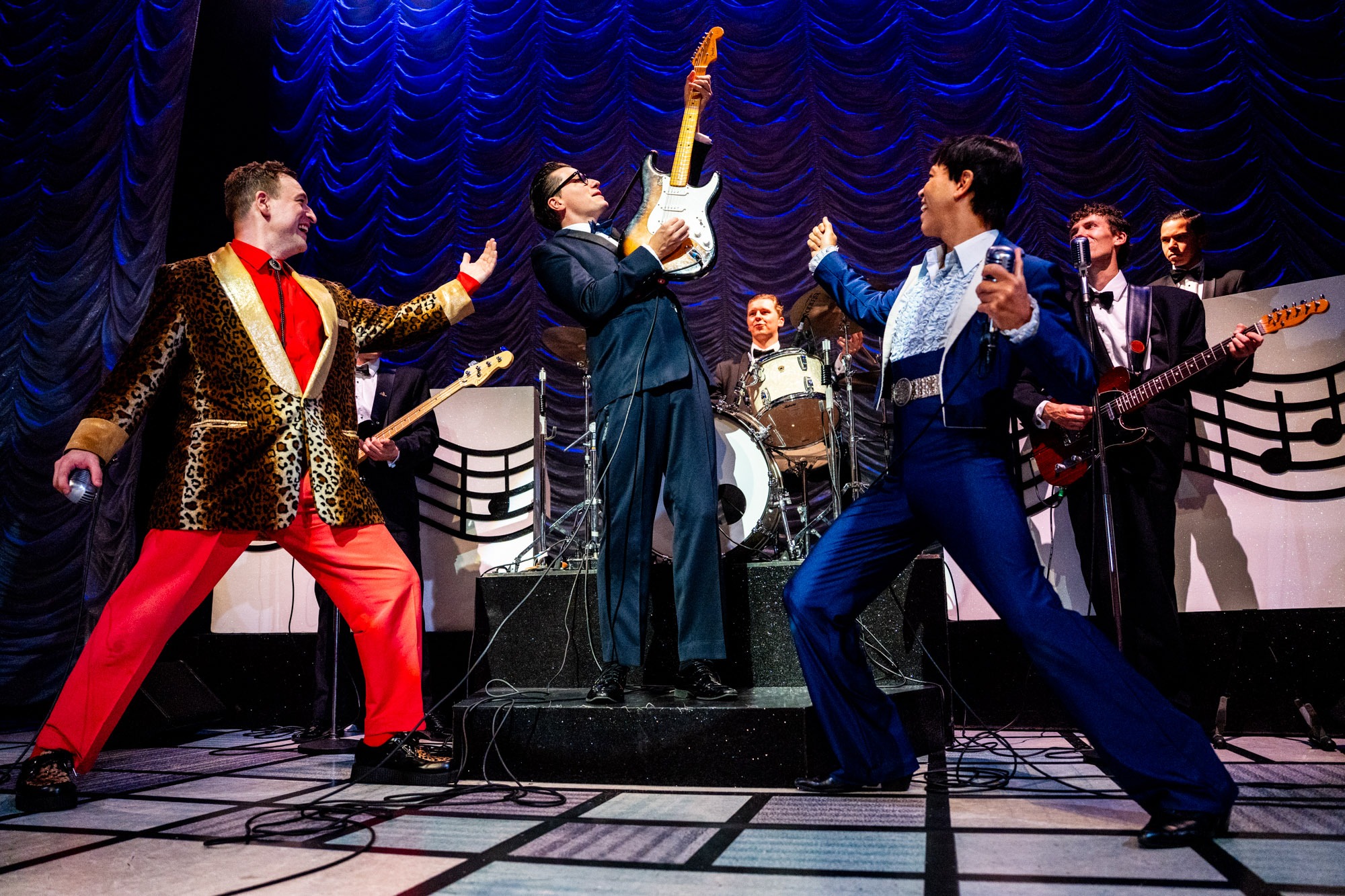
A J Jenks is convincing as Buddy. He can play, sing, and has the moves, and the glasses. He’s hardly off stage, acting and performing – full of energy. His scene with bassist Joe B Mauldin (Melker Nilsson) is difficult to believe, even though I’ve seen it. The way Nilsson can play the double bass while he dances with it, with spins and inversions, is captivating. An extraordinary performance. And then Buddy climbs on that double bass while both musicians play and sing – fantastic. The support from the band’s drummer, and their guitarist Niki Sullivan (Joe Stirling) makes the whole thing work. All the performances were faultless.
Credit must also go to Miguel Angel for choreography, as if performing as Ritchie Valens isn’t enough – this show has so many stars. The character of Ritchie adds another dimension to the show. He’s learned from the notoriety of Elvis Presley that ‘gyrations’ are a good story, good publicity, and his audience loves it. He brings us some laugh-out-loud moments and the rock is getting the house going. The atmosphere is fantastic, with some sing-along and spontaneous dancing in the aisles.
This is classic, feel-good, musical theatre. I’d be happy to go again to see this show.
Buddy: The Buddy Holly Story plays at Buxton Opera House until Saturday 28 March. Tickets are available here.
Phil Scown has been a regular theatre-goer since his student days many years ago. Mysteries, thrillers, ghost stories, comedies and musicals are all part of his theatre diet. Phil writes short stories in a variety of genres, some of which have become screenplays. He likes to tour England, Scotland and France, nowadays by car rather than motorcycle. At other times Phil likes to cook and to drive his Caterham, though generally not at the same time.
Trending Now

Review: Enlightenment at People's Theatre
Review: A Christmas Carol at Leeds Playhouse
You may also like