“Their movement around the stage is a touch of genius…”

The Memory of Water By Shelagh Stephenson, Octagon Theatre Bolton
By Hannah Molyneux
I don’t cry in the theatre often, but I sat down to watch The Memory of Water, Shelagh Stephenson’s play, a comedy-drama about three sisters planning their mother’s funeral, prepared to shed a tear or two. While it didn’t quite find that emotional level for me, it did capture a chaotic, fractious, and wildly funny snapshot of life, told in real time.
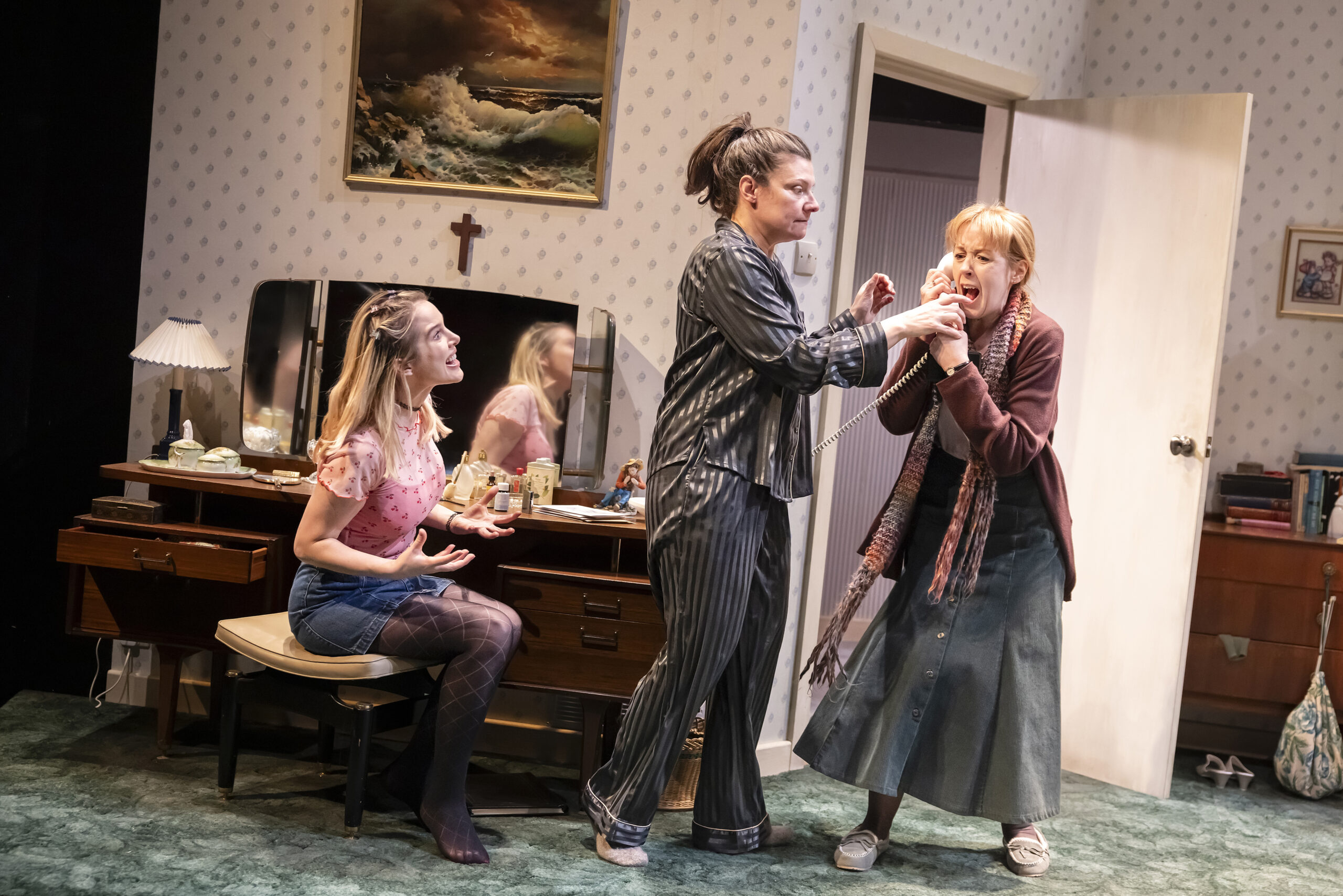
Katie Scott’s set design is evocative in ways that the play itself sometimes struggles to find. All of the action takes place in their mother’s bedroom, which is so intricately detailed that my eye is constantly drawn back to it – the shoeboxes under the bed, the glimpses into the hallway, the gently falling snow behind the curtain. But it’s what happens at the edges that is perhaps most interesting: the whole room looks to have been torn away from the house, with exposed timbers poking out of the top and sides and the floor sitting on a bed of sand, at times eerily lit from below. It’s as though it has been wrenched away in a storm and has a rawness that foreshadows something of the relationship between the three women at the centre of the play. When Victoria Brazier’s Teresa notes “that crack’s getting bigger,” we feel already that the cracks are not only confined to the walls.
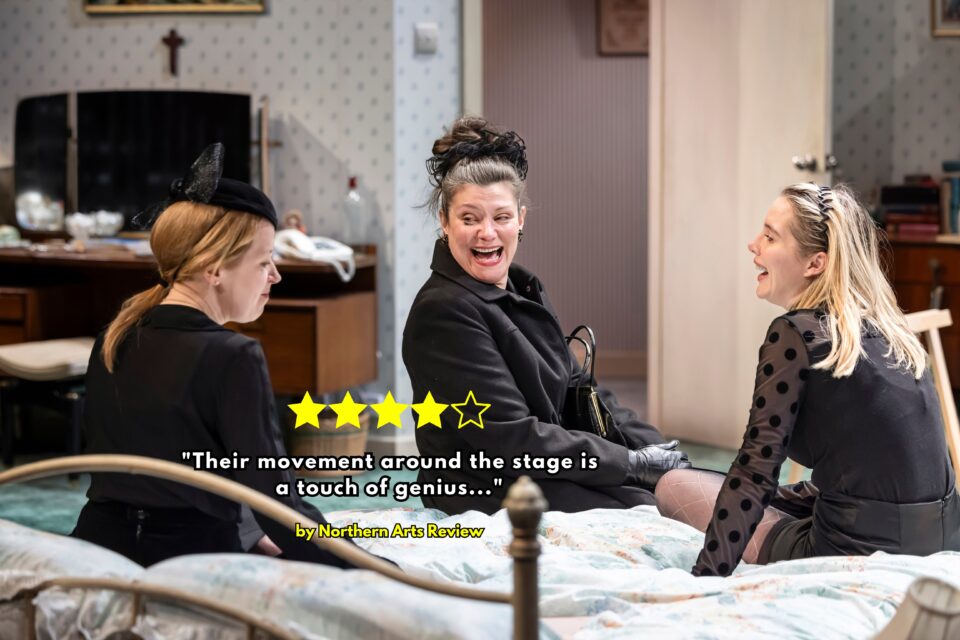
This production announces 1996 with a burst of Spice Girls, which is fitting as what we’re about to witness is more than a little spicy. The sisters bicker relentlessly from the start in a way that anyone with siblings would recognise, yet these aren’t particularly relatable characters – their traits and behaviours are so extreme in many ways that, while we might see elements of ourselves in them, it’s difficult to completely empathise with them. Polly Lister’s Mary is perhaps the most nuanced of the three, both sarcastic and cutting but also introspective and reflective. Teresa (Victoria Brazier) is practical and organised but anxious and resentful which, given she receives almost no support from her siblings, is reasonably understandable. Catherine (Helen Flanagan) is immature and inappropriate and crying out – literally, at some points – for real affection. They are a holy trinity of dysfunction and neuroses, three points of a triangle who just can’t seem to pull together. Their movement around the stage is a touch of genius, representing this triangle physically by having the sisters occupy completely separate spaces from each other – as one moves, another moves away from her to a different position. This device makes it all the more impactful when they do finally come together in a moment of levity and semi-reunion at the end of the first act.

Hearts are laid bare and revelations are made, but these moments of drama are almost not dramatic enough – we want them to land a bit harder, to be reeling from the tension of them before we’re drawn out with a laugh. There’s a push and pull of tension and humour that we miss, and it’s not because the humour isn’t there (it is truly laugh-out-loud in parts and the audience lap it up) but because the build-up to those moments of release hasn’t quite gripped us in the way it might. The comedy itself is beautifully delivered, at times dry and deadpan and at others wild and raucous, but always superbly entertaining.
The play returns again and again to the ideas of memory, nostalgia, and the notion that our memories might not always reflect reality. The writing hints at a yearning for some never-experienced version of life which doesn’t feel to be fully worked out, and it also glances by the interesting idea that to remember everything perfectly would be more of a curse than a blessing. Toward the end, we find Mary wrestling with memory and identity, questioning who we are if our memories are constantly shifting beneath us (much like the shifting sands beneath the set). Here we have one of the only expressions of real sadness and grief in the play (not counting Catherine’s many sighs of “I’m so depressed”), and we realise that this shift from bickering and sniping to something deeper is just what we needed. It’s where the performance is at its most human and where, beyond the chaos, it finds its heart. As an audience, we’d love to linger here even longer.
The Memory of Water plays at Octagon Theatre until Saturday 21 February. Tickets are available here.
Hannah Molyneux is a proudly Mancunian writer and musician whose day job revolves around community engagement. She is passionate about community arts and the huge benefits they have for people and places. Hannah can most often be found enjoying the great outdoors or optimistically crafting with her children. You can read more of her writing here. You can find her on Instagram here.
Trending Now

Review: To Kill a Mockingbird at Leeds Playhouse

Review: Night Collar at St Helens Theatre Royal
You may also like