“…brings Sheffield’s recent past alive…”
Gwenda’s Garage by Nicky Hallett, Playhouse Sheffield
By Phil Scown
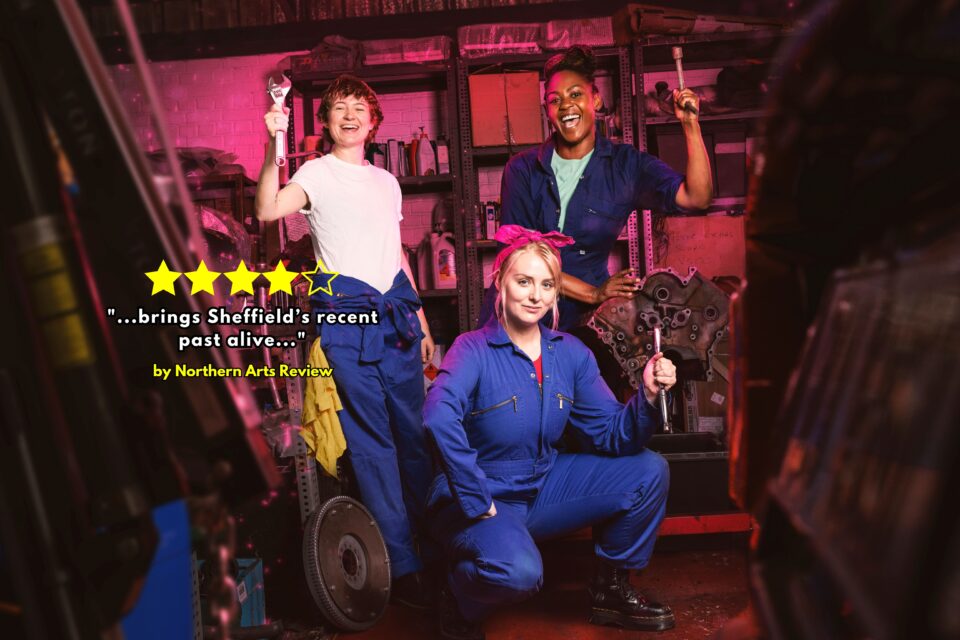
The programme lists fifteen musical numbers. These are used, in part, to tell the story of Gwenda’s Garage. Gwenda’s was founded in 1985 by skilled women who could not get jobs in the ‘man’s world’ of car mechanics. It is a piece of Sheffield history in troubled times. These skilled mechanics made their own jobs, played the system as best they could and formed a lesbian collective – Gwenda’s Garage. There is no ‘Gwenda’, the name comes from a female motorcar and motorcycle record breaker. The Garage is led by Carol (Eva Scott). She is supported by mechanics Terry (Sia Kiwa) and Bev (Nancy Brabin-Platt) and their apprentice Dipstick (Lucy Mackay). They have one customer, Feona (Georgina Coram). Liz Kitchen supports the team by playing other roles such as a policeman or angry vicar. The performance was a near sell-out, with very few empty seats. Given the subject matter, it was no surprise that the audience was largely female. Men, don’t let that put you off.
It is no surprise that this is a lesbian, queer-themed play. With the context of Britain in the 1980s, its political activism and pockets of anarchy, the play’s tone of informality fits with the times. Big marches took place, but there were also small acts of defiance. Graffiti, postering, small ways to have a pop at the establishment. This was Sheffield after the miners’ strike and the closure of much of the steel industry. Thousands of Sheffield men and women were out of work. Women were not welcome in the traditionally male-dominated industries. Gwenda’s Garage was a way of channelling the resentment felt by this small group of women. Though there is some bitterness in the play, most of what we see is resilience and humour – true Northern grit. There are one-liners and laughs; spirits not crushed.
The five main roles are all distinct, with clear social positions. Dipstick (Lucy Mackay) is the young apprentice lacking world knowledge, but with the energy to take action. Carol (Eva Scott) runs the garage, and looks after everyone. She is the steadying hand, the nurturer. Terry (Sia Kiwa) has suffered a life of both racism and anti-queer bigotry. Suffering racism gives her a different perspective. Bev (Nancy Brabin-Platt) is a frustrated mother, tangled in bureaucratic hurdles. Feona (Georgina Coram) is a displaced southerner making a life in Sheffield.
All the cast were good. If I were to single one out it would be Nancy Brabin-Platt, playing Bev, as the most affecting, presenting well the drive to be a parent, creating conflict between being true to herself and her friends, and a bureaucracy demanding that she publicly deny who she really is and who her friends are. The personal nature of Bev’s dilemma creates a very real depiction of the establishment’s ability to control people at the deepest level.
It is a musical play. The sound is clear and lyrics can be heard properly. This is a tribute to sound production (Joe Dines and Ryan Raistrick) and the lyrics (Val Regan and Nicky Hallet). The five-piece band gives good support to the cast (Richard Body, Jude Holland, Liz Kitchen, Jude Abbott and Becky Eden-Green). Fifteen musical numbers can’t all be stand-outs. Those of note are the climax to Act One: The Bigots’ Chorus – raucous, loud and poking fun at the moral panic of the establishment – an ensemble number. Act Two opens with another ensemble number that is near a cappella (there is a drum beat) Get Your Hands Dirty – a wordplay on being a mechanic and on getting involved with political activism. The numbers that are not ensemble pieces and are to be noted are : I Want to be a Mother (Bev), I’m Learning, a duet with Feona and Dipstick, Meet me on the Bridge (Terry and Bev, and Holding it Together (Carol). Along with the musical numbers there is a lot of choreography. A success for Rachel Yates as Movement Director and for Georgina Coram as Dance Captain.
The play seems to wander a bit in the first half of Act Two. This may be by comparison with the climax of Act One, or it may be that there are too many plotlines vying for positions of prominence. There are a lot of intertwined issues in Gwenda’s Garage. There’s mass unemployment, government oppression of minorities, sexuality in education and the establishment response of Clause 28, the media lies (no social media then, just press and broadcasts), the North-South divide. At a personal level the play exposes the difficulties of keeping relationships together, racism and parenting. How these are intertwined at both individual and government levels is explored. Being ‘woke’ isn’t new, it just has a new name. Those that rail against ‘wokeness’ now, railed against social justice then too.
Gwenda’s Garage brings Sheffield’s recent past alive. Being of an age where I can remember the events of the play the first time around, it was great to connect with that time of my life, bringing memories into personal connection with the present. Newer generations will get a window on the world before the term ‘woke’ was invented, get to see that it’s not new, and learn, maybe, that their parents are not the old relics they thought.
Gwenda’s Garage is fun while telling a story of women who were trailblazers. The core issues of the play are still issues forty years after its setting. Progress has been made in that time, but there is more to be done and we should smile while we do it. Gwenda’s Garage throws light on the fabric of society, highlighting the good in people, while getting into the shadows too.
Gwenda’s Garage plays at Playhouse Sheffield until Saturday 25 October. Tickets are available here.
Phil Scown has been a regular theatre-goer since his student days many years ago. Mysteries, thrillers, ghost stories, comedies and musicals are all part of his theatre diet. Phil writes short stories in a variety of genres, some of which have become screenplays. He likes to tour England, Scotland and France, nowadays by car rather than motorcycle. At other times Phil likes to cook and to drive his Caterham, though generally not at the same time.
Trending Now

Review: To Kill a Mockingbird at Leeds Playhouse

Review: Night Collar at St Helens Theatre Royal
You may also like